


In case you have heard about Agentic AI system before, you must be wondering who is this new “kid” around the block? Imagine it as a group of agents that plan and act autonomously, while being governed and controlled. But the real question is, can we rely on them & can they scale as per the business demands without a failure? An old friend can help us answer these questions, i.e., Akka. It has been a go to choice for building reliable and highly performant systems for almost a decade now. This article will guide you through your first ever Agentic AI application that is both reliable and fault tolerant.
What is Akka Agentic AI system?
Before we get to meet Akka Agentic AI, we first need to understand why Agentic AI is so important? Today applications cannot remain just a set of rules. They need to actively learn, adapt, and take actions autonomously. Agentic AI systems helps us designing & developing applications that can deliver a more personalized user experience. And not just applications, it can help in increasing teams’ productivity and reduce time to market.
However, imagine there are too many AI Agents interacting with each other, how will they keep track of their conversations. Moreover, they would also need to actively adapt to different inputs from millions of users. This is where Akka shines. It enables us to build a highly efficient Agentic AI system which is scalable and reliable.
Our First Hello to Akka Agentic AI
Let’s say “Hello!” to our first Akka AI Agent:
- Prompt: A message (command) to AI System (OpenAI in this case) to generate desired effect
- User Input: Input from User which needs to be processed
- Reply: The response generated by the AI Service
import akka.javasdk.agent.Agent;
import akka.javasdk.annotations.ComponentId;

@ComponentId("hello-world-agent")
public class HelloWorldAgent extends Agent {

  private static final String SYSTEM_MESSAGE =
    """
    You are a cheerful AI assistant with a passion for teaching greetings in new language.

    Guidelines for your responses:
    - Start the response with a greeting in a specific language
    - Always append the language you're using in parenthesis in English. E.g. "Hola (Spanish)"
    - The first greeting should be in English
    - In subsequent interactions the greeting should be in a different language than
      the ones used before
    - After the greeting phrase, add one or a few sentences in English
    - Try to relate the response to previous interactions to make it a meaningful conversation
    - Always respond with enthusiasm and warmth
    - Add a touch of humor or wordplay when appropriate
    - At the end, append a list of previous greetings
    """.stripIndent();

  public Effect<String> greet(String userGreeting) {
    // prettier-ignore
    return effects()
      .systemMessage(SYSTEM_MESSAGE)
      .userMessage(userGreeting)
      .thenReply();
  }
}
Time to Say Hello!
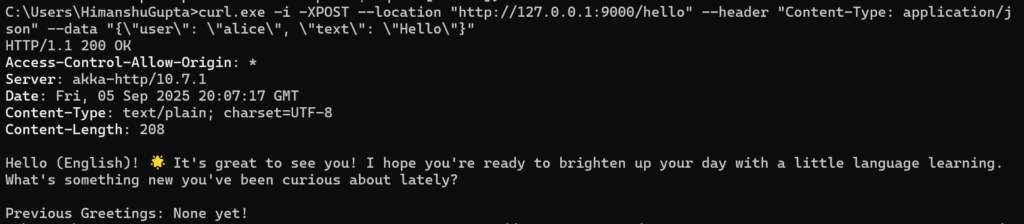
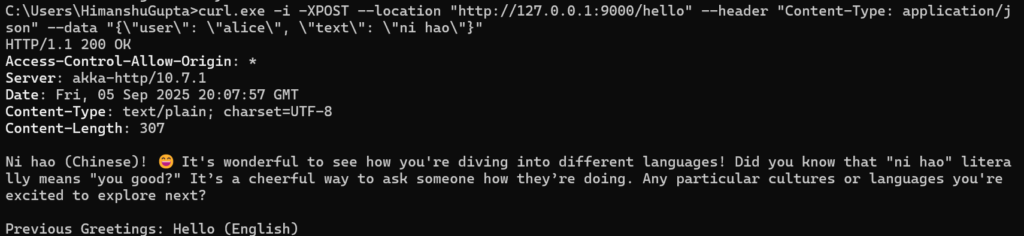
Let’s see what results AI Agent gives us if we try to say “Hello!” in different languages. Will it be able to understand our language and present us with the correct response.
English
Chinese
And many more…
It’s a Wrap!
In this article, we:
- Looked at why Agentic AI systems are important.
- Built our first ever AI Agent using Akka