


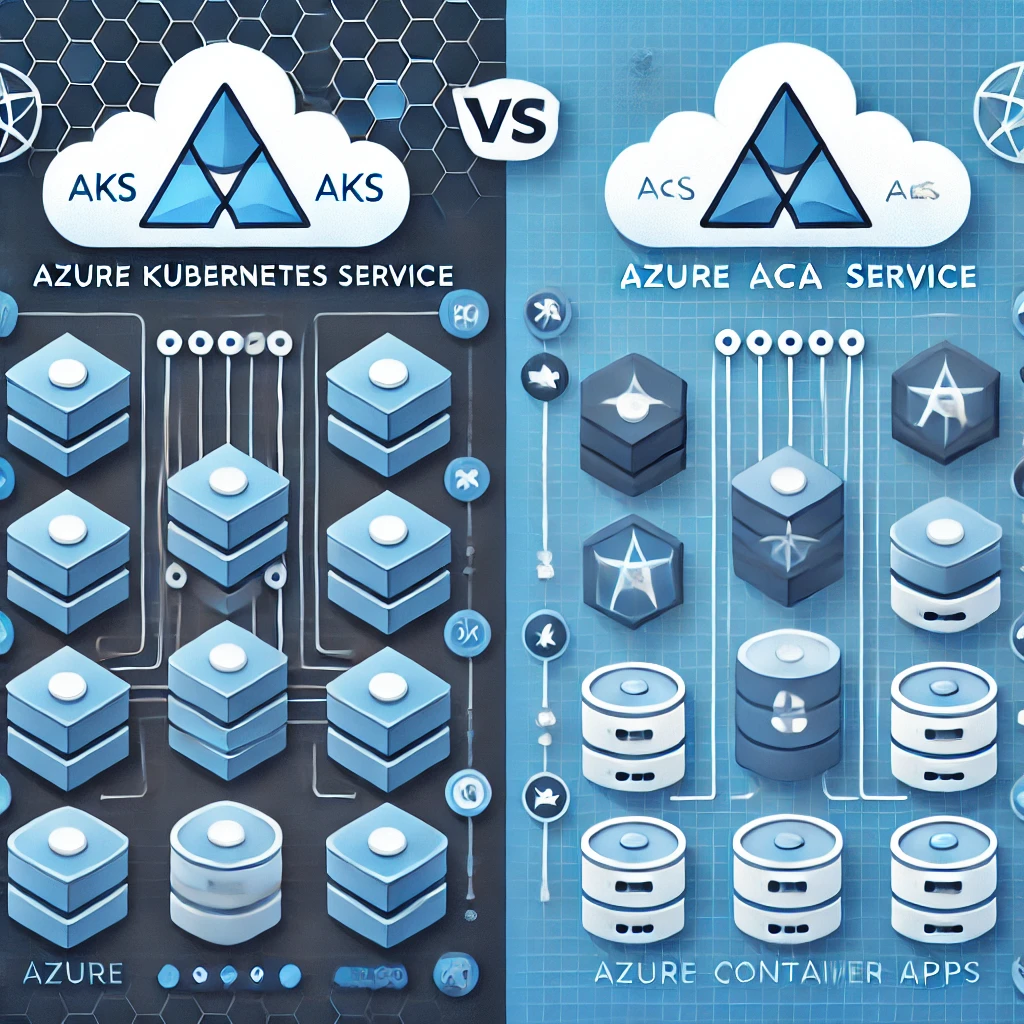
Hello Readers!! Welcome to the new blog!! AKS vs ACA, which is best in cloud migration? When migrating an application to the cloud, choosing the right platform is crucial to ensure scalability, cost-effectiveness, and ease of management. Two of the prominent services offered by Azure for running containerized applications are Azure Kubernetes Service (AKS) and Azure Container Apps (ACA). Both are excellent choices, but their use cases, complexity, and operational overhead differ significantly. This blog will provide a detailed comparison of AKS and ACA, helping you decide which is the best approach for your cloud migration.
What is Azure Kubernetes Service (AKS)?
Azure Kubernetes Service (AKS) is a fully managed Kubernetes service that simplifies deploying, managing, and scaling containerized applications using Kubernetes. AKS allows for granular control over your containerized environment while offering powerful features for scalability, networking, and security.
Key Features of AKS:
- Full Kubernetes Access: AKS provides access to the entire Kubernetes ecosystem, allowing advanced networking configurations, persistent storage options, and custom scaling policies.
- Fine-grained Control: You have complete control over container orchestration, allowing for customization of workloads, service meshes, and more.
- Integration with Azure Ecosystem: AKS integrates deeply with Azure services like Azure Monitor, Azure Active Directory (AAD), and Azure DevOps, enabling streamlined management and monitoring of the cluster.
Use Cases for AKS:
- Complex Applications: Applications that require fine-tuned orchestration, custom configurations, and integration with a broad set of microservices.
- Large-Scale Deployments: Ideal for enterprises looking to deploy a vast number of containers or microservices.
- High Traffic Applications: Suitable for applications with significant traffic that need dynamic scaling based on demand.
What is Azure Container Apps (ACA)?
Azure Container Apps (ACA) is a serverless container service for running applications in a simpler, more abstracted environment compared to AKS. ACA provides a fully managed experience where developers can focus on building their applications without worrying about infrastructure management.
Key Features of ACA:
- Serverless Containers: ACA allows developers to run containerized applications without managing any Kubernetes infrastructure. It automatically handles scaling, load balancing, and underlying infrastructure.
- Integrated Autoscaling: ACA automatically scales your application based on HTTP requests, events, or background tasks using KEDA (Kubernetes Event-Driven Autoscaling).
- Simplified Deployments: It abstracts away the complexity of managing Kubernetes and focuses more on running stateless microservices, event-driven applications, and background tasks.
Use Cases for ACA:
- Simpler Applications: Ideal for applications that don’t require complex orchestration, such as REST APIs or small microservices.
- Event-Driven Architectures: ACA excels at running event-driven architectures like serverless functions.
- Short-Lived or Burst Workloads: Suitable for applications that have fluctuating demand, as ACA can scale up or down quickly without manual intervention.
AKS vs. ACA for Cloud Migration: A Detailed Comparison
| Feature | Azure Kubernetes Service (AKS) | Azure Container Apps (ACA) |
|---|---|---|
| Complexity | High—Full control over Kubernetes, requiring expertise in container orchestration and infrastructure. | Low—Serverless platform with managed scaling and infrastructure. Ideal for developers looking to avoid Kubernetes complexity. |
| Control | Full control over the cluster, networking, storage, and deployment pipelines. | Minimal control—focus is on running containers, and Azure manages the infrastructure. |
| Scalability | Scales containers across multiple nodes, supporting complex scaling configurations. | Automatic autoscaling based on HTTP traffic, events, or background tasks. |
| Cost | Costs include managing Kubernetes clusters, VMs, and other infrastructure components. | More cost-efficient for small to medium applications with pay-per-use pricing for compute and scaling. |
| Use Cases | Best for large, complex, high-traffic applications requiring fine-grained control. | Best for simpler, event-driven, or short-lived workloads that benefit from rapid scaling. |
| Learning Curve | Steeper learning curve—requires knowledge of Kubernetes, container orchestration, and infrastructure management. | Easier to adopt—developers can focus on code, and the platform manages the infrastructure. |
| Integration with Azure | Strong integration with various Azure services like Azure Monitor, Azure DevOps, and Azure Active Directory. | Also integrates with Azure services but focuses on simplicity. Supports Azure Logic Apps, Event Grid, etc. |
| Flexibility | Extremely flexible—allows for advanced networking, custom controllers, and extensive configurations. | Limited flexibility compared to AKS, with a stronger focus on running workloads in a serverless fashion. |
| Security and Compliance | Supports custom security configurations, pod security policies, and advanced isolation mechanisms. | Less customizable but still integrates with Azure security and compliance features, including Azure Active Directory integration. |
Choosing Between AKS and ACA for Cloud Migration
When to Choose AKS:
- High Customization Needs: If your application demands extensive custom configurations, AKS is the better choice. You can tailor every aspect of the Kubernetes cluster, including networking, storage, and workload management.
- Complex Applications: Applications that use a microservices architecture with multiple components may benefit from the flexibility and control that AKS provides.
- Enterprise-Scale: If you’re running large-scale applications or services that must handle high traffic loads and need custom scaling and orchestration rules, AKS is ideal.
- Hybrid Cloud and On-Prem Integration: If you need to integrate your Kubernetes cluster with on-premises systems or other cloud services, AKS provides a more flexible solution for cloud migration use case.
When to Choose ACA:
- Simplicity and Speed: For developers who need to quickly deploy a containerized application without managing infrastructure, ACA offers the easiest route. The platform abstracts away the complexities, so you can focus on coding.
- Event-Driven Architectures: If your application is built around event-driven workflows, such as processing messages from a queue or handling event streams, ACA’s built-in KEDA integration makes it the perfect fit for cloud migration.
- Cost-Sensitive Applications: ACA is more cost-efficient for small-to-medium workloads. Since it’s serverless, you only pay for what you use, making it ideal for workloads with variable or intermittent traffic.
- DevOps Light: If your team lacks DevOps or Kubernetes expertise and wants a hands-off approach to managing containers, ACA provides an easier path to cloud migration.
Conclusion: Which One Should You Choose?
The decision between Azure Kubernetes Service (AKS) and Azure Container Apps (ACA) for cloud migration ultimately comes down to the complexity and scale of your application.
- Choose AKS if you need fine-grained control over your infrastructure, are running a complex, high-traffic application, or have a team skilled in managing Kubernetes.
- Choose ACA if you want simplicity, faster deployment cycles, and a serverless environment that can easily handle event-driven or burst workloads without the need for deep Kubernetes expertise.
By understanding the strengths and limitations of both platforms, you can make an informed decision that best aligns with your application’s architecture, traffic patterns, and the skill set of your team.