


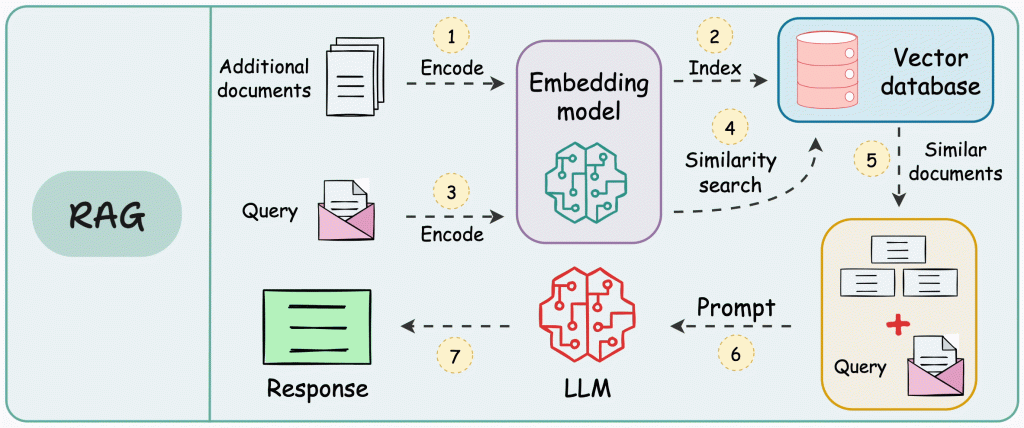
That’s where Retrieval-Augmented Generation (RAG) comes in. Instead of forcing a model to memorize information during training, RAG allows it to retrieve relevant knowledge from your own documents at query time and generate grounded answers.
In this article, we’ll walk through a fully local, no-paid-API RAG system built with:
- FastAPI for APIs and WebSockets
- PostgreSQL for metadata and chat history
- Qdrant for vector search
- Redis for caching and Celery messaging
- Celery for asynchronous document processing
- Ollama running:
nomic-embed-textfor embeddingsllama3.2for answer generation
The entire stack runs locally through Docker, making it ideal for organizations that require privacy, low operating costs, and complete control over their data.
Why Build a Local RAG System?
Many RAG implementations rely on external APIs from OpenAI, Anthropic, or Cohere. While convenient, this introduces several challenges:
- Recurring API costs
- Data privacy concerns
- Internet dependencies
- Vendor lock-in
- Rate limits
A local architecture solves these problems.
Benefits include:
- ✅ No token costs
- ✅ Documents never leave your environment
- ✅ Full customization
- ✅ Offline capabilities
- ✅ Predictable latency
For internal knowledge bases, educational systems, legal documents, research papers, and enterprise manuals, local RAG can be a very attractive solution.
High-Level Architecture
The system follows a classic Retrieval-Augmented Generation pipeline.
┌──────────────────────────────────────────────────────────────┐
│                    DOCUMENT INGESTION FLOW                   │
└──────────────────────────────────────────────────────────────┘
                 ┌─────────────────┐
                 │   Admin Upload  │
                 │      PDF        │
                 └────────┬────────┘
                          │
                          ▼
          ┌─────────────────────────────────┐
          │ FastAPI Document Service        │
          │ • Store PDF                     │
          │ • Create document record        │
          │ • Queue processing job          │
          └──────────────┬──────────────────┘
                         │
                         ▼
              ┌─────────────────────┐
              │ Redis + Celery      │
              │ Async Processing    │
              └─────────┬───────────┘
                        │
                        ▼
            ┌──────────────────────────┐
            │ PyMuPDF Extraction       │
            │ • Layout analysis        │
            │ • Reading order recovery │
            │ • Header/Footer removal  │
            └──────────┬───────────────┘
                       │
                       ▼
            ┌──────────────────────────┐
            │ Structure-Aware Chunking │
            │                          │
            │ Parent: 1400 tokens      │
            │ Child : 400 tokens       │
            │ Overlap: 60 tokens       │
            └──────────┬───────────────┘
                       │
                       ▼
            ┌──────────────────────────┐
            │ Ollama Embeddings        │
            │ nomic-embed-text         │
            │ (768 dimensions)         │
            └──────────┬───────────────┘
                       │
          ┌────────────┴───────────────┐
          ▼                            ▼
┌──────────────────┐      ┌────────────────────┐
│ PostgreSQL       │      │ Qdrant             │
│                  │      │ Vector Database    │
│ Documents        │      │                    │
│ Parent Chunks    │      │ Child Embeddings   │
│ Metadata         │      │ Similarity Search  │
└──────────────────┘      └────────────────────┘

┌──────────────────────────────────────────────────────────────┐
│                    QUESTION ANSWERING FLOW                   │
└──────────────────────────────────────────────────────────────┘
              ┌──────────────────────┐
              │    User Question     │
              └──────────┬───────────┘
                         │
                         ▼
              ┌──────────────────────┐
              │ Conversation Context │
              │ + Chat History       │
              └──────────┬───────────┘
                         │
                         ▼
              ┌──────────────────────┐
              │ Query Embedding      │
              │ (Ollama)             │
              └──────────┬───────────┘
                         │
          ┌──────────────┴──────────────┐
          ▼                             ▼
┌──────────────────────┐    ┌──────────────────────┐
│ Qdrant Search        │    │ PostgreSQL BM25      │
│ Semantic Retrieval   │    │ Keyword Retrieval    │
└──────────┬───────────┘    └──────────┬───────────┘
           │                           │
           └─────────────┬─────────────┘
                         ▼
              ┌──────────────────────┐
              │ Reciprocal Rank      │
              │ Fusion (RRF)         │
              └──────────┬───────────┘
                         │
                         ▼
              ┌──────────────────────┐
              │ Top-K Context Chunks │
              └──────────┬───────────┘
                         │
                         ▼
              ┌──────────────────────┐
              │ Ollama llama3.2      │
              │ Grounded Generation  │
              └──────────┬───────────┘
                         │
                         ▼
              ┌──────────────────────┐
              │ Streaming Response   │
              │ WebSocket Tokens     │
              └──────────────────────┘
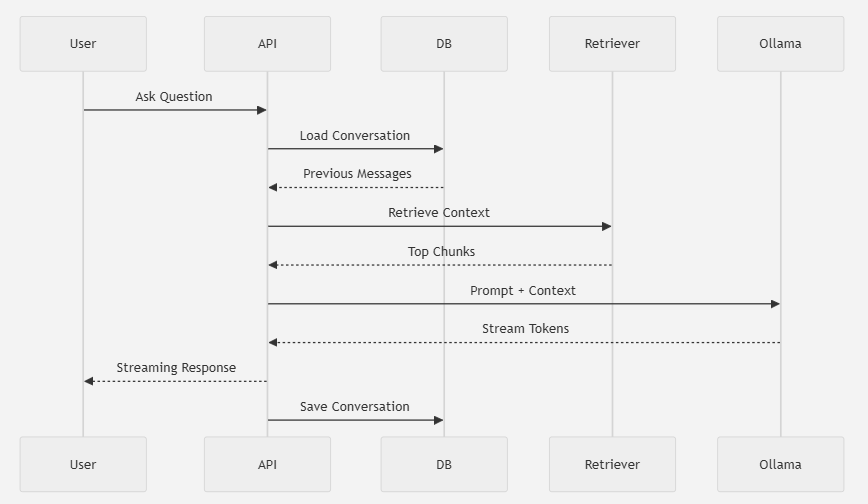
The workflow separates document processing from user chat, ensuring responsive conversations while heavy indexing happens asynchronously.
Conversation flow
Service Breakdown
The core infrastructure consists of six services.
| Service | Responsibility |
|---|---|
| FastAPI | Uploads, chat APIs, WebSockets |
| Celery Worker | PDF processing |
| PostgreSQL | Metadata, chats, chunks |
| Qdrant | Vector similarity search |
| Redis | Cache and broker |
| Ollama | Embeddings and LLM inference |
Docker networking allows services to talk to each other by service name:
QDRANT_URL=http://qdrant:6333
OLLAMA_URL=http://ollama:11434
A useful Docker tip:
Inside containers:
http://ollama:11434From the host machine:
http://localhost:11434If a container needs to reach software running directly on macOS:
host.docker.internalSetting Up the Environment
After cloning the project:
docker compose up -d --buildDownload the two local models:
docker compose exec ollama ollama pull nomic-embed-text
docker compose exec ollama ollama pull llama3.2
Run migrations:
docker compose exec api alembic upgrade headVerify containers:
docker compose psUnderstanding Embeddings
Before discussing indexing, let’s quickly explain embeddings.
An embedding converts text into a numerical vector.
Example:
“What is RAG?”
===> [0.24, -0.13, 0.88, …]
Documents with similar meaning produce vectors located near each other in vector space.
This project uses: nomic-embed-text
Therefore: EMBEDDING_DIMENSIONS=768
match the Qdrant collection configuration.
If dimensions mismatch, indexing and searches will fail.
PDF Processing Pipeline
Once a PDF is uploaded, a Celery worker takes over.
Document lifecycle:
queued
   ▼
extracting
   ▼
indexing
   ▼
saving
   ▼
ready/failed
This decouples heavy processing from API requests and improves scalability.
A user doesn’t need to wait for indexing to finish.
Smarter PDF Extraction
A common mistake in RAG systems is treating a page as a giant blob of text.
That destroys structure.
This project instead uses PyMuPDF layout-aware extraction.
The extractor captures:
1/ Page number
2/ Bounding coordinates
3/ Text blocks
4/ Reading order
It also:
- Detects headings
- Recognizes paragraphs
- Finds lists
- Detects question blocks
- Attempts table identification
- Removes repeating headers and footers
Parent-Child Chunking Strategy
Chunking is arguably the most important part of a RAG system.
Too small:
- Missing context
Too large:
- Retrieval becomes noisy
This project uses a two-level chunking design.
Parent Chunks
1400 tokensStored in PostgreSQL.
Purpose:
- Preserve semantic sections
- Retain structure
- Support auditing
Child Chunks
400 tokensStored in Qdrant.
Purpose:
- Retrieval
- Embedding generation
Overlap
60 tokensWhy?
Without overlap:
Sentence A ends...
Sentence B starts...
could be split apart, causing information loss.
Overlap helps maintain continuity.
Why Hybrid Retrieval Beats Pure Vector Search
Many beginners assume vector search alone is enough.
Consider:
RW Question 3The term itself may be critically important.
Vector similarity may not prioritize it strongly.
This system combines:
Dense Retrieval
Using Qdrant:
Meaning-based searchGreat for:
- Concepts
- Semantic similarity
- Natural language questions
BM25 Retrieval
Using PostgreSQL:
- Keyword search
Great for:
- IDs
- Names
- Exact labels
- Technical terms
Reciprocal Rank Fusion (RRF)
After obtaining two rankings, the system merges them using:
Reciprocal Rank FusionFormula:
Advantages:
- Simple
- Effective
- Robust
- Industry-proven
Rather than choosing vector search or keyword search, RRF lets both contribute.
In practice, RRF often improves retrieval quality substantially over either method alone.
Grounded Generation with Ollama
After retrieval:
- Top K chunksShow more lines
are sent to:
- llama3.2
The prompt explicitly instructs the model:
Answer only from provided context.
This reduces hallucinations and keeps answers grounded in uploaded documents.
For exam-style PDFs, the prompt prioritizes:
Answer:
Key:
Solution:
Conversation-Aware Retrieval
One underrated feature of modern RAG systems is conversational memory.
Suppose a user asks:
Tell me about RW Question 3.Followed by:
Give me more details.The second query alone lacks context.
This project solves that by using:
- Recent chat history
- Previous user topics
- Conversation-specific retrieval
The retriever can resolve references like:
it
this
that section
more information
making follow-up interactions feel much more natural.
Why Caching Matters
LLM systems frequently repeat work.
Two users may ask:
What is Question 3?multiple times.
Redis caches:
Embeddings
24 hoursRetrieval Results
5 minutesBenefits:
- Reduced Qdrant queries
- Lower retrieval latency
An important architectural detail:
The system maintains a corpus version.
Whenever a new PDF becomes active:
Cache keys become invalid automatically.Newest-Document Architecture
One particularly elegant design decision is that chat only searches the latest successfully indexed document.
Upon upload:
- Existing vector collection deleted
- Older documents archived
- New document indexed
- Retrieval restricted to ready documents
Benefits:
- Predictable search scope
- No document contamination
- Simpler retrieval logic
Historical documents remain available for auditing while keeping the active knowledge base clean.
Current Limitations
No system is perfect.
Current constraints include:
Scanned PDFs
The extractor currently works best with:
Selectable text PDFsImage-only documents require OCR.
Possible improvements:
- Tesseract OCR
- PaddleOCR
- Azure Document Intelligence
- DocTR
Complex Tables
Table extraction is heuristic.
Future enhancements could include:
- Camelot
- Tabula
- LayoutParser
- Unstructured.io
Multi-Document Retrieval
The current design intentionally focuses on:
- Newest document only
Future versions could support:
- Collections
- Knowledge bases
- Multi-document ranking
Final Thoughts
This project demonstrates that we don’t need expensive APIs to build a capable Retrieval-Augmented Generation platform. By combining FastAPI, PostgreSQL, Qdrant, Redis, Celery, Ollama, and hybrid retrieval, we can create a fully local RAG solution that is private, scalable, and surprisingly effective.
The strongest aspects of the architecture are:
- Structure-aware PDF extraction
- Parent-child chunking
- Hybrid retrieval (Vector + BM25)
- Reciprocal Rank Fusion
- Conversation-aware search
- Streaming responses
- Automatic cache invalidation
- Zero external AI costs
For teams building internal copilots, document assistants, enterprise search, educational Q&A systems, or research knowledge bases, this architecture provides an excellent foundation that can evolve into a production-grade AI platform.