


Insurance underwriting depends on accurate, complete, and trustworthy data. Underwriters evaluate policy applications, claims history, customer demographics, credit information, and external risk indicators to make informed decisions. However, poor data quality can lead to incorrect risk assessments, pricing errors, compliance concerns, and ultimately financial losses.
As insurers modernize their data platforms using Delta Lake and lakehouse architectures, managing data quality becomes a critical requirement rather than an afterthought. While traditional ETL pipelines often rely on custom validation scripts and manual monitoring, Delta Live Tables (DLTs) provides a declarative approach to continuously validate, monitor, and enforce data quality throughout the data pipeline lifecycle.
In this article, we’ll explore how insurance organizations can leverage Delta Live Tables to build trusted underwriting data pipelines, automatically identify data quality issues such as missing values, duplicate claims, and policy inconsistencies, and ensure that only validated data reaches underwriting analysts and downstream decision-making systems.
Why Data Quality Matters in Underwriting?
Underwriting decisions are only as reliable as the data feeding them. For instance:
- A policy record arrives without a policy number.
- A claims system accidentally sends duplicate claim submissions.
- A policy’s effective date occurs after its expiration date.
- Risk scores are missing for high-value commercial policies.
- Customer records become inconsistent across multiple source systems.
Each of these issues can impact underwriting outcomes and create operational risk.
Common Underwriting Data Quality Problems
| Data Quality Issue | Impact |
| Missing policy identifiers | Inability to link policy records |
| Duplicate claims | Inflated loss ratios |
| Invalid risk classifications | Incorrect pricing decisions |
| Policy inconsistencies | Regulatory and compliance issues |
| Missing customer attributes | Incomplete risk assessment |
| Delayed data arrival | Stale underwriting decisions |
Without automated validation, these problems often remain undetected until they affect business users.
Why Delta Live Tables (DLTs)?
DLTs simplifies the creation of reliable data pipelines by combining:
- Data transformation
- Data quality enforcement
- Pipeline orchestration
- Monitoring and observability
Instead of embedding validation logic throughout custom ETL code, engineers can define expectations declaratively. DLTs automatically:
- Validates incoming data
- Tracks quality metrics
- Quarantines bad records
- Stops processing when critical rules fail
- Provides visibility into pipeline health
This makes DLTs particularly valuable for underwriting systems, where data quality directly influences business decisions.
Insurance Underwriting Architecture with DLTs
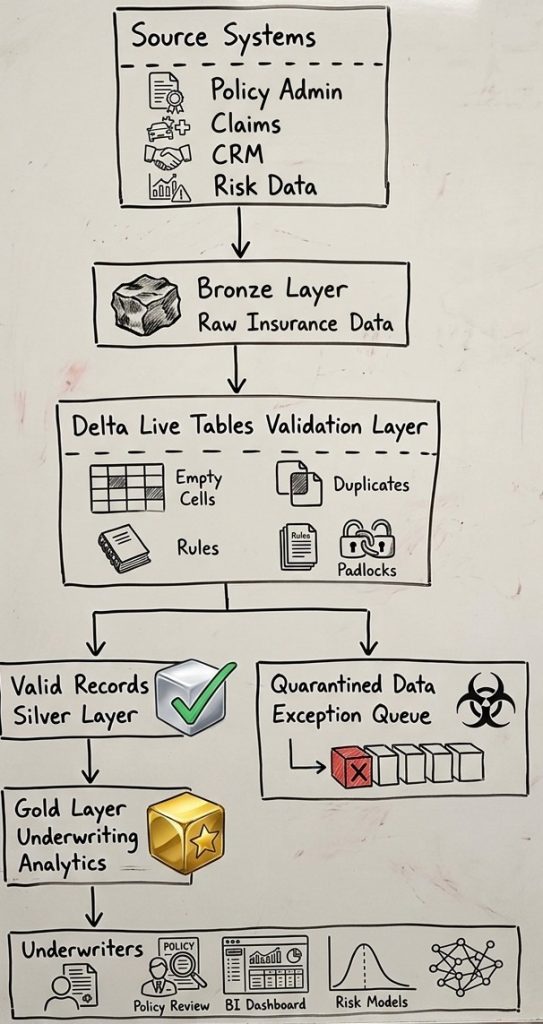
Validating Mandatory Policy Fields
The most fundamental validation is ensuring mandatory underwriting fields exist. Typical required attributes include:
- Policy Number
- Customer ID
- Policy Effective Date
- Product Type
- Insured Value
DLT Expectation
CREATE OR REFRESH LIVE TABLE validated_policies
CONSTRAINT valid_policy
EXPECT (
    policy_number IS NOT NULL
)
AS
SELECT *
FROM LIVE.raw_policies;
This rule ensures that every policy record contains a valid policy number before entering downstream underwriting workflows.
Example Input Data
| policy_number | customer_id | product_type |
| POL1001 | CUST001 | Auto |
| NULL | CUST002 | Home |
| POL1003 | CUST003 | Commercial |
Output After Validation
| policy_number | validation_result |
| POL1001 | Passed |
| NULL | Failed |
| POL1003 | Passed |
Records failing validation can be tracked and investigated before affecting underwriting decisions.
Handling Missing Risk Assessment Data
Risk scoring models depend on several important inputs. Examples include:
- Credit score
- Property value
- Geographic risk zone
- Vehicle information
- Previous claims history
A DLT expectation can identify missing attributes.
CREATE OR REFRESH LIVE TABLE enriched_risk_data
CONSTRAINT risk_score_present
EXPECT (
    risk_score IS NOT NULL
)
AS
SELECT *
FROM LIVE.policy_risk_feed;
Input Data
| policy_number | risk_score |
| POL1001 | 725 |
| POL1002 | NULL |
| POL1003 | 680 |
Validation Results
| policy_number | status |
| POL1001 | Accepted |
| POL1002 | Rejected |
| POL1003 | Accepted |
This prevents underwriting models from producing inaccurate outputs due to incomplete information.
Detecting Duplicate Claims
Duplicate claim records are one of the most common insurance data quality issues. Duplicates may occur because of:
- Integration failures
- Retry mechanisms
- Batch processing errors
Example Claims Data
| claim_id | policy_number |
| CLM1001 | POL1001 |
| CLM1002 | POL1002 |
| CLM1001 | POL1001 |
DLT Duplicate Detection Logic
CREATE OR REFRESH LIVE TABLE duplicate_claims
AS
SELECT
    claim_id,
    COUNT(*) AS duplicate_count
FROM LIVE.claims_bronze
GROUP BY claim_id
HAVING COUNT(*) > 1;
Output
| claim_id | duplicate_count |
| CLM1001 | 2 |
These records can be isolated before reaching underwriting reporting environments.
Validating Policy Consistency
Business rules are often more important than simple null checks. For example:
- Effective date must be before expiration date.
- Premium amount must be positive.
- Coverage limit must exceed deductible.
- Customer age must satisfy underwriting eligibility criteria.
Policy Consistency Validation
CREATE OR REFRESH LIVE TABLE quality_checked_policies
CONSTRAINT policy_dates_valid
EXPECT (
    effective_date < expiration_date
)
AS
SELECT *
FROM LIVE.policy_data;
Sample Data
| Policy | Effective Date | Expiration Date |
| POL1001 | 2025-01-01 | 2026-01-01 |
| POL1002 | 2026-01-01 | 2025-01-01 |
Validation Output
| Policy | Result |
| POL1001 | Passed |
| POL1002 | Failed |
Such rules prevent logically inconsistent records from entering premium pricing models and underwriting dashboards.
Creating a Quarantine Layer
One best practice is to separate invalid records into a quarantine table. This enables:
- Investigation and remediation
- Data stewardship workflows
- Regulatory audit support
- Continuous quality improvement
DLT Quarantine Pattern
CREATE OR REFRESH LIVE TABLE quarantined_policies
AS
SELECT *
FROM LIVE.raw_policies
WHERE policy_number IS NULL
OR effective_date >= expiration_date;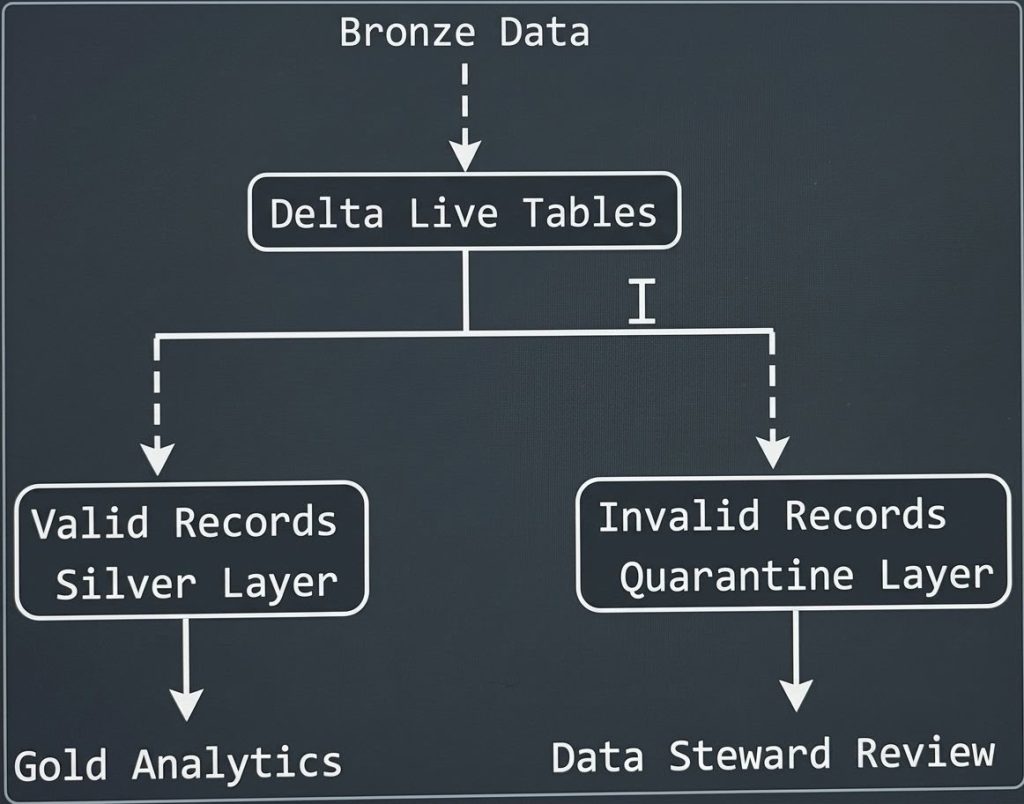
Monitoring Data Quality Metrics
One of DLT’s strongest features is built-in observability. Organizations can monitor:
- Validation pass rate
- Number of rejected records
- Duplicate counts
- Failed expectation trends
- Pipeline execution status
Example Daily Data Quality Dashboard
| Metric | Value |
| Policies Processed | 1,250,000 |
| Passed Validation | 1,243,750 |
| Failed Validation | 6,250 |
| Pass Rate | 99.5% |
| Duplicate Claims | 138 |
| Invalid Policies | 422 |
These metrics allow engineering and underwriting teams to quickly identify emerging issues.
Multi-Layer Data Quality Strategy
A mature underwriting platform should implement quality controls across the entire lakehouse.
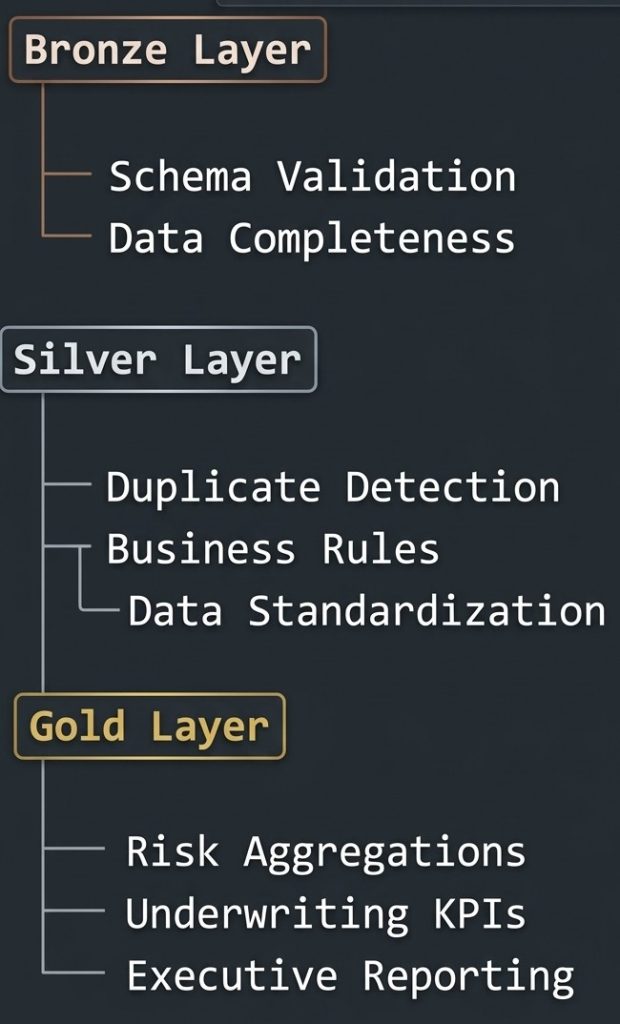
This layered approach ensures that every dataset consumed by analysts and underwriters has already passed multiple validation checkpoints.
Business Benefits
Insurance organizations adopting Delta Live Tables for underwriting data quality typically achieve:
| Benefit | Business Outcome |
| Automated validation | Reduced manual effort |
| Earlier defect detection | Faster remediation |
| Higher data trust | Better underwriting decisions |
| Continuous monitoring | Improved operational visibility |
| Regulatory compliance | Stronger auditability |
| Quarantine workflows | Controlled exception management |
In-Summary
As underwriting data volumes continue to grow, insurers need a scalable and automated approach to data quality management. Delta Live Tables provides a powerful framework for enforcing validation rules, detecting duplicates, identifying policy inconsistencies, and continuously monitoring pipeline health.
By integrating quality checks directly into the data pipeline, insurers can ensure that underwriting teams operate on trusted, consistent, and accurate information. This not only improves risk assessment and pricing decisions but also strengthens compliance, governance, and operational efficiency across the insurance lifecycle.
Organizations that treat data quality as a first-class engineering discipline will be better positioned to build trusted underwriting platforms and unlock the full value of modern lakehouse architectures powered by Delta Lake and Delta Live Tables.