


If you’ve ever felt like you’re “using AI wrong” because you don’t know terms like agent, skill, system prompt, or chain-of-thought — here’s some good news: the way most effective everyday users already talk to AI has a name. It’s called conversational prompting (sometimes called iterative prompting), and it’s less a technique than the absence of one.
What conversational prompting actually is
Conversational prompting means treating AI the way you’d treat a capable colleague on their first day: you give them real context, tell them what you need, look at what they produce, and adjust. No upfront blueprint. No special vocabulary. Just a back-and-forth.

It has two simple parts:
- Zero-shot prompting — giving a plain, direct instruction with no examples or special formatting. (“Write a weekly report with 3 sections: done, in progress, blockers.”) This is the technical name for what you’re already doing when you just… ask clearly.
- Iterative refinement — instead of trying to perfect your request in one shot, you treat the first reply as a draft and steer it: “shorter,” “friendlier tone,” “cut that paragraph.” Researchers studying how non-experts use AI have found this loop — get something back, then adjust — is far more reliable than trying to write one flawless prompt upfront.
Put together, that’s conversational prompting: clear ask, real context, then refine through dialogue.
Why it beats “prompt engineering” for everyday use
Prompt engineering — few-shot examples, system prompts, chain-of-thought instructions, temperature settings — exists for a real reason: it’s how people build AI-powered tools and products that need to behave consistently at scale, without a human in the loop to course-correct.
But when you’re just a person trying to get a report written or a decision sanity-checked, you are the human in the loop. You don’t need to pre-engineer consistency — you can just look at the output and say “not quite, try again.” That’s not a workaround; it’s actually the better tool for the job. Research on how non-expert users interact with AI has consistently found that people who try to force in technical structure they don’t fully understand tend to get vaguer, less grounded answers than people who just state their real situation plainly and go back and forth.
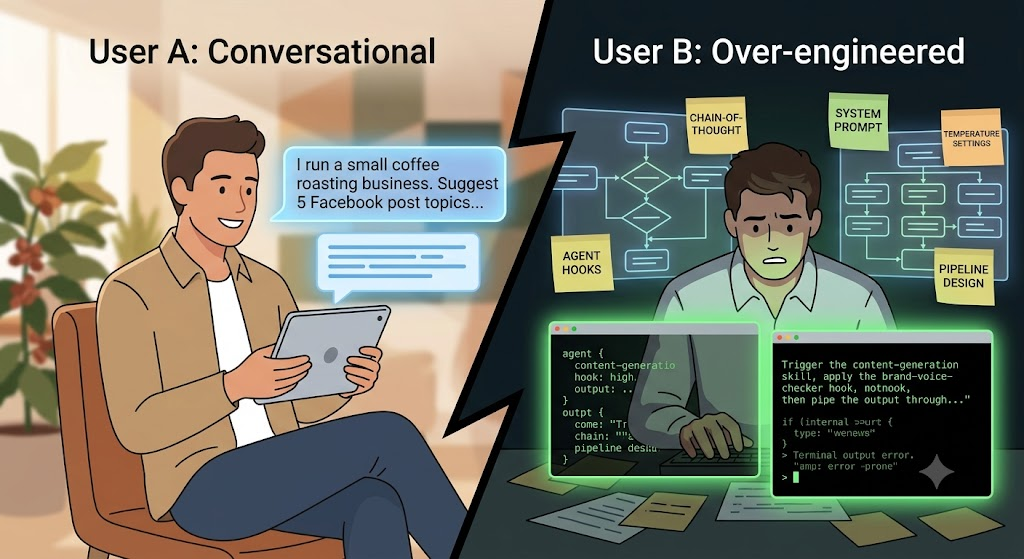
What it looks like in practice
The ask:
“I run a small coffee roasting business. Suggest 5 Facebook post topics for this week, each with a catchy opening line. Audience is office workers aged 25–35.”
The refinement, if the first draft isn’t quite right:
“Make these more playful, and add one that promotes our new decaf blend.”
That’s it. No agents, no hooks, no pipeline design. Two plain messages, real context, one adjustment.
Compare that to someone trying to sound advanced:
“Trigger the content-generation skill, apply the brand-voice-checker hook, then pipe the output through a social-scheduler agent.”

The AI has no such tools wired up in an ordinary chat — it can only pretend to follow along, inventing something to match the vocabulary. The result usually needs more editing, not less.
Three habits that make conversational prompting work
1. Open with real context, not a request in isolation “I sell coffee, audience is 25–35 year old office workers” does more work than any technical framing ever could. The AI needs facts, not architecture.
2. Name the shape you want back “3 bullet points,” “5 topics with one-line hooks,” “under 100 words” — concrete shape beats abstract instruction.
3. Treat every reply as round one, not the final answer Don’t hold out for the perfect single prompt. Ask, read, adjust. Most tasks land in 2–3 short exchanges.
The takeaway
You don’t need a new vocabulary to use AI well — you need to talk to it the way you’d talk to a sharp new hire: plainly, with context, and open to a quick back-and-forth. That approach already has a name — conversational prompting — even if you never called it anything at all.