



Data mesh is an innovative data architecture that decentralizes data ownership and governance across different teams or domains within an organization, moving away from a centralized model. It aims to boost scalability, agility, and data quality by enabling domain-specific teams to manage and share data autonomously, while adhering to unified governance standards and protocols.
What is data mesh?
Data mesh is a decentralized way of structuring data within an organization, where each business domain (like marketing, sales, customer service) takes ownership of its own datasets. This approach gives more control and responsibility to the teams or individuals who create and use the data, promoting better alignment with business needs and improving data management efficiency.
Moreover, the data mesh architecture effectively addresses security challenges through distributed ownership. Organizations deal with diverse data sources across various business lines that need to be combined for analysis. The data mesh approach efficiently connects these sources under centralized rules for sharing and governance. It allows business units to control how data is accessed, by whom, and in what formats. While implementing a data mesh can complicate architecture, it ultimately enhances efficiency by enhancing data access, security, and scalability.
Why use data mesh?
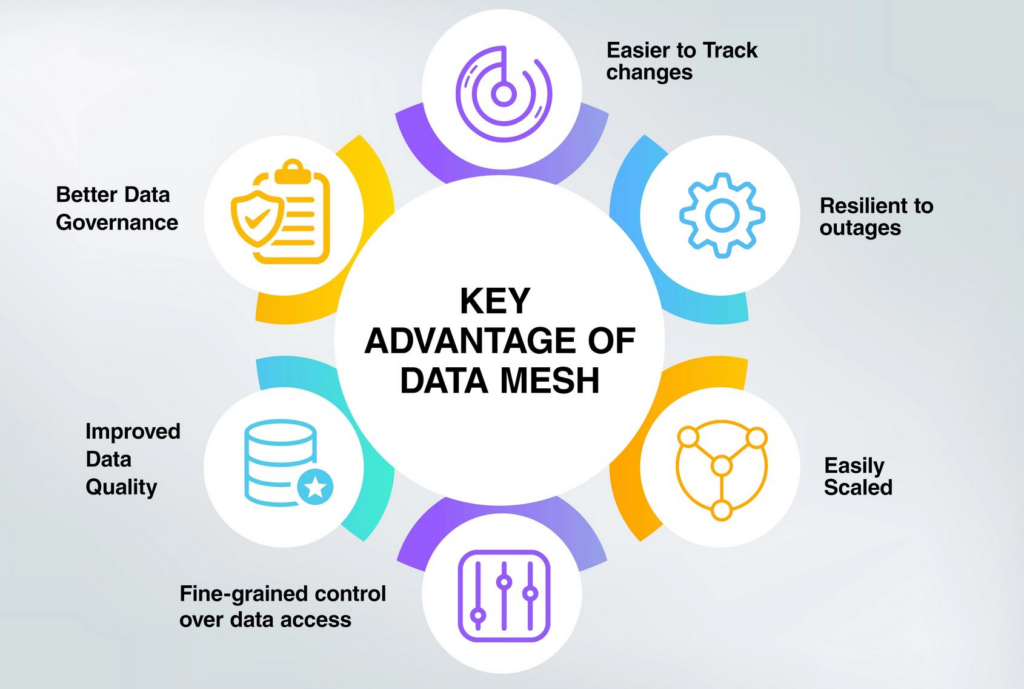
Organizations today face significant challenges in effectively managing and deriving value from their ever-increasing volumes of data. Typically, a centralized team ingests data, transforms it into a consistent format, and ensures reliability. This centralized approach involves implementing complex data pipelines that require substantial effort to maintain and modify, often resulting in bottlenecks and delays.
Here’s how a data mesh can address these challenges and why organizations should consider adopting it:
- Faster innovation: Data mesh speeds up innovation by empowering teams to freely explore and refine their data without administrative hurdles. This freedom enables them to swiftly adjust to market changes and develop new solutions at a faster pace.
- Scalability and flexibility: Data mesh enhances scalability and flexibility by distributing data management responsibilities across domains. Each domain independently develops and iterates on data pipelines to adapt to evolving business needs. This reorganization reduces operational bottlenecks and technical strains associated with centralized data infrastructures, promoting smoother system maintenance and adaptation.
- Cost efficiency: Data mesh promotes cost efficiencies by shifting from batch processing to real-time data collection using cloud data platforms and streaming pipelines. This approach leverages cloud storage, where teams can dynamically scale compute resources as needed, optimizing costs by paying only for the storage and compute they use.
Four principles of data mesh
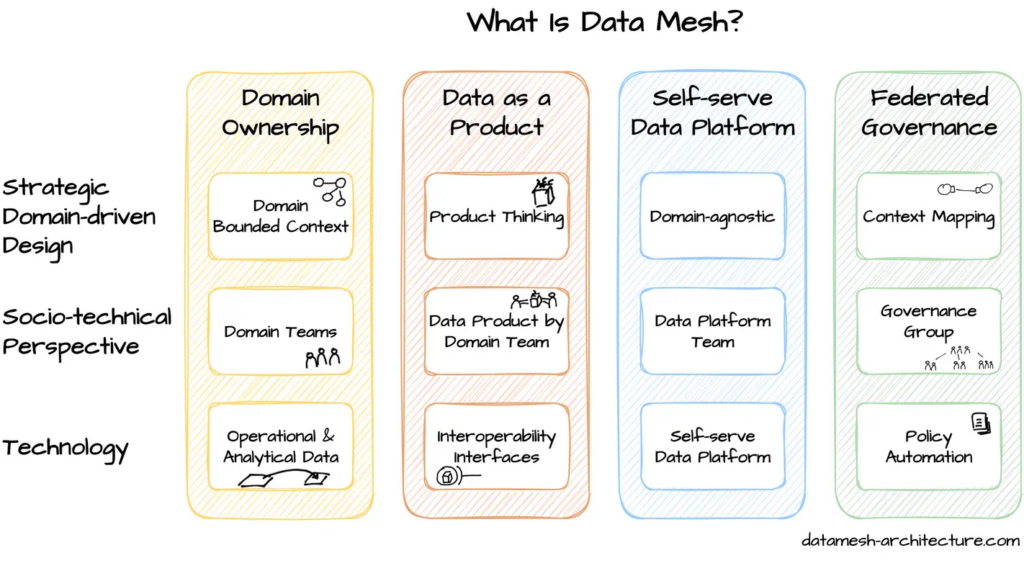
Domain Ownership: Domain ownership in the data mesh model shifts responsibility to domain-specific teams, aligning with business functions. Each team manages the collection, transformation, and provisioning of data related to their domain, ensuring data is hosted and served in a consumable format.
Data as a Product: Here, data is treated as a product that domain teams deliver in a self-service manner to other teams or applications. Domain-specific teams take ownership of their data products. They are responsible for collecting, transforming, and serving data that pertains to their business function or domain. This approach integrates modern product management practices, where each domain team views their datasets as products tailored to specific consumer needs.
Self-serve data infrastructure platform: The concept behind the self-service data infrastructure platform is to apply platform-oriented thinking to data management. In a distributed architecture, each domain previously managed its own pipelines for preparing and storing data. Now, a self-serve data platform eliminates redundancy by providing shared tools. Data engineers set up tools and systems for all teams to build, execute, and store data products.
Federated governance: Federated governance ensures consistent application of centralized policies across domains, while accommodating specific domain needs. This model safeguards data security, privacy, and regulatory compliance organization-wide, while empowering domains to manage their data autonomously.
Summary
Data mesh redefines data management by decentralizing control to domain-specific teams, treating data as a product. This approach enhances scalability, agility, and data quality by empowering teams to manage their own data pipelines independently. Key principles include decentralization, data as a product, self-serve infrastructure, and federated governance drive innovative data management across organizations.
References
https://www.datamesh-architecture.com
https://www.hibernian-recruitment.com/en/how-to-understand-data-mesh