


Modern systems are no longer monolithic. Data is generated continuously, processed asynchronously, and stored across multiple platforms. As systems grow more distributed, data quality becomes both more critical and harder to guarantee.
From a Test Engineer’s perspective, testing such systems is less about validating one database or one service, and more about ensuring that data remains accurate, consistent, and meaningful throughout its entire journey. This blog shares a deeper look into how I approached data testing in distributed systems, focusing on principles rather than tools, while using real-world technologies as illustrative examples.
Understanding Data as a Flow, Not a Location
“Where did this data come from, and where will it be used next?”
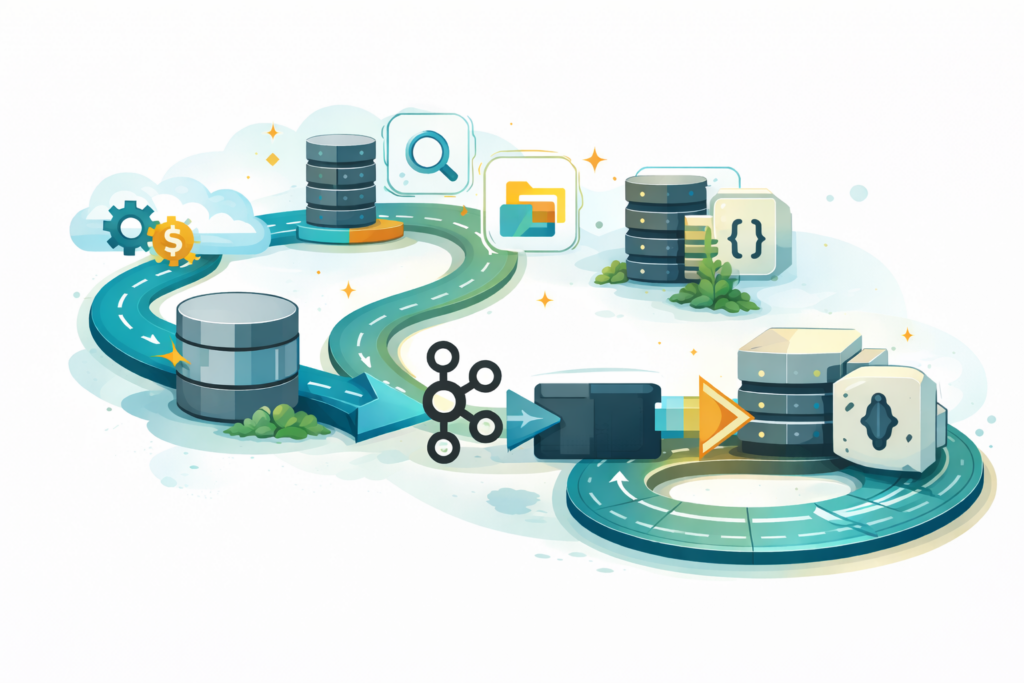
Traditional testing often treats databases as final destinations. In distributed systems, this mindset quickly breaks down. Data is rarely static – it moves, transforms, and gets reinterpreted as it travels.
A single data event might:
- Originate from a user action or backend process.
- Be stored temporarily in a transactional database.
- Be streamed through a messaging system.
- Be reshaped and stored again for search, analytics, or reporting.
From a TE standpoint, data must be validated across its journey, not just at rest. Even if data looks correct in one system, it may be delayed, duplicated, partially transferred, or misinterpreted downstream.
Data Generation and Triggered Processes
“If this action happens twice or fails halfway, what happens to the data?”
At a high level, data testing often starts by validating how data is created. Every data flow begins with a trigger. These triggers may be explicit (user actions) or implicit (scheduled jobs, backend calculations, or automated processes). These triggers are responsible for initiating data changes that later propagate through the system.
From a testing perspective, triggers are often underestimated. However, subtle issues here can cascade throughout the system:
- Duplicate events due to retries.
- Missing events due to timing or dependency issues.
- Incorrect values caused by incomplete business logic.
Rather than testing how triggers are implemented, I focused on what they produce:
- Is data consistently generated?
- Are edge cases handled safely?
- Is behavior predictable under failure or retry scenarios?
If data creation is unstable or inconsistent, downstream validation becomes unreliable, regardless of how robust the rest of the pipeline is.
Source Data as the Foundation of Quality
“Does this data accurately represent the business event that created it?”
Once data is generated, it is typically persisted in an initial storage layer. This could be a traditional relational database or a specialized system such as a graph database, depending on the business use case.
From an overview standpoint, this layer acts as the foundation of truth for everything that follows. My focus was not on specific tables or queries, but on principles such as:
- Structural correctness (fields, relationships, constraints).
- Alignment with business rules.
- Consistency across related records or entities.
In practice, systems may model the same domain differently. The risk is not technical failure, but semantic drift – where data technically exists but no longer represents business reality. Any defects at this level tend to be replicated downstream, often making them harder to detect later.
Data Mapping and Transformation
“Does this transformed field still mean the same thing to the business?”
As data moves between systems, it rarely stays in the same shape. Fields are renamed, data types change, and business logic is applied. This is where data mapping and transformation come into play. In practice, this might involve mapping fields from a source database into a messaging platform, and then transforming that message before storing it in destination systems.
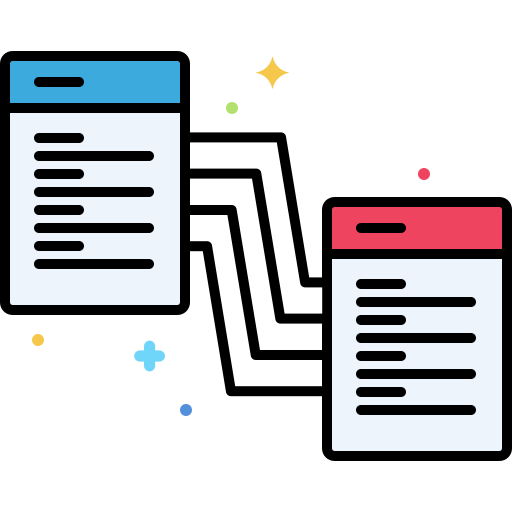
Common risks include:
- Fields that technically map, but semantically differ.
- Type conversions that truncate or distort values.
- Optional fields that quietly disappear.
- Business rules applied inconsistently across consumers.
From a TE perspective, the goal is not to memorize mappings, but to validate that:
- The meaning of data is preserved across transformations.
- Required fields remain available and correct.
- The design intentionally handles optional or missing data.
Mapping is one of the highest-risk areas because failures are often silent. They often have a direct impact on reporting, analytics, and user-facing features.
Streaming and Data Movement
“If data is delayed, replayed, or partially consumed, does the system still behave correctly?”
Using Streaming platforms (such as Kafka is an example) to decouple systems and enable scalable data movement. Data becomes asynchronous, replayable, and consumed by multiple systems independently.

Streaming introduces risks such as:
- Message duplication or loss.
- Ordering assumptions that do not hold.
- Consumers processing data at different speeds.
- Schema evolution affecting only part of the ecosystem.
Rather than testing the streaming platform as a standalone component, I viewed it as a transport layer. Key questions at an overview level included:
- Do producers reliably deliver data to consumers?
- Are failures visible and recoverable?
- Can we introduce schema or format changes safely?
Whether custom consumers consumed the data or the streaming platform’s connectors transferred it, the core TE concern remained the same: ensuring that data in motion retained its integrity.
Downstream Data Consumption and Storage
“Would two users relying on different systems see the same truth?”
Downstream systems often serve different purposes – A relational database, a search index, and a document store may all contain the “same” data, but optimized for different use cases.
From a high-level testing perspective, I focused less on system-specific details and more on:
- Consistency between source and target data.
- Correct interpretation of fields and values.
- Completeness of transferred records.
Differences in storage models make downstream validation more complex, but also more important, because we may use the same data in very different ways. Discrepancies across systems often lead to stakeholder confusion when reports, dashboards, and search results do not align.
Schema Validation and Change Management
“Who might break if this structure changes?”
In distributed systems, data structures evolve over time. New fields get added, existing ones change, and some become obsolete. Schema management tools and versioning help manage this evolution, but they do not eliminate risk.
From a TE viewpoint, schema validation was about understanding impact:
- Will existing consumers still work?
- Will older data remain readable?
- Are changes backward and forward compatible?
Even small schema changes can affect multiple downstream systems if not carefully validated.
End-to-End Thinking in Data Testing
“Can I explain this data’s journey from start to finish?”
One of the most important lessons I learned is that data testing must be end-to-end. Isolated checks – such as validating a single database or counting records – provide limited confidence.
End-to-end data testing typically involves:
- Tracing data from creation to final usage.
- Reconciling counts and samples.
- Testing edge cases and failure scenarios.
- Validating both structure and meaning.
This approach helped uncover issues that were invisible when testing the systems in isolation.
Key Takeaways
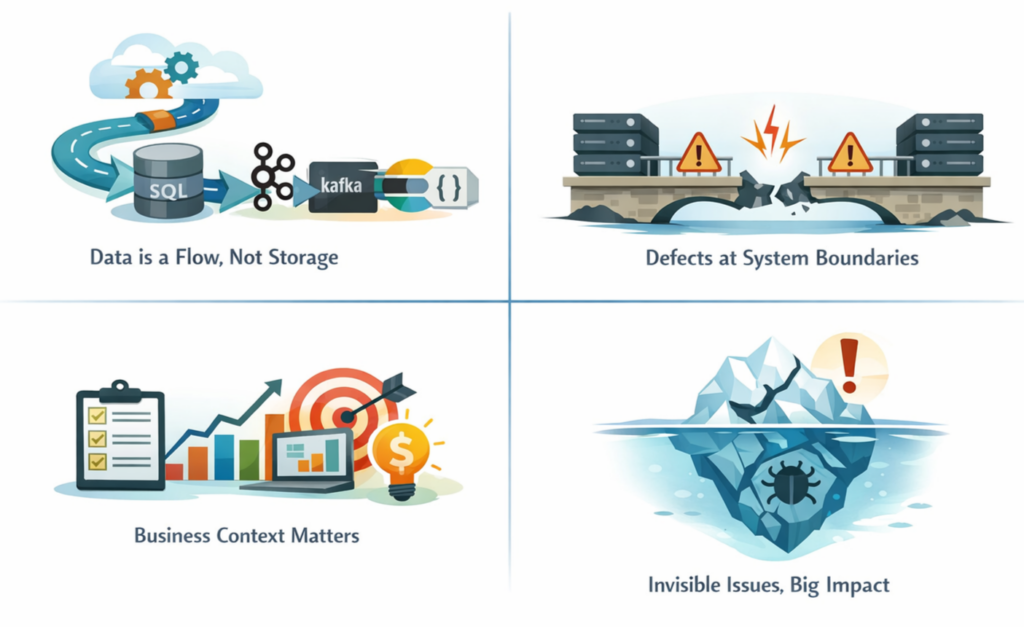
Data is a Flow, Not Storage
This emphasizes the mindset shift required for data testing. Validate data quality across its entire journey, not just in one database
Defects Occur at System Boundaries
Most critical issues appear when data moves between systems (for example, from a database into Kafka, or from Kafka into downstream stores).
Business Context Matters
Technical correctness alone is not enough. Understanding what the data represents from a business perspective is essential to meaningful validation.
Invisible Issues, High Impact
Data issues are often silent and hard to detect, yet they can significantly affect reports, decisions, and user trust.
Final Thoughts
Data testing in distributed systems is not about checking whether data exists. It is about ensuring that data remains truthful, consistent, and meaningful as it flows across technologies, teams, and use cases.
As Test Engineers, our value lies in seeing what others cannot – the gaps between systems – and protecting the trust placed in data-driven decisions regardless of how many systems it passes through.