


Data Warehouse Architecture – Part 3: Dependent Data Marts
Integrate once, then serve every department from the same foundation.
Last time, Sales and Finance ended up with two different revenue numbers because each built its own pipeline. The dependent data mart architecture solves this by changing where integration happens.
How it works
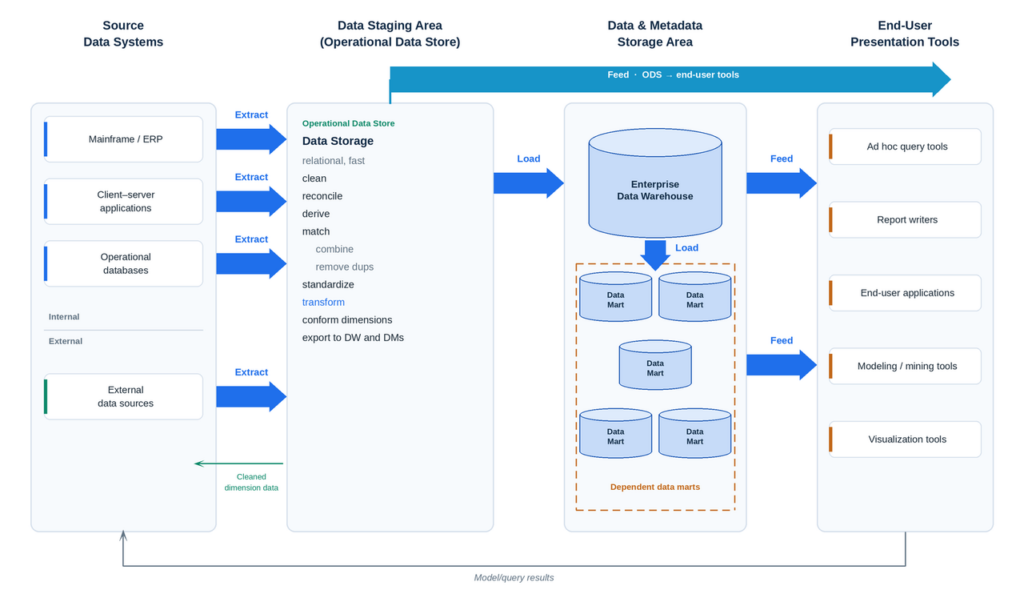
- Integrate once. Data from the sources is extracted, cleaned, reconciled, and standardized in a shared processing area.
- Load into the EDW. The result goes into an Enterprise Data Warehouse (EDW): a warehouse that covers the whole organization, holding reconciled data and long-term history.
- Feed the marts. Each department’s data mart is loaded from the EDW, not from the raw sources. That is why they are called dependent: they depend on the warehouse. The dashed orange box in the diagram shows these dependent marts.
- Serve users. Tools can read from the marts, and in some designs directly from the EDW or ODS.
The key rule: marts never go back to the raw sources. They only take data that has already been standardized.
What is an ODS, and how is it different from the EDW?
The diagram’s processing area is labeled Operational Data Store (ODS). An ODS holds integrated operational data with a focus on the current state. The EDW is for analysis and long-term history.
The diagram’s processing area is labeled Operational Data Store (ODS). An ODS holds integrated operational data with a focus on the current state. The EDW is for analysis and long-term history.
| 1 | ODS | EDW |
|---|---|---|
| Focus | What is happening now | What happened over time |
| Data | Current state, often overwritten | Historical, accumulated over years |
| Refresh | Every few minutes | Typically batch (e.g., nightly) |
| Example question | “Where is my order #A123?” | “How did March compare with last year?” |
Example: same numbers, now explainable
Back to our retail chain. This time a shared ETL does two things before any mart sees the data:
- Standardizes customer IDs, so one customer has exactly one ID across order, customer, and store data.
- Applies one set of revenue rules (the “golden rules”) defined once.
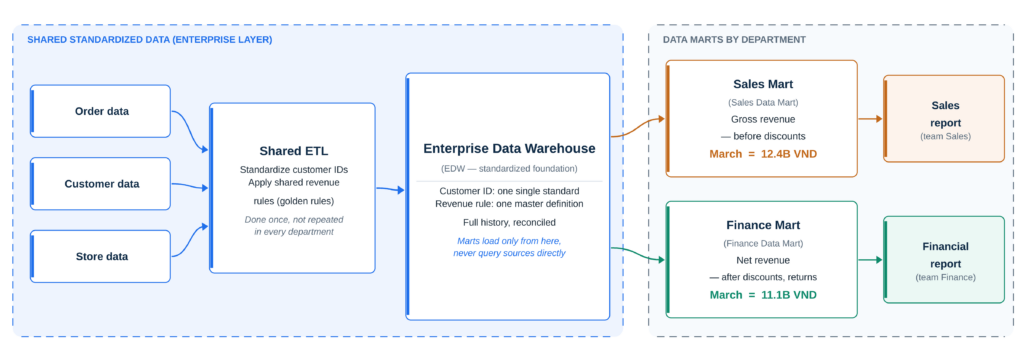
Now the departments’ marts are built on that foundation:
- Sales Mart: gross revenue (before discounts), March = 12.4 billion VND.
- Finance Mart: net revenue (after discounts and returns), March = 11.1 billion VND.
The numbers are the same as in the independent example, but the situation is very different. Both come from one master definition in the EDW. The 1.3-billion gap is intentional (gross vs. net), it can be explained through a data dictionary, and anyone can reconcile the two by following the same lineage.
Adding an ODS: two flows from one shared ETL
The same standardized data can serve two different kinds of questions:
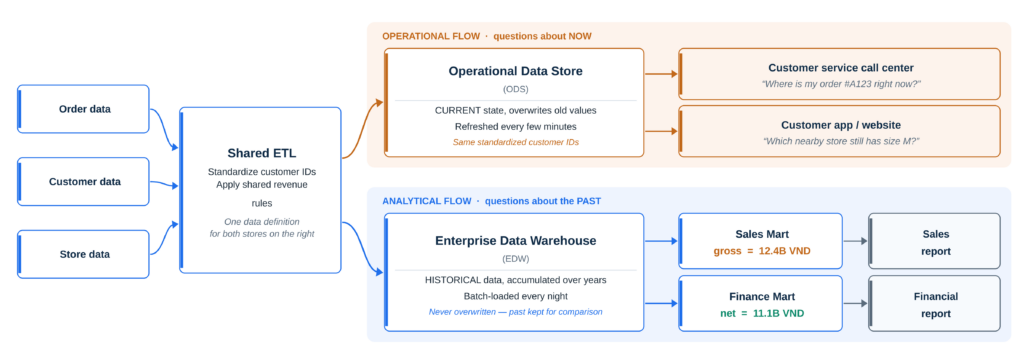
- Operational flow (ODS): shows the current state, refreshed every few minutes, and overwrites old values. It powers the customer service call center (“Where is my order #A123 right now?”) and the customer app (“Which nearby store still has size M?”).
- Analytical flow (EDW + marts): keeps history, loaded in a nightly batch, never overwritten. It powers the Sales and Finance reports.
Because both start from the same shared ETL, they use the same standardized customer IDs.
Pros and Cons
Pros
- Less re-interpretation of sources: Marts don’t each decide what a source column means. It’s decided once in the EDW.
- Easier reconciliation: Differences between marts trace back to one definition.
- Easier data sharing: Departments build on the same data and semantics.
Cons
- More to manage: You must build and operate the EDW layer and the jobs that refresh each mart.
- Possible extra latency: Data passes through one more step (source → EDW → mart), so marts may lag behind.
When to choose it
Choose dependent marts when many departments need consistent, comparable numbers and you can invest in a central warehouse and its governance. It’s the classic enterprise approach, trading some speed and upfront effort for trust in the data.
Next in the series: what if marts didn’t need to be physical copies at all, and the warehouse could react in near real time?