


Data Warehouse Architecture – Part 2: Independent Data Marts
Fast to start, painful to reconcile.
In the previous blog we saw the two-level architecture: one warehouse, one source of truth. But building a company-wide warehouse takes time, budget, and agreement between departments. What if one team needs answers *now*?
What is a data mart?
A data mart is a smaller data store designed for one group of users or one business need, such as Sales, Finance, or Inventory. Think of the warehouse as a supermarket and a mart as a small specialty shop: it carries only what one customer group needs, arranged the way they like it.
The independent data mart architecture
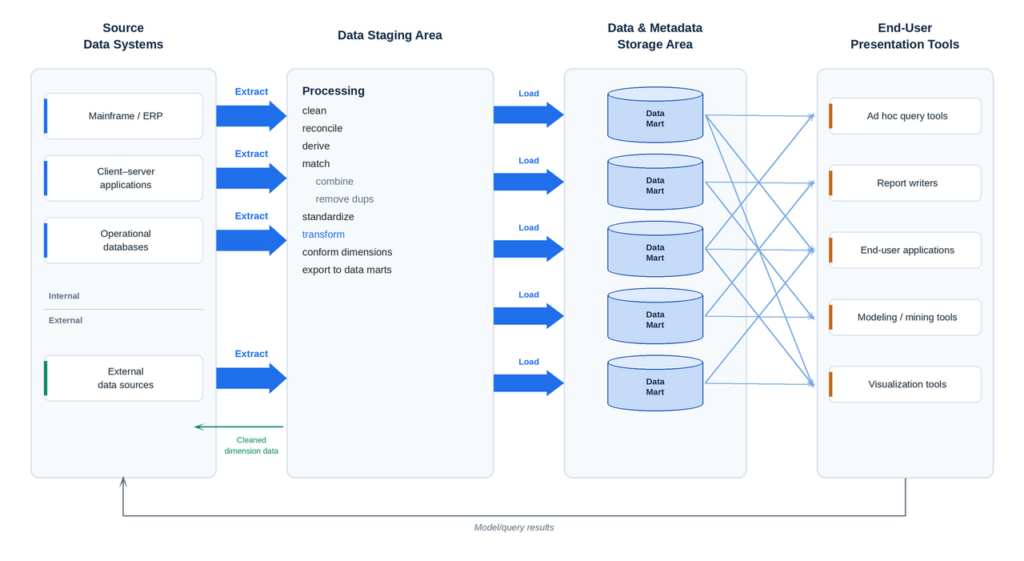
In this design, each mart is built on its own, with no central warehouse behind it:
- Each mart takes data from the sources it needs. The Sales mart connects to the order system, another mart might connect to the ERP and an external data source.
- Each mart has its own ETL. Every team writes its own logic to extract, clean, and transform data. In the diagram this is why several separate flows go from the sources to separate marts.
- Users query the mart that serves their job. Each mart is reached by its own set of tools.
Because every mart does its own integration, integration happens in many places instead of one. That is the key difference from the other architectures.
Example: two teams, two numbers
A retail company’s Sales team and Finance team both read the same order data. Each builds its own ETL and its own mart.
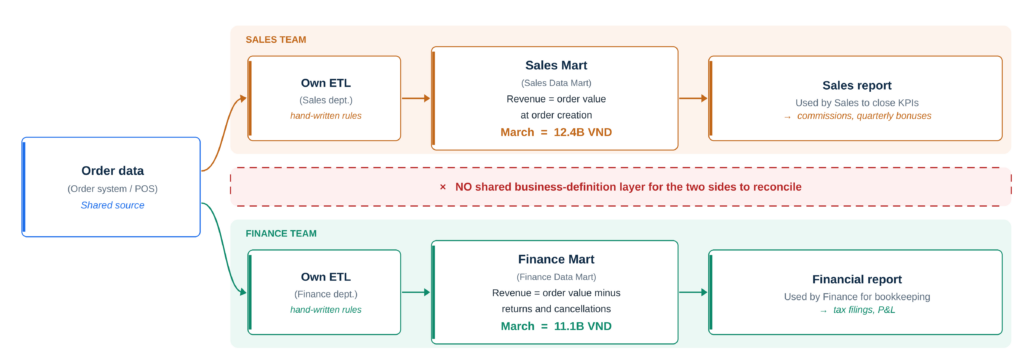
- The Sales team defines revenue as the order value at the moment the order is created. Its mart shows March = 12.4 billion VND. Sales uses this to calculate commissions and quarterly bonuses.
- The Finance team defines revenue as order value minus returns and cancellations. Its mart shows March = 11.1 billion VND. Finance uses this for tax filings and the profit-and-loss statement.
Neither team is necessarily wrong: they simply answer slightly different questions. The real problem is what’s missing in the middle of the diagram, the red band: there is no shared business-definition layer where the two definitions are written down, named, and compared. When an executive asks, “Why do the two reports differ by 1.3 billion?”, nobody can quickly prove which number is right or explain the gap. And because each team wrote its own transformation rules, the explanation may sit only in someone’s script or head.
Why this keeps happening
- Duplicated work. Every mart re-solves the same problems (for example, cleaning customer names) in its own way.
- Metric drift. Over time, small differences in rules multiply, and the same word (“revenue”, “active customer”) ends up meaning different things.
- Hard to combine marts. Different codes, grain, and definitions mean joining data across marts is slow and error-prone.
Pros and Cons
Pros:
- Fast to deploy for a local need: One team can start without waiting for a company-wide design or agreement.
- Small initial scope: Fewer people and fewer sources, so the project is easy to organize.
Cons:
- Integration work repeated: Each mart builds and maintains its own ETL. Cost grows with every new mart.
- Metric definitions diverge: No single master definition exists, so numbers conflict.
- Hard to combine data across marts: There’s no shared foundation to join on, which makes cross-department analysis painful.
When to choose it
Independent marts can be reasonable for a single department with an urgent, well-bounded need, or as a quick pilot. But as more departments build their own, the inconsistencies pile up. Many organizations that start here eventually move to a shared warehouse, which is the subject of the next post.
Next in the series: how an enterprise data warehouse fixes the “two numbers” problem.