


Data Warehouse Architecture -Part 4: Logical Data Marts and the Active Data Warehouse
Same data, different views, and fresh enough to act on.
The previous architectures share two traits: marts are physical copies of data, and the warehouse is usually updated in batches. The fourth architecture challenges both.
Two ideas in one architecture
- Logical data marts. Instead of copying data into separate mart databases, a mart is a view or logical layer on top of the warehouse. Different teams see different slices and shapes of the same data.
- Active data warehouse. An active DW is an integrated warehouse updated in near real time. It doesn’t only support analysis: it also sends results back into business operations so events can be handled promptly.
How it works
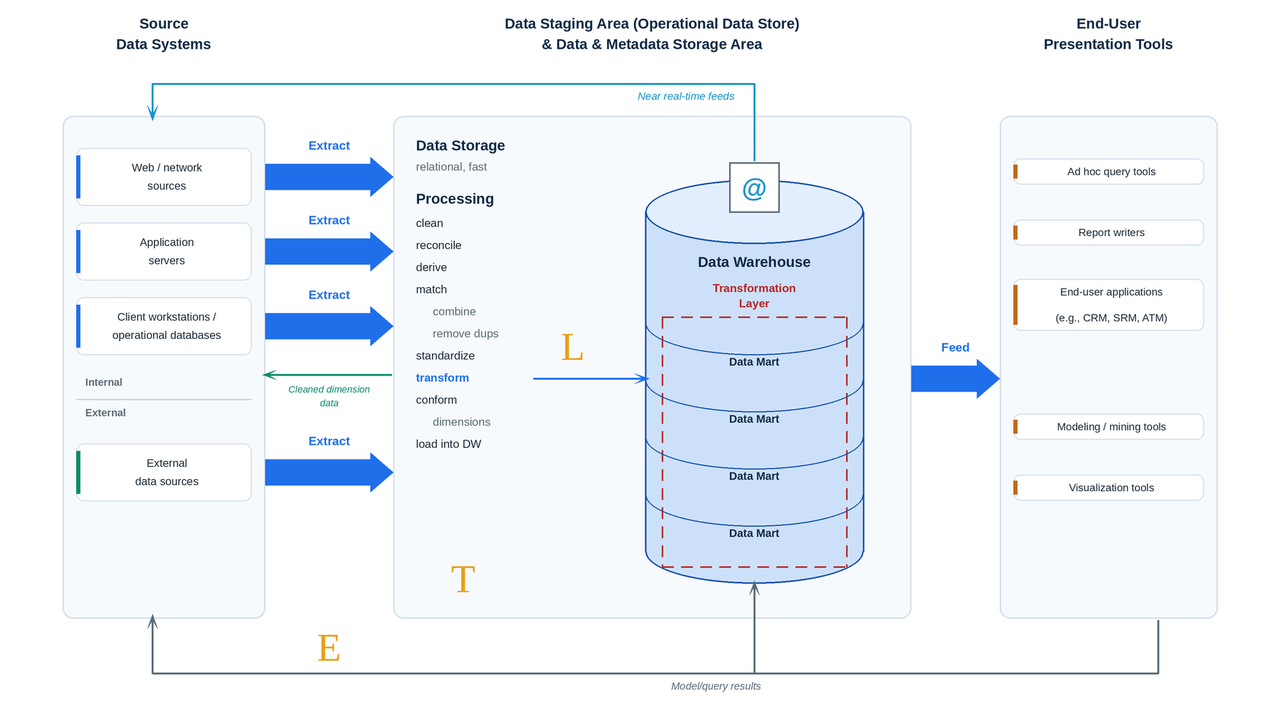
- Near real-time feeds. Data from the sources (web/network sources, application servers, operational databases) arrives continuously rather than in a nightly batch.
- Data Warehouse. Stores the integrated data plus metadata (meaning, origin, update time).
- Transformation layer. Applies business rules on top of the warehouse data to shape it for each purpose.
- Logical data marts. The “Data Mart” sections inside the warehouse are not separate databases. They are views, each one giving a different business perspective.
- Feedback loop. Analysis results go back to the operational side (the “model/query results” arrow), so people or systems can act on them.
Example: an online bookstore
A bookstore website records every purchase and every stock change. The Active DW ingests these within moments. (The numbers below are a hypothetical example.)
Step 1: raw facts in the warehouse. The shared warehouse knows that book S01 sold 30 copies in the last hour, and the latest stock reading is 8 copies.
Step 2: the transformation layer applies rules. It selects valid orders, sums copies sold per hour, and joins each book with its most recent stock figure.
Step 3: each mart gives a different view of the same data.
| Logical mart | Takes from the DW | Answers |
|---|---|---|
| Sales mart | Book ID, copies sold per hour | “Which items are selling fast?” → S01: 30 copies/hour |
| Replenishment mart | Copies sold, latest stock, alert threshold | “Do we need to reorder?” → S01 has 8 left, below the threshold of 10 |
Step 4: act. Because 8 is below the threshold of 10, the system sends a restock suggestion to the website’s admin page. Staff approve it, the books arrive, stock is updated, and the new data starts the next analysis cycle. That loop is what makes the warehouse active.
Both “30” and “8” come from the same warehouse. Only the viewpoint differs.
Logical view vs. materialized view
Logical marts are usually built with views. A related concept is the materialized view, which stores results physically. The mechanism details depend on the database system.
| Logical view | Materialized view | |
|---|---|---|
| Storage | Stores only the query definition | Stores the physical result of the query |
| When data changes | Query runs on the current base data | Refreshed manually, on a schedule, or by trigger |
| Trade-off | Uses compute each time the query runs | Uses storage and needs refresh upkeep |
Pros and cons, explained
| (+): Pros (-): Cons | Why |
|---|---|
| + Fewer data copies | Marts are views, so there’s less duplicated data to store and keep in sync. |
| + Faster reaction | Near real-time feeds shorten the time between an event and a response. |
| + Shared data and meaning | All views draw on the same warehouse and the same definitions. |
| – The pipeline must be reliable | Continuous feeds and a feedback loop need monitoring. A broken feed means stale or wrong alerts. |
| – Shared load | All views query one warehouse, so heavy views can compete for resources. |
| – Freshness depends on updates | A logical mart is only as fresh as the warehouse’s own update flow. |
When to choose it
Choose this approach when decisions can’t wait for tomorrow’s batch: inventory alerts, fraud detection, personalization, and similar use cases.
Putting it all together: the four architectures compared
| Architecture | Where data is integrated | Mart type | Freshness |
|---|---|---|---|
| Two-level | One warehouse | No marts | Periodic batch |
| Independent marts | Separately in each mart | Physical, standalone | Each mart’s own schedule |
| Dependent marts | Centrally in the EDW | Physical, fed from EDW | EDW and mart load schedules |
| Logical marts + Active DW | Centrally in the DW | Logical views | Near real time |
There is no single “best” choice. To pick one, ask:
- How many teams need the data? More teams push you toward a shared foundation.
- How consistent must the numbers be? If finance and sales must agree, avoid independent marts.
- How fresh must the data be? If hours matter, consider an active DW.
- How much can you invest? Simpler designs are cheaper to start; governed designs pay off at scale.