



Introduction
Microservices architecture has gained immense popularity in recent years due to its ability to break down complex applications into smaller, manageable services that can be developed, deployed, and scaled independently. Among the plethora of tools and frameworks available for building microservices, .NET stands out as a robust and versatile option, offering a rich ecosystem of libraries and tools for development.
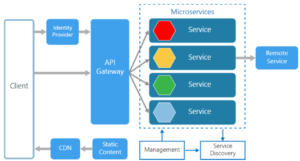
Key Concepts:
1. Microservices Architecture:
-
-
- Definition: Microservices architecture is an approach to software development where a complex application is decomposed into smaller, independent services that are loosely coupled and can be developed, deployed, and scaled independently.
- Principles: Microservices architecture emphasizes the following principles:
- Service autonomy: Each service is responsible for its own functionality and data.
- Decentralized data management: Services manage their own data stores, avoiding shared databases.
- Communication via APIs: Services communicate with each other through well-defined APIs, typically over HTTP or messaging protocols.
- Resilience and fault isolation: Services are designed to be resilient to failures and faults, and failures in one service should not cascade to others.
- Service Boundaries:
- Identification: Defining clear boundaries for services based on business capabilities or domain contexts.
- Definition: Establishing well-defined interfaces and contracts between services to enable independent development and deployment.
- Separation of Concerns: Ensuring that each service focuses on a specific business capability or domain, avoiding overlapping responsibilities.
- Inter-Service Communication:
- RESTful APIs: Representational State Transfer (REST) is a common architectural style for designing networked applications. RESTful APIs are used for communication between microservices, providing a standard way to access and manipulate resources.
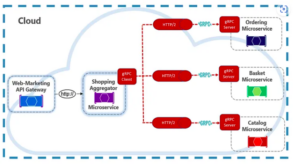
- gRPC: gRPC is a high-performance, open-source RPC (Remote Procedure Call) framework developed by Google. It enables efficient communication between services using protocol buffers and HTTP/2.
- Messaging: Message-based communication patterns, such as publish-subscribe or message queues, can be used for asynchronous communication between microservices, facilitating loose coupling and scalability.
- Containerization with Docker:
- Docker: Docker is a popular platform for containerization, allowing developers to package applications and their dependencies into lightweight, portable containers that can run consistently across different environments.
- Benefits: Containerization simplifies deployment, improves scalability, and enhances consistency by encapsulating applications and their dependencies.
- Orchestration with Kubernetes:
- Kubernetes: Kubernetes is an open-source container orchestration platform that automates the deployment, scaling, and management of containerized applications. It provides features such as service discovery, load balancing, and automatic scaling to simplify the management of microservices architectures.
- Benefits: Kubernetes enables developers to deploy and manage microservices at scale, ensuring high availability, resilience, and resource efficiency.
- Design Patterns and Best Practices:
- Domain-Driven Design (DDD): DDD is an approach to software development that focuses on understanding and modeling the core domain of a system. It helps in defining clear service boundaries and designing services around business capabilities.
- Circuit Breaker pattern: The Circuit Breaker pattern is a design pattern used to handle faults and failures in distributed systems. It prevents cascading failures by temporarily interrupting requests to a failing service and providing fallback mechanisms.
- API Gateway pattern: The API Gateway pattern involves using a centralized entry point for client requests and routing them to appropriate microservices. It enables cross-cutting concerns such as authentication, rate limiting, and request routing to be handled centrally.
-
Conclusion
Microservices architecture offers a flexible and scalable approach to building modern, distributed systems, and .NET provides a robust platform for developing microservices-based applications. By leveraging .NET Core or .NET 5+ along with containerization and orchestration tools like Docker and Kubernetes, developers can create resilient, scalable, and maintainable microservices architectures. With the right design patterns, best practices, and tools, organizations can unlock the full potential of microservices to drive innovation and agility in their software development processes.