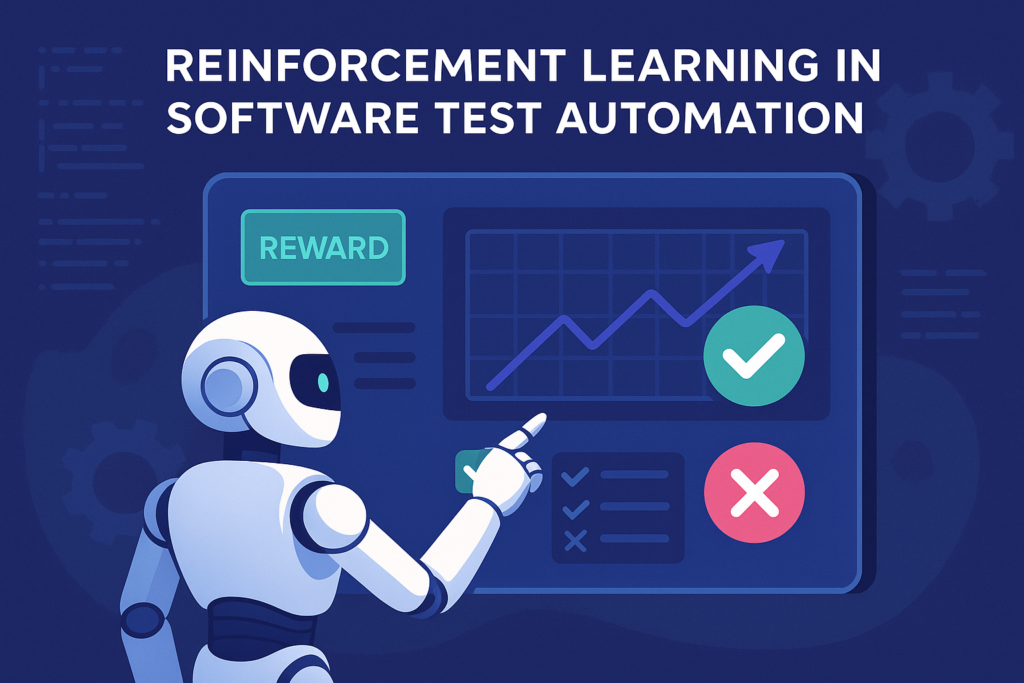
In software testing, reinforcement learning is a technique in which a computer program or agent determines which tests should be run based on performance, so that it can catch errors effectively.
Reinforcement Learning
Reinforcement learning is a way to test software by trying out different testing actions, seeing what works (like finding bugs), and then getting better at making test decisions over time. In software testing, reinforcement learning means automatically finding the best test cases by rewarding the system when it finds errors and fixing them when it doesn’t.
Saves money on cloud, CI, and CD while cutting down on testing time
Provides developers with feedback more quickly.
Makes pipelines more intelligent with each execution.
The Problem with Static Test Suites in RL
Traditionally, testing pipelines rely on static test suites:
Each code change triggers a large number of tests.
Testers may run tests even if they don’t relate to the most recent modification.
Redundant tests slow down feedback cycles and waste computing time.
Dynamic Test Selection (DTS) to the Rescue
DTS now only runs those tests that have the highest chances of failing. People generally use several strategies to achieve this goal, such as prioritising tests, evaluating the impact of changes, and using machine learning for prediction.
Code coverage analysis
Change impact analysis
Historical failure data
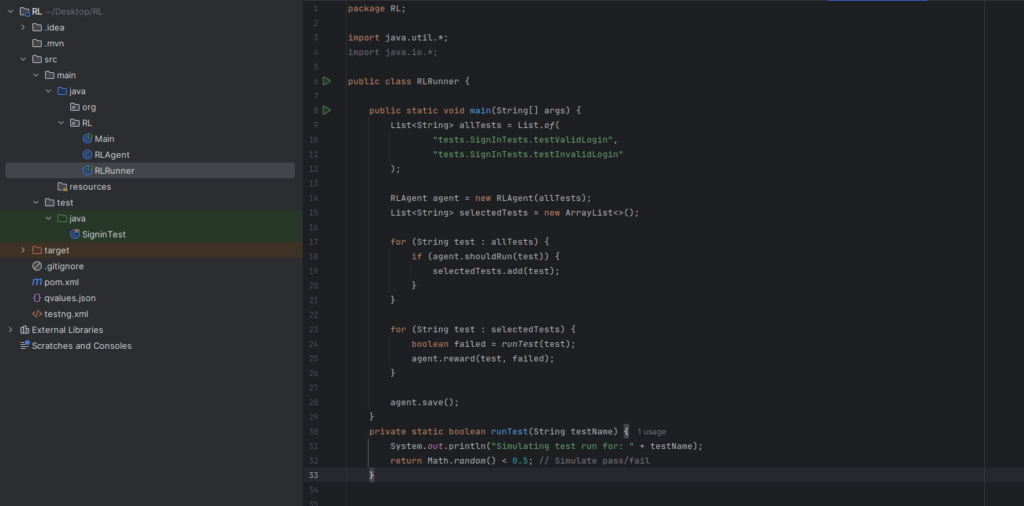
Project Structure
RL/
├── src/main/java/RL/
│   ├── RLAgent.java     # Reinforcement Learning agent logic
│   └── RLRunner.java    # Main class to run selective tests
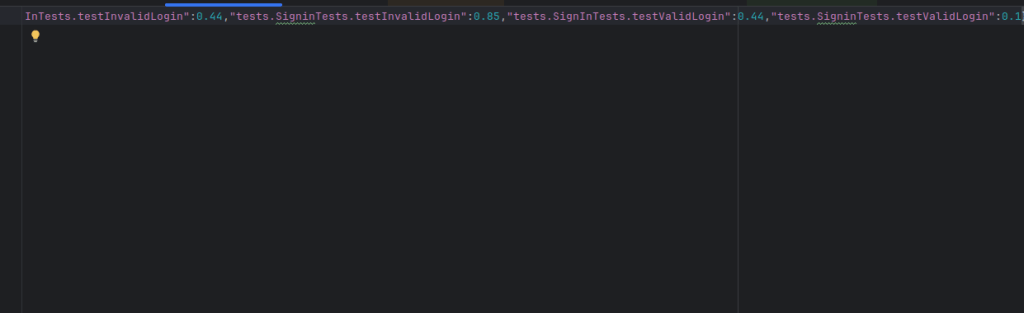
├── qvalues.json         # Stores learned test behaviors (Q-values)├── pom.xml              # Maven project setup
└── testng.xml           # TestNG configuration
Purpose
Instead of running the entire test suite every time, RL is primarily used in dynamic test cases by running only the most valuable or high-risk test cases to improve the testing process. Best approaches:-
Reduce feedback loops and speed up releases to increase the efficiency of the CI/CD pipeline.
Avoid low-impact tests to save time and money.
To increase the defect detection rate, focus on those areas where changes have increased the failure rate.
Keep learning from previous results and continuously improve and adapt your testing process to make improve the decisions in the future.
How It Operates
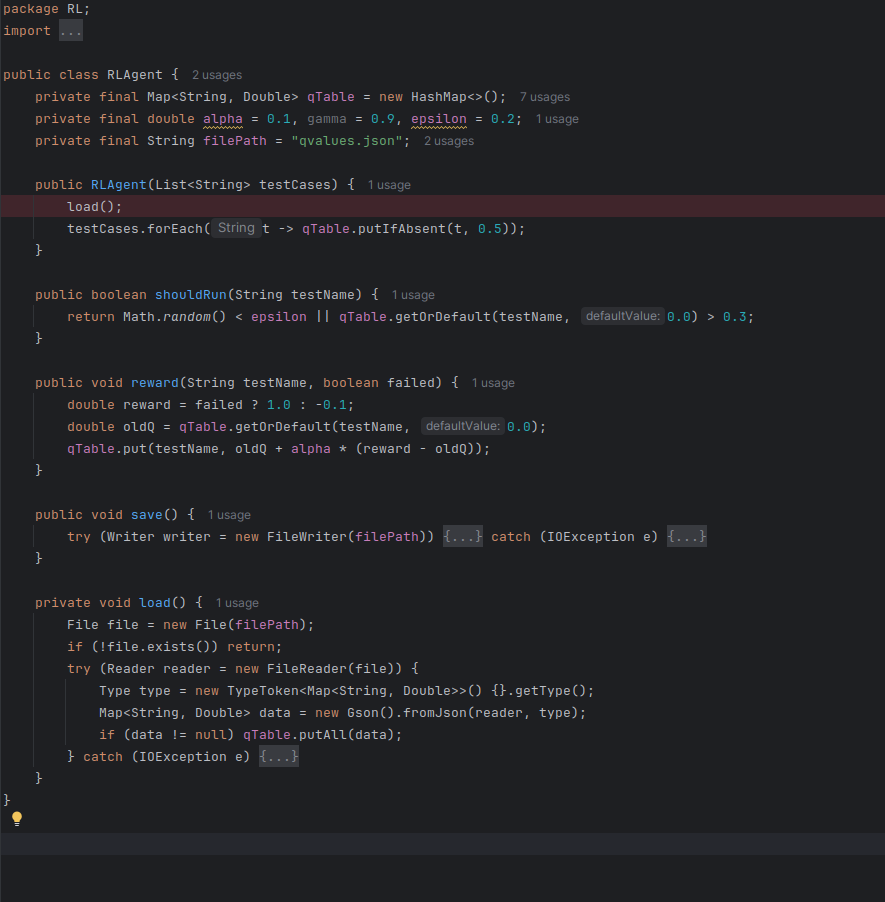
RLAgent.java
Maintains a Q-table (test name → score) in qvalues.json
Uses epsilon-greedy strategy to balance:
Exploration (random tests)
Exploitation (run tests with high failure likelihood)
Update scores:
Failing test → Higher score
Passing test → Lower score
RLRunner.java
Runs the pipeline:
Outlines every test that could be conducted (hardcoded list)
Determines which tests to run using RLAgent.shouldRun().
Hi there! My name is Soniya Raichandani and I'm a Software tester with over 4.5 years experience.I have worked with a variety of testing methodologies and tools, including manual and automated testing, regression testing, and performance testing.I created this blog to share my knowledge and experiences with the testing community. My goal is to help other testers improve their skills and stay up-to-date with the latest trends in software testing.