



Introduction
As your applications scale and multiply within the cluster, it becomes crucial to manage resource consumption effectively. Kubernetes-resource-quotas, a powerful feature designed to provide control and transparency over resource allocation within your cluster. In this blog post, we’ll explore the significance of resource quotas, how they work, and how to leverage them for optimal Kubernetes resource management.
Understanding Kubernetes Resource Quotas
What are Resource Quotas?
Resource Quotas in Kubernetes are a means of constraining resource consumption within namespaces. Cluster administrators can set limits on the amount of compute resources (CPU and memory) and the number of objects (pods, services, persistent volume claims, etc.) that can be created within a given namespace.
Key Concepts:
1. Resource quotas operate at the namespace level, providing isolation and control over resource usage for specific workloads or teams.
2. Quotas can be set for both compute resources (CPU and memory) and non-compute resources (number of objects like pods or services).
3. Quotas consist of hard limits that cannot be exceeded and soft limits that trigger warnings when approached.
Implementing Resource Quotas
Defining a Resource Quota:
1. kubernetes Resource quotas are associated with namespaces. To create a new namespace, run the command below:
$ kubectl create namespace <namespace-name>

2. Create a resource quota YAML file specifying limits for compute and non-compute resources.
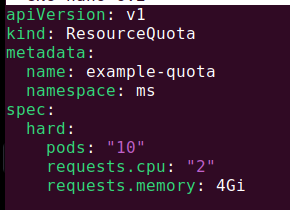
3. Apply the resource quota to the namespace you created, run the following command:
$ kubectl apply -f <resource_quota_file.yaml>

4. To regularly monitor resource usage within namespaces, run the following command:
$ kubectl top.
Best Practices for Resource Quotas
- Use Quotas for Namespace Isolation:
Leverage quotas to isolate workloads within namespaces, preventing resource contention. - Regularly Review and Adjust Quotas:
Periodically review resource usage patterns and adjust quotas accordingly. - Set Realistic Quota Limits:
Establish quota limits that align with the available cluster resources and the anticipated growth of workloads. Avoid setting overly restrictive quotas that may hinder normal operations. - Plan for Scalability:
Consider future scalability needs when defining resource quotas. Anticipate the growth of workloads and adjust quotas to accommodate increasing resource demands.
Conclusion: Sailing Smoothly with Resource Quotas
Kubernetes Resource Quotas empower administrators to maintain order and efficiency within their clusters.
In the vast Kubernetes landscape, Resource Quotas stand as guardians, ensuring fair and efficient resource utilization. Embrace the power of quotas to bring balance to your clusters, fostering an environment where applications thrive without hindering each other. Efficiently manage your resources, navigate the Kubernetes waters with confidence, and keep your clusters sailing smoothly into the future.