


What Is Mutation Testing?
Mutation testing starts with a program that already works correctly.
Instead of assuming the code is perfect, we deliberately mess with it a little by introducing small changes called mutations.
These changes are tiny, things like swapping a + for a -, changing > to >=, or flipping a logical operator.
Each of these slightly altered versions of the program is then run through the existing test suite.
If the tests fail, that’s actually good new, the tests noticed the change and killed the mutant.
But if the tests still pass, the mutant survives, which suggests that the tests might not be strong enough to catch that kind of fault.
In short, mutation testing checks whether your tests are smart enough to notice when something is subtly wrong.
What Are Equivalent Mutants?
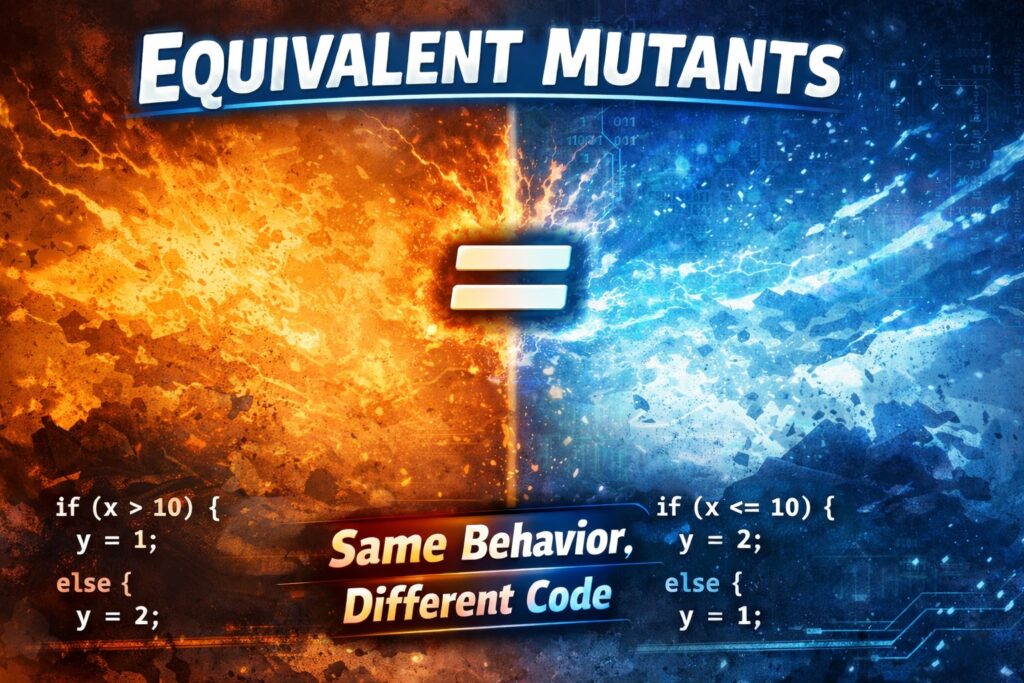
An equivalent mutant is a mutated version of the code that behaves exactly the same as the original for all valid inputs.
The code changes. BUT The behavior does not.
No test can distinguish between the two — not because the tests are bad, but because there is nothing observable to detect.
Why Equivalent Mutants Can’t Be Eliminated.
Mutation tools work at the syntactic level, not the semantic one.
They change operators, conditions, or values without understanding whether the change alters behavior.
Some changes are simply equivalent: E.g:
- x < 0 vs x < -1
- flag == true vs flag
- value * 1
Generally, determining whether two programs are equivalent is undecidable.
Common Sources of Equivalent Mutants
Equivalent mutants often arise from:
- Redundant conditions (
x == truevsx) - Boundary-preserving changes (
>=vs>) - Compiler optimizations masking differences
- etc …
The Real Issue: Metric Misuse
Mutation scores count all surviving mutants as failures.
This creates a dangerous illusion: Weak tests and equivalent mutants look identical in reports .
Teams chase higher scores instead of better understanding.
Time is wasted trying to “fix” what cannot be fixed.
At this point, mutation testing stops improving quality and starts distorting priorities.
Why Chasing 100% Is a Bad Idea
A perfect mutation score often means:
- Trivial code was over-tested.
- Complex logic was excluded
- Judgment was replaced by automation.
A slightly imperfect score, backed by reasoning, is far more honest than a perfect score no one believes.
How Do Tools Handle Equivalent Mutants?
Since perfect detection is impossible, mutation testing tools use heuristics:
- Static analysis to filter obvious cases
- Selective mutation (using fewer mutation operators)
- Manual inspection for surviving mutants
- Higher-order mutants to reduce trivial equivalences
Even with these strategies, equivalent mutants cannot be completely eliminated.
Using Mutation Testing Responsibly
Mutation testing works best when treated as a diagnostic tool, not a KPI.
Good practices include:
- Accepting that some mutants should survive
- Focusing on business-critical and decision-heavy code
- Reviewing survivors instead of blindly fixing them
- Tracking trends over time, not absolute number
Conclusion
Equivalent mutants reveal a hard truth: metrics cannot reason about meaning — people must.
Mutation testing adds value when it sparks discussion about behavior, invariants, and observability.
It fails when it is reduced to a number on a dashboard.
Stop trying to detect every mutant.
Start understanding why some of them shouldn’t be detected.