


Event-Driven Microservices in Java
1.Introduction
Modern applications must scale efficiently and respond quickly to user actions. Monolithic architectures often struggle with large, complex systems because a change in one module can impact the entire system. Microservices break the application into smaller, independent services that can evolve separately.
Event-driven architecture (EDA) enables these services to communicate asynchronously, reducing tight coupling and improving system resilience.
This approach allows developers to build more robust, flexible, and scalable applications.
In an e-commerce platform, orders, payments, and shipping are separate services. Even if one service fails temporarily, the others continue working,
while events keep the system state synchronized.
2.What is Event-Driven Architecture (EDA)?
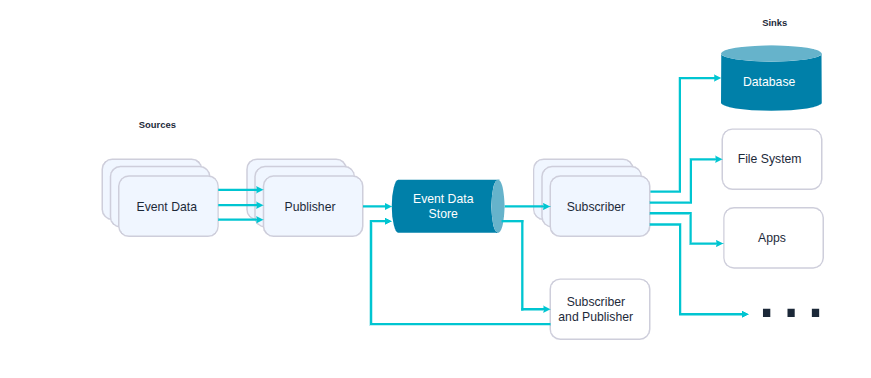
Event-driven architecture allows microservices to communicate by emitting and consuming events rather than making direct API calls. An event is a message that signals that something has occurred in the system. Services subscribe to events they care about and react accordingly, enabling asynchronous processing.
EDA offers several benefits, including loose coupling between services, better scalability, and real-time data processing. It also helps maintain consistency across distributed systems without blocking operations.
- Netflix: When a user plays a video, events trigger recommendations, analytics updates, and logging, all asynchronously.
- Uber: Booking a ride generates events for driver assignment, fare calculation, and customer notifications.
3.Core Patterns in Event-Driven Microservices:
Event Sourcing:
Event sourcing stores all changes to the application state as a sequence of events instead of just the current state.
This approach allows the system to reconstruct its state at any point in time and provides a full audit trail.
It improves reliability and traceability because you can replay events to understand past behavior or recover from failures.
Event sourcing is especially useful for systems with complex workflows or regulatory compliance requirements.
Example: Order status in an e-commerce system: created → paid → shipped → delivered.
CQRS (Command Query Responsibility Segregation):
CQRS separates the responsibilities of reading data (queries) and writing data (commands). This separation allows optimization of each side independently for better performance and scalability. Commands handle state changes, while queries provide fast, read-only access to data. CQRS is particularly effective in high-throughput systems where read and write workloads differ significantly.
Example: Payment service processes transactions (commands), while a reporting service handles queries for dashboards.
Event Streaming:
Event streaming involves the continuous flow of events through a distributed messaging system. It enables real-time data processing and immediate reactions to system changes. Event streaming ensures all services are synchronized and updated without polling or blocking calls. It also supports analytics and monitoring pipelines for business intelligence.
Example: Kafka streams updating analytics dashboards instantly based on user actions in an application.
4.Tools & Frameworks for Java:
Several frameworks support building event-driven microservices in Java, including Apache Kafka and Spring Cloud Stream.
- Apache Kafka is a distributed event streaming platform that decouples producers and consumers.
- Spring Cloud Stream provides abstractions to connect microservices to messaging systems like Kafka efficiently.
- Axon Framework simplifies building CQRS and event-sourced applications with prebuilt components.
Together, these tools enable robust, scalable, and maintainable event-driven microservice architectures.
Example:
An “OrderCreated” event published to Kafka can be consumed by inventory, notification, and analytics services independently.
5.How Event-Driven Microservices Work?
Event-driven microservices communicate asynchronously by producing and consuming events rather than relying on direct API calls.
For example, an Order Service handles customer orders and emits events like OrderCreated or OrderShipped.
Other services, such as Inventory and Notification, subscribe to these events and react automatically.
This ensures each service can operate independently, improving resilience and reducing tight coupling.
Conceptually, events act as a backbone for the system, keeping services synchronized without blocking operations.
Example Workflow:
– Notification service sends confirmation email.
– Customer places an order → OrderCreated event emitted.
– Inventory service updates stock in real-time.
6.Benefits and Challenges:
The primary advantage of event-driven microservices in Java is their ability to handle real-time data processing efficiently.
- Benefits: improved scalability, resilience, real-time processing, and independent service operation. They allow teams to develop, deploy, and maintain services separately without affecting the entire system.
- Challenges: managing duplicate events (idempotency), debugging distributed systems, and handling evolving event schemas. Despite these challenges, event-driven architectures are widely adopted for high-performance, large-scale systems.
Example:
Netflix processes millions of events per second; idempotency ensures users aren’t charged twice.
7.Real-World Use Cases:
Event-driven microservices are commonly used in systems that need real-time responsiveness and high scalability.
- E-commerce: orders, payments, and inventory services remain synchronized through events.
- Streaming platforms: user actions trigger recommendations, analytics updates, and logging in real-time.
- Ride-sharing apps: booking events automatically handle driver assignment, fare calculation, and notifications.
- EDA is also effective in banking, logistics, and IoT applications where timely updates are crucial.
Conclusions
Event-driven microservices provide a robust, scalable foundation for modern applications.
Using Kafka, CQRS, and event sourcing allows services to operate independently while staying synchronized.
Although challenges exist, such as event duplication and schema evolution, following best practices can mitigate them.
Hands-on practice with small projects is essential to fully grasp and master these concepts.
Adopting event-driven microservices in Java helps organizations create future-ready, scalable architectures.