



Introduction:
In today’s data-driven world, organizations are faced with the challenge of managing diverse and rapidly evolving data sets efficiently. Azure Cosmos DB emerges as a powerful solution, offering unparalleled scalability, global distribution, and multi-model capabilities for building modern, cloud-native applications. In this comprehensive guide, we’ll delve into the core concepts, features, and use cases of Azure Cosmos DB, empowering developers to harness the full potential of this cutting-edge database service.
Understanding Azure Cosmos DB:
Azure Cosmos DB is a globally distributed, multi-model database service provided by Microsoft Azure. It is designed to handle a wide variety of data types and workloads, including document, key-value, graph, and column-family data models. Let’s explore some key aspects of Azure Cosmos DB:
- Global Distribution: Azure Cosmos DB enables developers to replicate data across multiple regions worldwide, ensuring low-latency access and high availability for users across the globe. This global distribution model allows for seamless scaling and fault tolerance, making Azure Cosmos DB ideal for geo-distributed applications.
- Multi-Model Support: Unlike traditional databases that are limited to a single data model, Azure Cosmos DB supports multiple data models within the same database engine. This includes document databases (e.g., MongoDB), key-value stores (e.g., Redis), graph databases (e.g., Gremlin), and column-family stores (e.g., Cassandra), providing developers with flexibility and choice for storing and querying data.
- Scalability and Performance: Azure Cosmos DB is designed for horizontal scalability, allowing developers to scale throughput and storage resources independently based on application demand. It offers guaranteed low latency reads and writes, automatic indexing, and tuneable consistency levels, enabling high-performance, responsive applications at any scale.
- Global Consistency: Azure Cosmos DB provides configurable consistency levels to accommodate different application requirements. From strong consistency for transactional workloads to eventual consistency for read-heavy scenarios, developers can choose the appropriate consistency level based on their application’s needs while maintaining global data consistency.
- Built-in Security and Compliance: Azure Cosmos DB offers robust security features, including encryption at rest and in transit, role-based access control (RBAC), and compliance certifications such as HIPAA, GDPR, and SOC. This ensures that sensitive data is protected and that applications comply with regulatory requirements.
Sure, here’s a brief exploration of how to integrate Azure Cosmos DB into a .NET application:
Exploring Azure Cosmos DB for .NET Applications
Azure Cosmos DB provides developers with a robust and scalable NoSQL database solution that seamlessly integrates with .NET applications. Whether you’re building a web application, a microservice, or a mobile app, Azure Cosmos DB offers the flexibility and performance needed to handle diverse workloads.
To begin exploring Azure Cosmos DB in your .NET application, follow these steps:
- Create an Azure Cosmos DB Account: Start by creating an Azure Cosmos DB account in the Azure portal. Choose the API that best fits your application’s needs, such as SQL API, MongoDB API, Cassandra API, etc.
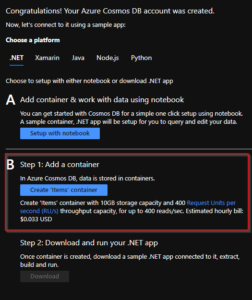
- Set Up Your Database and Containers: Once your Azure Cosmos DB account is created, configure your databases and containers. Containers are used to store your data, similar to tables in a relational database.

- Install the Azure Cosmos DB SDK: Install the Azure Cosmos DB SDK for .NET via NuGet. You can do this using the NuGet Package Manager in Visual Studio or by running the
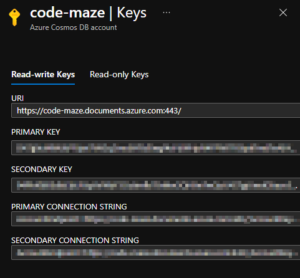
Install-Package Microsoft.Azure.Cosmoscommand in the Package Manager Console. - Connect to Azure Cosmos DB: Use the connection string provided in the Azure portal to connect your .NET application to Azure Cosmos DB. Initialize the Cosmos Client object with your connection string.
Use Cases and Applications:
Azure Cosmos DB is well-suited for a wide range of use cases and applications across industries. Some common use cases include:
- Global Web and Mobile Applications: Azure Cosmos DB enables developers to build web and mobile applications that require low-latency access to data from anywhere in the world. Whether it’s a social media platform, e-commerce site, or gaming application, Azure Cosmos DB provides the scalability and responsiveness needed to deliver seamless user experiences at global scale.
- IoT and Telemetry Data Processing: Azure Cosmos DB is ideal for ingesting, storing, and analysing large volumes of IoT and telemetry data generated by sensors, devices, and machines. Its ability to handle high velocity, high volume data streams in real-time makes it a powerful platform for IoT applications in industries such as manufacturing, healthcare, and transportation.
- Personalized Content Delivery: Azure Cosmos DB enables developers to deliver personalized content and recommendations to users based on their preferences, behaviours, and interactions. By storing and analysing user data in real-time, applications can dynamically adjust content and recommendations to enhance user engagement and satisfaction.
- Real-time Analytics and Insights: Azure Cosmos DB facilitates real-time analytics and insights by providing low-latency access to operational data and historical archives. Developers can leverage built-in analytics capabilities, such as Azure Synapse Link and Apache Spark integration, to derive actionable insights and drive data-driven decision-making.
Conclusion:
In conclusion, Azure Cosmos DB stands out as a leading choice for building modern, cloud-native applications that demand global scale, high performance, and flexible data modelling capabilities. With its unparalleled features, including global distribution, multi-model support, scalability, and security, Azure Cosmos DB empowers developers to innovate and deliver next-generation applications that drive business value and impact. Whether it’s powering global web and mobile applications, processing IoT data streams, delivering personalized content, or enabling real-time analytics, Azure Cosmos DB offers the flexibility and scalability needed to meet the evolving needs of today’s digital landscape. As organizations continue to embrace digital transformation and cloud-native technologies, Azure Cosmos DB remains at the forefront, empowering developers to build the applications of tomorrow, today.