


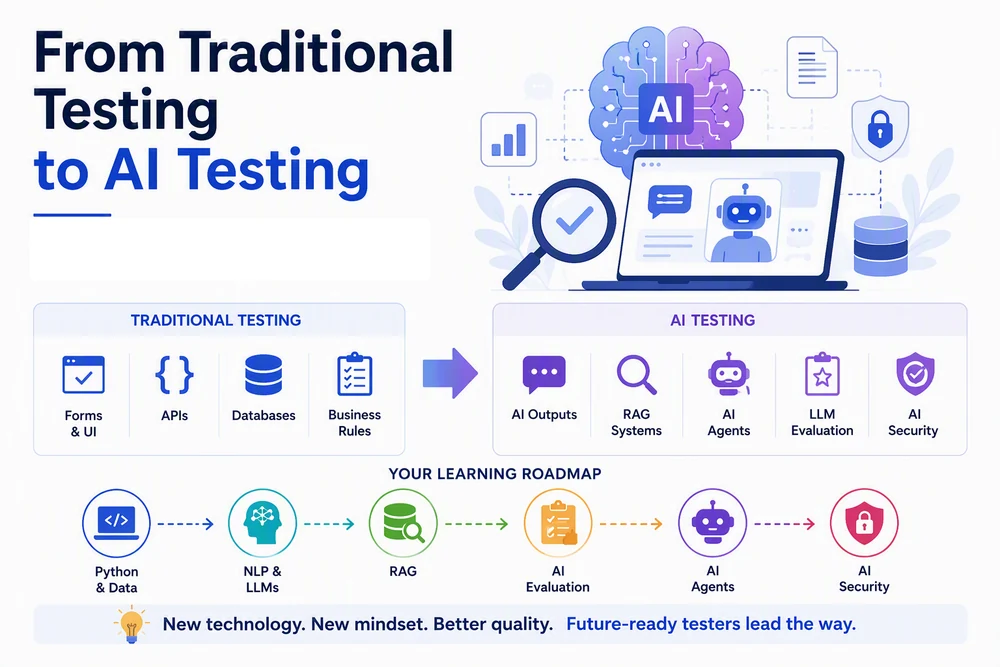
For years, testers focused on validating predictable systems. We tested forms, APIs, databases, integrations, and business workflows. Given a specific input, we expected a specific output. If the actual result matched the expected result, the test passed.
AI-powered applications introduce a completely different challenge.
Today, organizations are building AI chatbots, RAG-based knowledge assistants, AI copilots, autonomous agents, and intelligent automation systems. These systems do not always produce the same response for the same prompt. They reason, generate content, retrieve knowledge, call tools, and sometimes make decisions.
As a result, many testers are asking:
What should I learn to stay relevant in the age of Generative AI and AI Agents?
The good news is that testers do not need to become data scientists overnight. However, understanding how modern AI systems work has become increasingly important for anyone involved in software quality.
This article proposes a practical learning roadmap for testers who want to move from traditional testing toward AI testing.
Step 1: Build Strong Foundations
It’s tempting to jump straight into AI agents or the latest AI framework, but I found that having a solid foundation makes everything else much easier.
For testers, that foundation includes:
- Python basics
- JSON
- REST APIs
- Basic SQL
- Working with data
You don’t need to become a software engineer, but you should feel comfortable reading code, understanding API responses, and manipulating simple datasets. We should be comfortable with:
- Variables and data structures
- Functions and classes
- Reading and writing files
- APIs and JSON
- Basic data processing
Being able to create simple automation scripts will significantly accelerate learning later.
Step 2: Understand How LLMs Work
You don’t need to know how to train an AI model. You do need to understand why AI behaves the way it does. Learn the basics of:
- Machine Learning
- Transformers
- Large Language Models
- Tokens
- Temperature
- Context Window
These concepts explain why AI sometimes produces different answers for the same prompt and why hallucinations occur.
Step 3: Learn RAG Before AI Agents
If I had to recommend one AI topic for testers today, it would be RAG.
Most enterprise AI applications don’t answer questions from the model alone. They retrieve information from company documents, SharePoint, or databases before generating a response.
One thing that surprised me when testing a RAG application was that the answer looked correct, but one sentence wasn’t actually in the source document. From then on, I stopped evaluating only the final answer and started checking where the information came from.
If you want hands-on experience, you can build a small RAG application using a few PDF documents. Ask questions where the answers are:
- fully contained in the documents,
- partially contained,
- or not contained at all.
You’ll quickly see that testing retrieval is just as important as testing the generated response.
Step 4: Shift from Verification to Evaluation
This was probably the biggest mindset shift. Traditional software testing is mostly about verification. We compare the actual result with the expected result.
AI systems don’t always work like that. If you ask AI to generate a test strategy or review software requirements, there isn’t always a single correct answer. There may be several acceptable answers with different strengths and weaknesses.
Instead of asking:
Is this correct?
we often need to ask:
Is this good enough for its intended purpose?
This introduces new concepts such as:
- Evaluation datasets
- Golden datasets
- LLM-as-a-Judge
- Deterministic checks
- Human review
These approaches help us evaluate AI outputs more consistently.
Step 5: Learn AI Agent Testing
AI agents take AI one step further.
Unlike chatbots that simply answer questions, AI agents can plan tasks, call tools, retrieve information, generate code, and interact with business systems.
Testing an AI agent isn’t just about checking the final answer.
It’s also about understanding how the agent reached that answer.
For example:
- Did it create a reasonable plan?
- Did it select the correct tools?
- Did it retrieve the right information?
- Did it handle failures properly?
- Did it ask for approval before performing sensitive actions?
Testing an AI agent feels different because you’re evaluating both the outcome and the decision-making process.
Step 6: Don’t Forget Security
AI introduces risks that traditional applications don’t have.
In addition to common security testing practices, AI systems need to be evaluated for risks such as:
- Prompt injection
- Sensitive data exposure
- Unsafe tool usage
- Unauthorized actions
- Hallucinated or misleading information
These aren’t edge cases. They’re becoming common concerns in AI applications.
Step 7: Build Something
The fastest way to learn AI testing is through hands-on practice.
Consider building and testing projects such as:
- Internal document chatbots
- Knowledge assistants
- RAG search systems
- AI-powered test case generators
- Autonomous test execution agents
- Enterprise AI copilots
Practical experience will teach lessons that cannot be learned from books alone.
You will encounter challenges related to:
- Hallucination
- Grounding
- Evaluation
- Security
- Performance
- Agent behavior
These are exactly the skills organizations are beginning to demand.
Final Thoughts
Traditional testing skills remain valuable, but they are no longer enough on their own.
The future tester will need to understand how AI applications retrieve information, generate responses, make decisions, call tools, and interact with enterprise systems.