


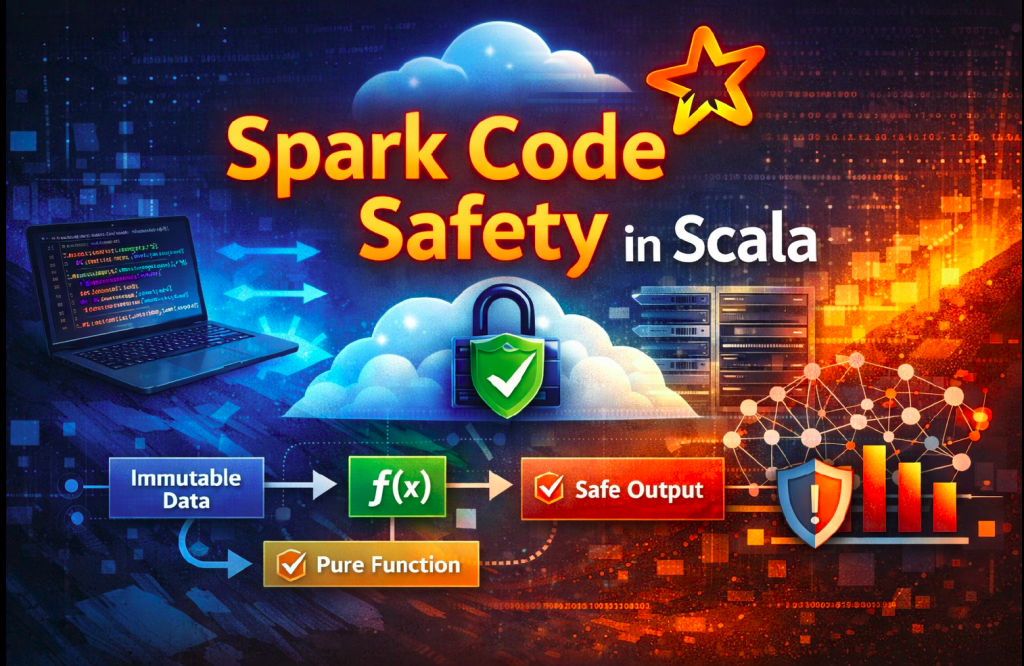
Apache Spark is powerful, but with great power comes great responsibility. When Spark applications grow in size and complexity, small mistakes can easily turn into hard-to-debug production issues. This is where functional programming in scala really shines.
Scala’s functional features help you write Spark code that is safer, more predictable, and easier to reason about, especially in distributed systems. Let’s break down why this matters.
Immutability and Spark Code Safety in Scala
In distributed systems like Spark, mutable state is dangerous. When multiple executors work in parallel, shared mutable data can lead to unexpected behaviour.
Scala encourages immutability by default. Instead of modifying existing data, you create new values.
val nums = List(1, 2, 3)
val doubled = nums.map(_ * 2)
Because data doesn’t change:
* No accidental overwrites
* No race conditions
* Easier debugging
In Spark, RDDs and DataFrames are already immutable, so Scala’s functional programming model fits naturally.
Pure Functions and Safer Spark Code Execution
A pure function always produces the same output for the same input and has no side effects
def square(x: Int): Int = x * xWhy this matters is spark:
* Spark can safely recompute tasks if they fail
* Retires don’t cause duplicate updates
* Logic remains consistent across nodes
This predictability is critical when Spark re-executes tasks during failures.
Safer Error Handling with option and either
Null values are a common source of runtime failures in Spark jobs. Scala gives you better tools.
Instead of:
val value: String = null
// use:
val value: Option[String] = Some("data")
// Or for error handling:
val result: Either[String, Int] = Right(42)
Benefits:
* No NullPointerException
* Errors handled explicitly
* Safer transformation in Spark pipelines
Higher-Order Functions Match Spark’s API
Spark APIs heavily rely on functions like map, flatmap, filter, and reduce.
Scala’s FP style makes these operations natural and expressive:
rdd
      .filter(_ > 10)
      .map(_ * 2)
      .reduce(_ + _)
This leads to:
* Less boilerplate code
* Clear data transformation pipelines
* Fewer logical bugs
Readable code is safer code.
No Shared State Across Executors
Functional programming discourages shared state. In Spark, this is extremely important because:
* Each executor runs in isolation
* Shared mutable state doesn’t behave as expected
FP forces you to think in terms of data transformations, not state changes, which aligns perfectly with Spark’s execution model
Better Fault Tolerance
Spark is fault-tolerant by design, but your code must be too.
Functional programming helps because:
* No hidden state
* Deterministic behaviour
* Safe recomputation of tasks
When a node fails, Spark can return tasks without worrying about a corrupted state.
Conclusion
Functional programming in Scala is not just a style preference – it’s a safety net for Spark applications.
By embracing immutability, pure functions, and explicit error handling, you write Spark jobs that are:
* More reliable
* Easier to understand
* Safer in production
If you’re building large-scale data pipelines with Spark, functional programming isn’t optional anymore – it’s a best practice
For more tech-related blogs, visit Nashtech Blog