




Overview
Welcome to the world of ReactJS, a powerful JavaScript library for building user interfaces. Whether you’re a seasoned developer or just starting your coding journey, ReactJS offers a robust framework for creating dynamic and interactive web applications. In this guide, we’ll walk you through the basics of ReactJS, provide code snippets for better understanding, discuss its advantages and disadvantages, explore common use cases, and help you kickstart your journey into the world of React.
What is ReactJS?
ReactJS, developed by Facebook, is an open-source JavaScript library used for building user interfaces, particularly for single-page applications. It allows developers to create reusable UI components and efficiently manage the state of these components. ReactJS follows a component-based architecture, where each UI element is treated as an independent, self-contained module.
Getting Started with ReactJS
Setting Up Your Development Environment
Before diving into ReactJS development, ensure you have Node.js and npm (Node Package Manager) installed on your system. Once installed, you can create a new React project using create-react-app, a command-line tool provided by Facebook.
npx create-react-app my-react-app
cd my-react-app
npm start
Understanding Components
In React, everything revolves around components. Components are reusable building blocks that encapsulate a part of the user interface. Here’s a simple example of a functional component in React:
import React from 'react';

function Welcome(props) {
return <h1>Hello, {props.name}!</h1>;
}

export default Welcome;
JSX Syntax
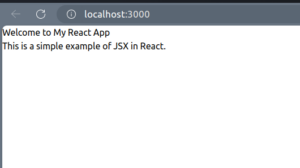
React uses JSX (JavaScript XML) to write UI components. JSX allows you to write HTML-like code within JavaScript, making it easier to visualize and understand the structure of your components. Here’s an example:
import React from ‘react’;
function App() {
return (
<div>
<h1>Welcome to My React App</h1>
<p>This is a simple example of JSX in React.</p>
</div>
);
}

export default App;

Sample output:
Managing State
State management is a crucial aspect of building dynamic UIs. React allows you to manage the component state using the useState hook. Here’s how you can use state in a functional component:
import React, { useState } from 'react';

function Counter() {
const [count, setCount] = useState(0);

return (
<div>
<p>Count: {count}</p>
<button onClick={() => setCount(count + 1)}>Increment</button>
</div>
);
}

export default Counter;
Advantages of ReactJS
- Component-Based Architecture: React promotes reusability and maintainability through its component-based architecture.
- Virtual DOM: React utilizes a virtual DOM, improving performance by minimizing DOM manipulation.
- Community and Ecosystem: React has a vast and active community and a rich ecosystem of libraries and tools.
- One-Way Data Binding: React’s one-way data flow simplifies state management and reduces the risk of bugs.
Use Cases for ReactJS
- Single-Page Applications (SPAs): React is well-suited for building SPAs that require dynamic updates without page reloads.
- Web Applications with Real-Time Data: Applications that rely heavily on real-time data, such as social media platforms and dashboards, benefit from React’s reactive nature.
- Cross-Platform Development: React Native, a framework based on React, allows developers to build mobile applications for iOS and Android using JavaScript and React principles
Conclusion
ReactJS revolutionized web development by offering a modern and efficient way to build interactive user interfaces. With its component-based architecture, JSX syntax, and efficient state management, React empowers developers to create scalable and maintainable applications. While React has its challenges, its numerous advantages and diverse use cases make it a compelling choice for front-end development.
Now that you’ve got a glimpse into the world of ReactJS, it’s time to roll up your sleeves, dive deeper, and unleash the full potential of this powerful library. Happy coding!
For more, you can refer to the React documentation: https://react.dev/learn
For a more technical blog, you can refer to the Nashtech blog: https://blog.nashtechglobal.com/