



Introduction
In today’s fast-paced software development world, DevOps has become crucial for organizations to deliver high-quality applications quickly and efficiently. Among the various tools available to streamline DevOps processes, Harness stands out as a powerful, AI-driven platform that’s changing the game. Let’s dive deep into what Harness is, why it’s gaining traction, and its key features.
What is Harness?
Harness is a comprehensive, AI-powered DevOps platform designed to simplify and accelerate software delivery. Founded in 2017 by Jyoti Bansal, the platform aims to address the complexities and challenges associated with modern software deployment and management.
At its core, Harness provides a suite of tools and services that cover various aspects of the DevOps lifecycle, including:
- Continuous Integration (CI)
- Continuous Delivery (CD)
- Cloud Cost Management
- Feature Flags
- Chaos Engineering
- Security Testing Orchestration
The platform leverages artificial intelligence and machine learning to automate many of the time-consuming and error-prone tasks in the software delivery process, allowing development teams to focus on innovation rather than operation
Why Should You Use Harness?
- Accelerated Time-to-Market: By automating deployment processes and reducing manual interventions, Harness helps organizations deploy software faster and more frequently.
- Reduced Risk: The platform’s intelligent rollback capabilities and canary deployments minimize the risk of failed deployments affecting end-users.
- Cost Optimization: Harness’s cloud cost management features help organizations optimize their cloud spend, potentially saving significant amounts on infrastructure costs.
- Improved Developer Productivity: By automating routine tasks and providing intuitive interfaces, Harness allows developers to focus on writing code rather than managing deployments.
- Enhanced Visibility: The platform offers comprehensive insights into deployment processes, making it easier to identify bottlenecks and areas for improvement.
- Scalability: Harness is designed to handle deployments of any scale, from small applications to large, distributed systems.
Key Features of Harness
Let’s explore some of the standout features that make Harness a powerful DevOps tool:
1. Continuous Delivery as-a-Service
Harness provides a robust CD solution that automates the entire deployment process. Key capabilities include:
- Pipeline Creation: Visual pipeline builder for easy creation and management of deployment workflows.
- Intelligent Deployments: Supports canary, blue-green, and rolling deployment strategies.
- Automated Rollbacks: AI-driven rollback capability that can automatically revert to the last known good state in case of failures.
- Multi-Cloud Support: Deploy to any cloud provider or on-premises infrastructure.
2. Continuous Integration
Harness CI offers a modern approach to building and testing code:
- Cloud-Native Architecture: Built on Kubernetes for scalability and flexibility.
- Parallel Execution: Run tests and builds in parallel to speed up the CI process.
- Caching: Intelligent caching mechanisms to reduce build times.
- Plugin Ecosystem: Extensive library of plugins for easy integration with various tools and services.
3. Cloud Cost Management
This feature helps organizations optimize their cloud spend:
- Real-Time Cost Visibility: Provides granular insights into cloud costs across different services and teams.
- Anomaly Detection: AI-powered detection of unusual spending patterns.
- Cost Forecasting: Predictive analytics to estimate future cloud costs.
- Recommendations: Actionable suggestions for optimizing cloud resource usage and spend.
4. Feature Flags
Harness’s feature flag management allows for controlled feature releases:
- Progressive Delivery: Gradually roll out features to specific user segments.
- A/B Testing: Easily set up and manage A/B tests for new features.
- Kill Switches: Quickly disable problematic features without redeploying.
- SDK Support: SDKs for various programming languages to easily integrate feature flags into applications.
5. Chaos Engineering
Harness Chaos Engineering helps improve system resilience:
- Scenario Management: Create and manage chaos experiments to test system behavior under stress.
- Automated Execution: Schedule and automate chaos experiments.
- Impact Analysis: Measure and analyze the impact of chaos experiments on system performance and reliability.
6. Security Testing Orchestration
This feature integrates security testing into the CI/CD pipeline:
- Automated Security Scans: Integrate and automate various security testing tools.
- Policy Enforcement: Define and enforce security policies as part of the deployment process.
- Vulnerability Management: Track and manage vulnerabilities discovered during the development process.
Getting Started with Harness
Harness simplifies the process of setting up CI/CD pipelines. To start using Harness, you can sign up for a free trial on their website. The platform offers a user-friendly interface and extensive documentation to help you get up and running quickly. Here’s a step-by-step guide to help you get started:
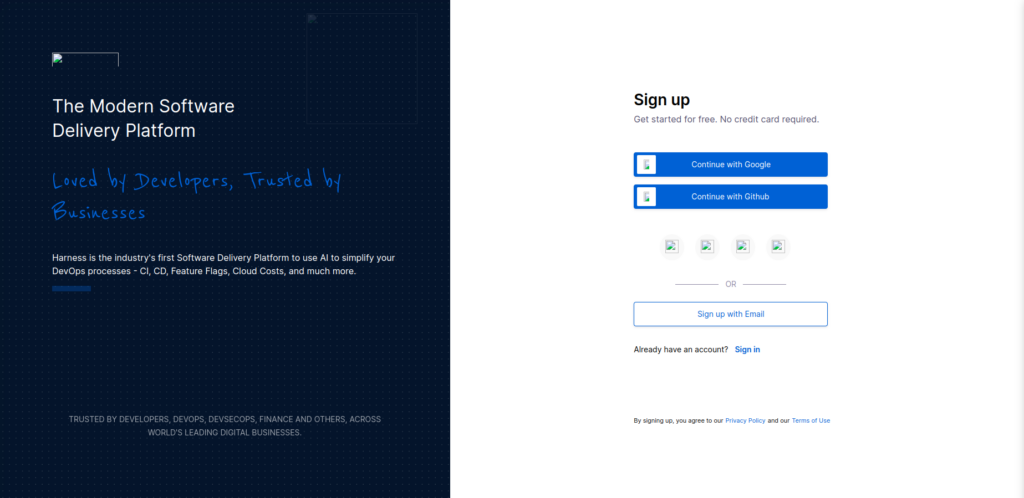
Sign Up and Setup
- Sign Up: Visit the Harness website and sign up for an account.
- Login: After signing up, log in to the Harness platform.
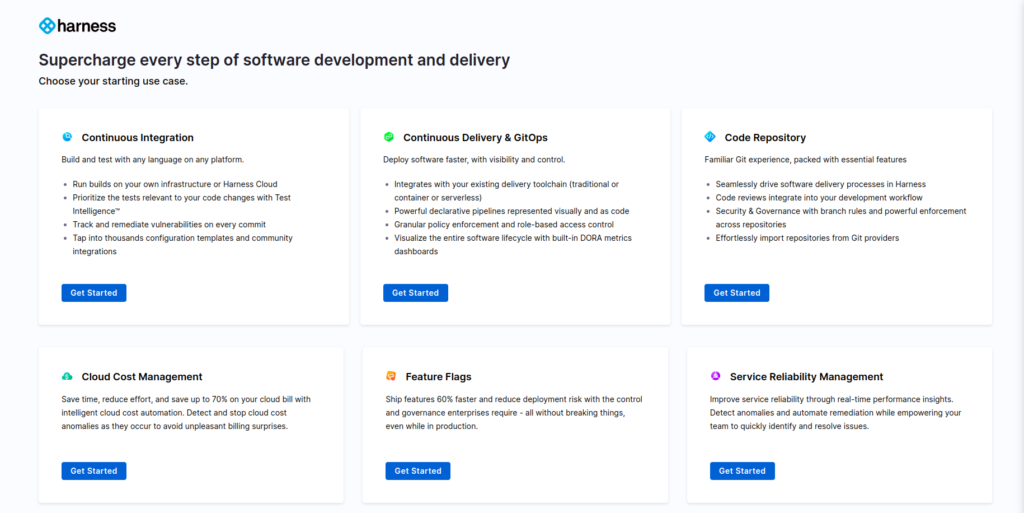
Choose Where to Start
Conclusion
Harness is a powerful, AI-driven DevOps platform that addresses many of the challenges faced by modern software development teams. By automating complex deployment processes, providing intelligent insights, and offering a comprehensive suite of tools, Harness enables organizations to deliver software faster, more reliably, and with greater efficiency. Whether you’re a small startup or a large enterprise, Harness can help streamline your DevOps practices and accelerate your software delivery. As the DevOps landscape continues to evolve, tools like Harness are likely to play an increasingly important role in shaping the future of software development and deployment. In the next blog we’ll see services of Harness in Action. Stay tuned!!