


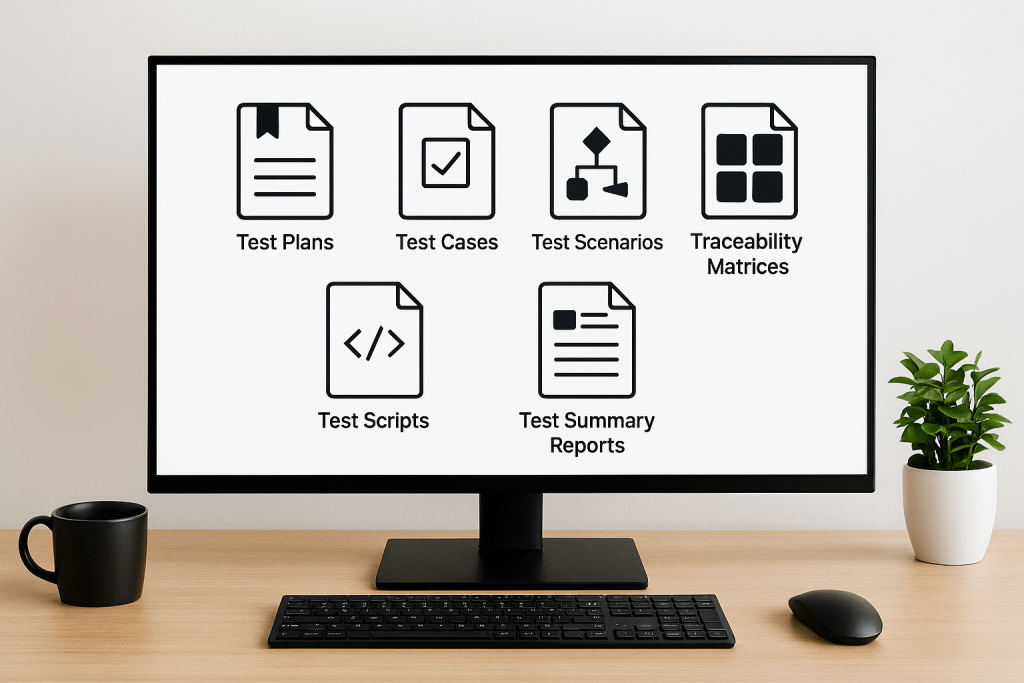
In fast, iterative delivery cycles, preparing test documentation isn’t just following process – it’s the operating system for quality. Done well, it preserves context between sprints, makes testing repeatable, and gives stakeholders auditable confidence.
1. Why Test Documentation Still Matters
Even with CI/CD and extensive automation, documentation remains the backbone of clarity, consistency, and compliance. It defines how you test, what you expect to happen, and how you’ll decide when risks are acceptable.
Standards bodies explicitly position documentation as outputs of defined test processes (not afterthoughts). ISO/IEC/IEEE 29119‑3, for example, provides adaptable, lifecycle‑agnostic templates so organizations can standardize without becoming rigid.
2. Practical reasons why it matters
- Knowledge retention – documents outlast team changes and keep context intact across releases.
- Clarity & alignment – shared artifacts prevent misinterpretation and keep product, engineering, and QA moving together.
- Repeatability – clear preconditions and expected results turn good intentions into reliable execution.
- Continuous improvement – structured reports capture outcomes, trends, and lessons to influence the next cycle.
- Traceability & auditability – requirements‑to‑tests mapping makes coverage visible and defensible.
3. Test Documentation Types
3.1 Planning and Strategy Documents
- Test Plan: A detailed document outlining the scope, objectives, methodology, schedule, environments, and resources required for the entire testing effort. It is typically prepared by the test lead or manager.
- Test Strategy: Describes the overall approach and techniques used for testing an application. It often complements the test plan.
- Test Policy: A high-level document defining the organization’s rules and principles for testing activities.
3.2 Specification Documents
- Test Scenario: High-level descriptions of potential user actions or application flows that need testing to verify functionality. They do not contain specific input data or navigation steps.
- Test Case: Detailed, specific steps and conditions used during testing to verify a particular functionality. Each test case includes a unique ID, preconditions, input data, steps to execute, and expected results.
- Test Script: Often used in automation, these are automated instructions written in a programming language to execute test cases.
- Requirement Traceability Matrix (RTM): A document that maps requirements to test cases to ensure that every requirement is tested and no functionality is missed.
- Test Data: The data required to execute the test cases, prepared before test execution begins.
3.3 Execution and Reporting Documents
- Test Log: A record that documents the actual results, execution status, and any observations during the test execution process.
- Bug/Defect Report: A document detailing issues found during testing. It includes information such as a unique ID, description of the bug, steps to reproduce it, severity level, status, and attached screenshots or logs.
- Test Execution Report: A summary prepared after the test execution phase is complete, providing an overview of testing outcomes, including the number of passed, failed, and blocked test cases, as well as overall project consistency.
- Test Summary Report: A final document summarizing all testing activities and results, used to determine if the software is ready for release.
4. Testing Templates
A shared structure means people write faster, reviewers scan faster, and tools integrate more predictably.
ISO/IEC/IEEE 29119‑3 includes formal, adaptable templates; using a lean version of these or using organization-wide template/project specific template creates consistency without sacrificing agility.
Below is the list of benefits:
- Consistency: the same sections in the same order reduce cognitive load for authors and reviewers.
- Minimize gaps: prompts for preconditions, data, risks, and expected results prevent “missing fields.”
- Smoothen onboarding process: new joiners learn one format instead of deciphering everyone’s style.
- Tooling synergy: predictable fields import cleanly into test management and reporting tools.
- Audit readiness: standardized artifacts reduce scramble before reviews and sign‑offs.
- Maintainability: uniform docs age better and are easier to refactor as the system evolves.
5. Best Practices for Writing Effective Test Documentation
- Be concise and relevant – Favor clarity over word count. Include only what improves execution or decisions; avoid duplication across artifacts.
- Tie docs to real user journeys – Prioritize critical flows (e.g., sign‑in, checkout). This maximizes signal and aligns with risk‑based testing.
- Keep docs living and version‑controlled – Update when requirements, UI, or APIs change. Treat documentation as a living asset, not a one‑off deliverable.
- Include evidence where it helps – Screenshots, logs, and links to build artifacts speed up triage and make outcomes credible.
- Right‑size to your context – In Agile, keep artifacts lightweight and collaborative; in regulated domains, align to formal templates and traceability expectations.
- Leverage your tooling – Encode templates in Confluence, manage cases in Jira/Xray, and auto‑generate execution and coverage reports where possible.
6. Common mistakes to avoid
- Over‑documenting – slows teams and becomes stale. Start lean and evolve based on usage.
- Under‑documenting critical paths – payments, authentication, and safety‑critical flows need explicit coverage.
- Delayed documents creation – plan and iterate alongside development and testing, not after the fact.
- Inconsistent formats and terminology – enforce shared templates and a common glossary.
7. Conclusion
Great test documentation isn’t about writing more—it’s about writing what matters, in a structure everyone understands. By standardizing on lean templates, linking coverage to real user journeys, and keeping artifacts alive in your toolchain, you’ll move faster with more confidence and be ready for audits, handovers, and scale.
References:
- ISO/IEC/IEEE 29119‑3:2021 – Software and systems engineering — Software testing — Part 3: Test documentation – https://www.iso.org/standard/79429.html
- IEEE 829 – Standard for Software and System Test Documentation – https://ieeexplore.ieee.org/document/4578383
- Atlassian Confluence – Test Plan template & guidance – https://www.atlassian.com/software/confluence/resources/guides/how-to/test-plan
- Atlassian – How to create and manage test cases with Xray and Jira – https://www.atlassian.com/devops/testing-tutorials/jira-xray-integration-manage-test-cases
- Atlassian Community – How to Write a Good Test Plan in 2025? – https://community.atlassian.com/forums/App-Central-articles/How-to-Write-a-Good-Test-Plan-in-2025/ba/p/3131998
- Atlassian Community – How To Build a Jira Test Case Template For Your Team – https://community.atlassian.com/forums/App-Central-articles/How-To-Build-a-Jira-Test-Case-Template-For-Your-Team/ba/p/2985515