



1. Browser Use
Browser automation used to mean brittle scripts. With Selenium or Playwright, every click follows a hard-coded selector like #submit-btn, and the whole flow breaks when a site changes its DOM IDs, CSS or layout.
Browser agents take a different approach. An AI agent drives a real browser to finish a task you describe in plain language. It clicks, types, navigates and pulls out data by itself. It uses an LLM plus vision to “see” the page as it loads. When the page changes, the agent looks again and adjusts instead of failing on a missing selector. It can also deal with pop-ups, changed modals and variations in the steps it wasn’t programmed for.
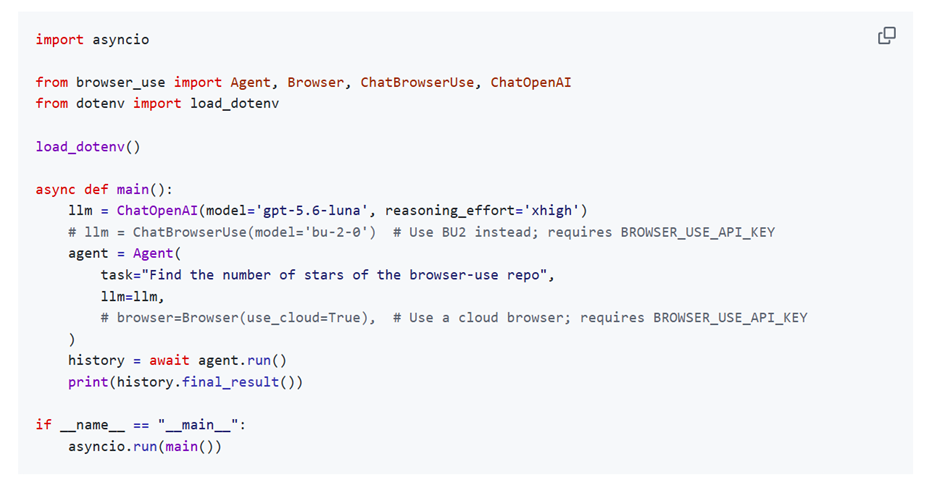
Browser Use is an open-source framework built around this idea: it gives an AI agent control of a real browser session.
Under the hood, every browser agent runs a loop with three stages:
- Perception: capture the page state from screenshots, the HTML DOM or the accessibility tree.
- Reasoning: an LLM compares the current page with the goal, picks the next step and recovers if a step fails.
- Action: send commands through Playwright, Puppeteer or browser extensions to click, type and extract data.
The loop repeats until the goal is met or the agent reports a blocker. The weak spot is reasoning. When a general chat LLM makes every decision, each step is slow and costly.
2. Jev, a model that decides instead of writing
Jev is a “System One” AI model from TypeSafe AI. It returns fast, structured, typed decisions and probabilities instead of generated text.
Decision-only by design. A standard LLM writes its answer word by word. Jev works more like a judge. You give it context (a state) and a set of typed questions, which can be choices, scores or yes/no binaries. It returns structured answers right away.
Built for speed and cost. A call takes about 70–500 ms. That makes Jev much faster and cheaper than chat LLMs for classification and routing.
Three examples of where this matters:
- Model routing: in a coding agent, Jev scores how hard each request is almost instantly. Simple lookups and extraction go to a small, cheap model, and complex architecture or logic tasks go to a stronger one. That saves a lot on running costs and adds almost no delay.
- Guardrails for tool calls: when an agent runs tools on its own, the biggest risk is a destructive command, such as deleting a database, dropping a table or overwriting system files. Asking a normal LLM whether a command is safe stalls the flow for several seconds. Jev can sit in the middle and classify the risk in about 0.1 s, blocking high-risk calls before they run.
- Model as a judge for evals: using an LLM as a judge over thousands of test cases burns tokens and takes a long time. Jev scores against a rubric quickly and cheaply. Its scores are also more consistent than judgments read out of LLM text.
3. Jev Ultrafast = Browser Use + Jev
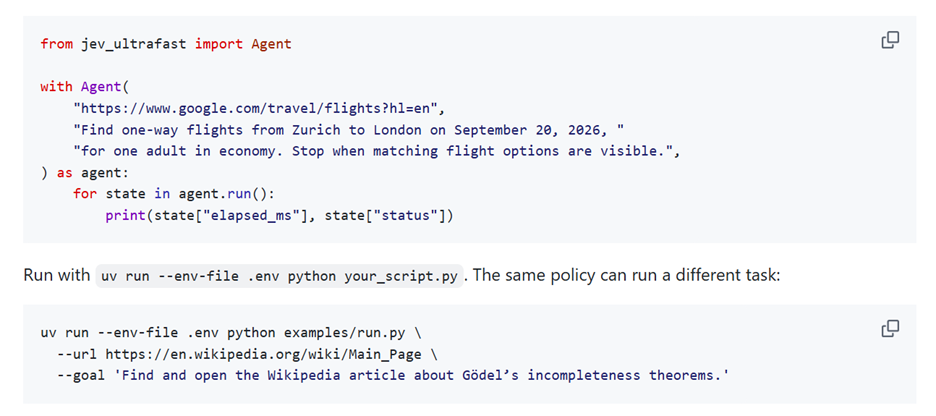
Jev Ultrafast splits the work between the two. Browser Use handles perception and action in the browser, and Jev makes the decisions.
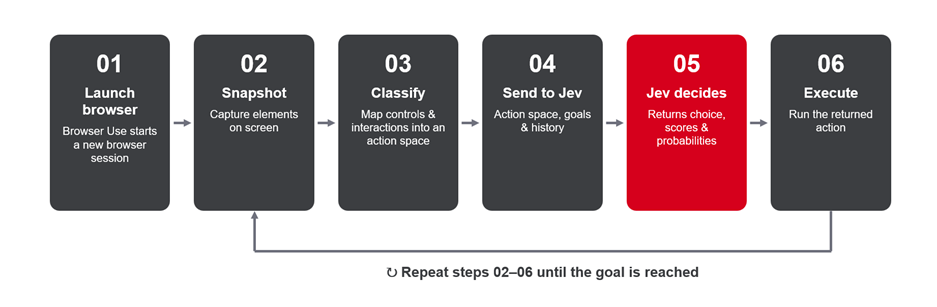
This design turns the question “what do I do next?” into a structured multiple-choice problem, which is exactly the kind of task Jev is built for. At roughly 70–500 ms per decision instead of a full LLM generation, each loop step gets much faster and cheaper. The scores and probabilities are also useful on their own: a low-confidence step can trigger a retry, a fallback to a larger model, or a safety check, the same way Jev is used for routing and guardrails.
Conclusion
Browser agents made web automation flexible, and Jev Ultrafast aims to make it fast. Browser Use sees and acts on the page, and Jev picks the next move in milliseconds with a clear confidence score for each decision. The result is a browser agent that is quicker, cheaper and easier to control than one that has a chat LLM reason about every click.
Referal: