


I. From Silicon Limits to Biological Potential
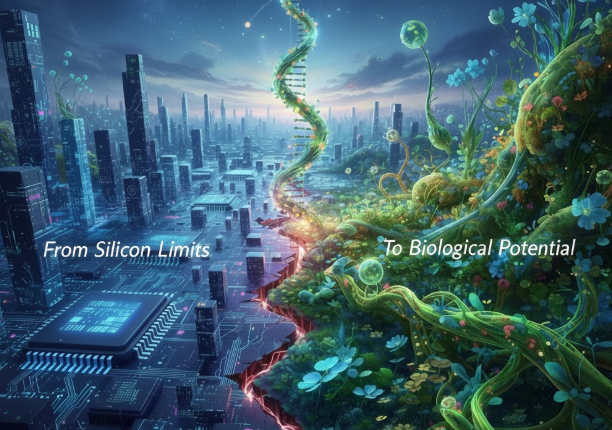
For decades, silicon has been the backbone of the computing revolution. It powered the rise of faster and faster processors, the observation that the number of transistors on a chip doubled roughly every two years. But that golden era is reaching its physical limits. As silicon transistors shrink to the scale of just a few atoms, they start running into serious problems. Quantum tunneling makes them unstable, and pushing for higher performance demands enormous amounts of energy while generating excessive heat. This drives up cost, strains data centers, and limits how far we can keep scaling traditional supercomputers.
The bottlenecks in speed, size, and energy efficiency are pushing the tech industry toward a new frontier: Biological Computing. Instead of continuously shrinking artificial components, this approach taps into biological mechanisms at multiple levels to process information. Early research explored molecules and cells — using DNA for extremely dense data storage and bacteria to build simple biological logic gates. But to achieve truly exceptional performance, the focus has shifted to the most efficient “hardware” evolution has ever produced: the human brain, which processes information with energy efficiency millions of times better than today’s top supercomputers.
This shift isn’t just about new material considerations, but primarily about a fundamental change in architecture itself – from traditional circuits to brain-inspired neural structures. While Von Neumann-style architectures continue to handle sequential processing, the industry is increasingly augmenting these designs with flexible, high-efficiency neural architectures capable of adaptation, opening the door to systems that are not only more powerful, but also vastly more energy – efficient and capable of learning and adapting the way brains work.
II. The Biological Computing Paradigm
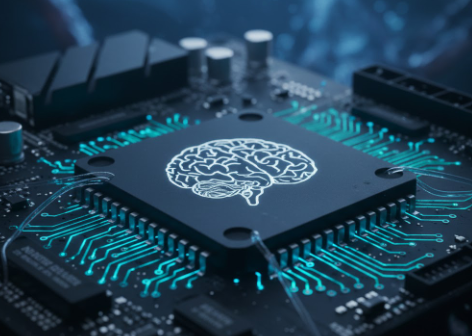
Biological Computing represents a fundamental shift in how we think about computation. Instead of relying solely on man-made materials and linear architectures, this paradigm draws inspiration from living systems-systems that evolved over millions of years to process information with extraordinary efficiency, adaptability, and resilience. At its core, Biological Computing explores how the mechanisms of life at different scales – molecular, cellular, and neural – can be used to build new forms of computation that go far beyond what silicon can offer.
This field has already gone through two early phases: the molecular level – with DNA computing enabling ultra-dense data storage, and the cellular level – where synthetic biology has been used to create simple biological logic gates. But to achieve truly advanced computational intelligence, the momentum today is moving toward a third level: the Neural level. And at this level, researchers are turning directly to the most energy-efficient information-processing system on the planet: the human brain.
As the field evolves, the spotlight is increasingly shifting toward the Neural level – a direction that many researchers now see as the most promising frontier in Biological Computing. Rather than simulating the brain, this emerging paradigm explores how the principles – and even the materials – of biological intelligence might be used to solve problems that silicon-based architectures struggle with. It hints at a future where computation becomes not only more powerful, but fundamentally more capable of learning, adapting, and reasoning in dynamic environments. Building on these breakthroughs, the following sections will suggest the possibility of systems that operate with a form of biological intelligence, setting the stage for what will soon be explored as Organoid Intelligence.
III. Organoid Intelligence (OI) & Trigger
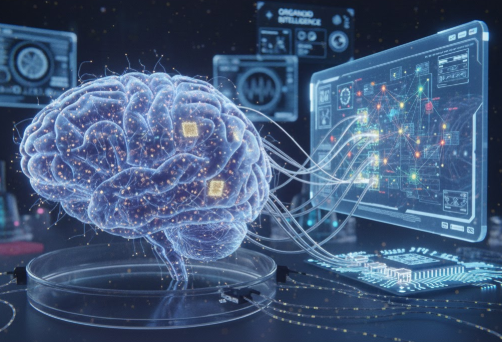
OI is an emerging field at the intersection of computer science and biology, involving the use of brain organoids—tiny tissue cultures grown from stem cells that embody the structure and function of the brain – to perform information processing, learning, and decision – making tasks.
The next trigger to consider: how is OI actually made operational ?

The answer lies in the Neural Level (by the Biological Computing Paradigm), which serves as the ultimate enabler for OI, surpassing the limitations of earlier molecular and cellular approaches. This stage provides the critical infrastructure needed to transform organoids from passive biological tissue into active, programmable, learning-capable processors.
Two key components make this possible:
- Living Hardware – the creation of brain organoids that can self-organize and exhibit intrinsic synaptic plasticity, allowing them to adapt and learn like biological neural networks.
- Operational Bridge – the development of neuro-electrical interfaces that enable bidirectional communication, allowing researchers to both stimulate (input data) and monitor (read output) organoid activity.
It is the convergence of Living Hardware and the Operational Bridge that activates Organoid Intelligence, formally bringing OI online as a functional system within the computing landscape.
IV. Integrating OI within the Biological Computing Paradigm
1. Operation and Preservation of OI

This is a crucial aspect, which involves the life support mechanisms of a biological computer. Its main goal is to maintain the viability and computational function of the organoid. Achieving this requires a delicate integration of advanced cellular biology techniques with precise electronics engineering. Without it, the “processor” would die or operate unpredictably, rendering any computation meaningless.
To achieve this dual objective, the process can be divided into two closely related aspects:
– Operation and Communication – This aspect focuses on how we interact with the living processor:
+ Organoid Cultivation: Pluripotent stem cells are differentiated into neurons to form 3D mini-brain tissues (organoids). This forms the “hardware” capable of learning.
+ Electronic Communication: Organoids are placed on a Multi-Electrode Array (MEA). The electrodes serve two main functions:
- Input: Deliver electrical pulses or light (via optogenetics) as data or stimulation signals (“training”) to the organoid.
- Output: Capture the electrical activity emitted by neurons, representing the computational results of OI.
– Preservation and Life Support – This aspect focuses on protecting and sustaining the living processor:
+ Cultivation Environment: Organoids must be maintained at 37°C with a continuous supply of nutrient-rich solution, containing oxygen, glucose, and growth factors – essentially mimicking cerebrospinal fluid.
+ Microenvironment Control:
- Avoid Contamination: The environment must remain fully sterile to prevent bacterial or fungal infections.
- Maintain Plasticity: OI must be continuously “activated” and “trained” to preserve its learning and adaptive capabilities (neuroplasticity) and prevent functional degradation.
2. OI as the Neural Processing Core
This is the aspect that focuses on how its inherent biological activity is converted into measurable computational capacity. The core objective is to understand and exploit the way living brain cells process data, which fundamentally differs from traditional silicon methods.
– Neuronal Computation Capacity: Defining the Living Unit of Thought:
Researchers are grappling with a critical question: What constitutes the “unit of computation” in a living brain? Unlike the rigid 0s and 1s of digital systems, the OI core computes based on network dynamics. Key metrics being actively explored include:
+ Associative Memory: This is the brain’s unique ability to link pieces of information. Instead of relying on fixed storage addresses (like a hard drive), OI connects data contextually. For instance, the system might recall an entire complex sequence after receiving only a minute trigger—a capability for optimized learning and pattern recognition far superior to conventional AI.
+ Computational Throughput: The ongoing effort here is to measure the speed and volume of data an Organoid can handle within a given time. Given that the system is massively parallel (millions of neurons firing simultaneously), its potential for high performance at extremely low energy consumption is immense.
– Temporal Coding: The Language of the Neural Network:
This describes the brain’s unique method of encoding information, which is vastly more complex than simple signal states:
+ The Brain’s Timing: While silicon primarily processes data based on value (on/off), the brain is highly sensitive to timing and pattern. The neural network is concerned not just with which neurons fire, but when they fire and in what specific sequence (pattern).
+The Implication: A rapid sequence of spikes (temporal coding) might represent entirely different information than the same sequence occurring slowly. Deciphering these complex temporal patterns is the essential key to truly understanding, programming, and unlocking the inherent intelligence contained within the OI core.
3. Hybrid Bio–Silicon Co-Processing
This is the magic aspect of Bio-Silicon Co-Processing Technology, leveraging specialized hardware to communicate with the living core:
– Input and Encoding: Digital data—the language of our current world—is first received and pre-processed by a Neuromorphic Chip. This chip, designed to mimic the architecture of the biological brain, then encodes the data. It translates the digital signals into precise electrical pulses or specific biochemical stimulation signals and sends them through the MEA into the OI neural network.
– Intelligent Processing (OI Core): The OI takes over the heavy intellectual lifting. It computes by constantly changing and strengthening its synaptic connections (a process known as Synaptic Plasticity). This allows the OI to demonstrate complex learning and pattern recognition with unparalleled energy efficiency—a task where dedicated chips are often limited.
– Learning and Feedback (Hybrid Reinforcement Learning – HRL): The Neuromorphic Chip acts as the crucial Evaluator and Instructor. It continuously monitors the OI’s response. If the biological output leads to a correct result, the Neuromorphic Chip immediately sends a “reward signal” (usually a targeted electrical pulse) back through the MEA. This signal specifically triggers the biological mechanism within the OI to reinforce the correct neural connection, thereby facilitating true, organic learning.
4. Output and Application
This is the aspect of converting living computation back into useful digital information (translating Brainwaves into Data):
– Biological Output: The OI delivers its answer in the form of complex electrical firing patterns. This is the literal language of the biological brain, encoded across time and space.
– Decoding and Post-processing: The Neuromorphic Chip steps in once more. It reads these complex electrical patterns via the MEA. Specialized decoding algorithms are then used to translate these temporal (time-based) and spatial patterns into meaningful digital data (e.g., a prediction, a complex decision, or a solved AI query).
In summary: Organoid Intelligence operates within a closed bio-digital loop, in which the living neural network is maintained on an MEA and learns through temporal coding, while the neuromorphic chip serves as the intermediary interface that converts digital and biological signals, supervises and reinforces learning, and decodes biological outputs into actionable digital data.
V. Potential Applications
1. Biological AI Systems
Running AI on Real Brain Matter:
– The Core Idea: We are moving beyond merely simulating the brain on silicon chips. Instead, we can now run AI directly on the brain’s biological matter—the Organoid.
– The Potential: These systems aren’t limited by clock speed or rigid linear architecture. They learn through genuine Synaptic Plasticity, enabling massively distributed, highly adaptable, and incredibly powerful information processing, just like a real brain. In essence, AI is no longer mimicking the brain – it’s running on it.
2. Drug Testing & Brain Embodiment
– The Problem: Testing drugs for neurological diseases (like Alzheimer’s or Parkinson’s) on animal models is often ineffective because animal brains don’t accurately replicate human responses.
– The OI Solution: An Organoid is a small, 3D structure of human brain tissue. It reacts to drugs and diseases exactly like the real human brain would. This creates a perfect, miniature “test brain.”
– The Impact: This technology allows us to accurately predict the efficacy and toxicity of new drugs before clinical trials, radically revolutionizing drug development and speeding up cures.
3. Cognitive Robotics
Making Robots Truly Smart:
– The Current Gap: Today’s robots rely on Artificial Neural Networks (ANNs), which require massive datasets and are inflexible when encountering unknown situations.
– OI-Powered Robots: Imagine a robot with a living processing core (OI Core). Thanks to synaptic plasticity, the OI enables the robot to learn faster, understand its environment better, and make nuanced, complex decisions in real-time, far surpassing current ANN capabilities.
4. Ultra Low-Energy Intelligence
The Ultimate Green Computing:
– The Efficiency Miracle: The human brain runs on about 20 Watts to perform the most complex tasks – an impossible feat for modern supercomputers, which require megawatts.
– The OI Potential: Biological processors (OI) can perform complex AI tasks (like voice recognition or visual processing) using only a few milliwatts (mW) of power.
– Real-World Use: Future laptops, smartphones, and Edge Computing devices could feature these “biological processors” for AI tasks, dramatically extending battery life and reducing heat generation.
5. Novel Learning Algorithms
Unlocking New AI Secrets:
– Learning from the Source: One of the most significant byproducts of OI research is the opportunity to directly observe how living neural networks learn.
– The Breakthrough: By studying how Organoids utilize Temporal Coding (the timing of neural firing) and Synaptic Plasticity, computer scientists can create entirely new, bio-inspired machine learning algorithms that are inherently more efficient and powerful than current ANN frameworks.
6. Personalized Medicine
Your Own Test Brain:
– The Unique Advantage: Organoids don’t have to be grown from generic stem cells. They can be created from the stem cells of an individual patient.
– The Benefit: This creates a truly personalized “brain replica.” Doctors can test different drugs and treatments directly on the patient’s own Organoid to see the exact reaction, leading to highly effective and unique personalized treatment plans.
VI. Challenges

1. Technical Challenges
The commercial viability of OI is primarily hindered by fundamental technical hurdles related to living matter. The first critical issue is Stability and Reproducibility: because Organoids are living tissue, biological variability between batches makes it nearly impossible to guarantee consistent computational results. The second major hurdle is Scalability: current manual culturing methods are costly and difficult to adapt for the massive production volumes (millions of units) required for industrial-scale Bio-Cloud Architectures. Furthermore, Biological Degeneration (cell death due to nutrient deprivation in the core tissue) significantly limits the Organoid’s functional lifespan, demanding urgent innovation in vascularization techniques. Finally, Data Interface Quality remains a challenge, requiring the development of advanced 3D MEAs to accurately capture signals deep within the tissue.
2. Ethical and Societal Challenges
The ethical challenges surrounding OI are profound and unavoidable . The central concern is The Consciousness Frontier: as OI grows more complex and capable of memory and learning, there is an inherent risk that it could cross a threshold into a form of rudimentary sentience. The scientific community must urgently establish clear Ethical Frameworks and define the moral status of these structures. Beyond this, Personalized Data Security is critical: since Organoids can be created from a patient’s own stem cells, they become a living biological data replica, posing unprecedented risks to privacy and demanding new legal and encryption standards to protect this unique form of personal genetic and computational information.
VII. Conclusion
As we push for faster computing, traditional silicon is starting to hit its physical limits. This challenge is pushing us toward Biological Computing Paradigm, which takes advantage of the brain’s incredible energy efficiency and ability to adapt. At the forefront of this shift is OI – 3D brain tissue used as a living processing unit. OI could break past silicon’s limits by delivering vastly greater energy efficiency and genuinely adaptive learning, moving us beyond simulating intelligence to actually harnessing living biological intelligence.
The future of computing will be defined by Bio-Hybrid Systems, redefine computing, achieving a seamless merge between the biological and digital worlds. The goal is to maximize the unique contributions of biology – namely superior intelligence and energy efficiency – while utilizing digital technology to provide the complementary strengths of speed, reliability, and practical communication. This powerful bio-hybrid architecture connects the OI Living Core with its specialized interface. It manages two – way signal conversion: encoding incoming digital data into the electrical signals needed to ‘train’ the organoid, and subsequently decoding the complex biological output back into usable data. This symbiotic relationship ensures that all high-level cognitive work (such as pattern recognition and complex decision-making) is handled by the highly efficient biological core, while the digital interface maintains speed, control, and necessary real-world connectivity
This convergence of OI and Biological Computing Paradigm is set to unleash a new generation of AI that learns faster, adapts instantly, and runs on minimal power, revolutionizing fields from personalized medicine and cognitive robotics to sustainable edge computing. While significant challenges—like scaling production and addressing profound ethical questions about biological sentience – remain, the shift to Biological Hybrid computing represents a pivotal moment, harnessing the best of both nature and engineering to fundamentally redefine what a computer can be.
References
https://www.sciencealert.com/computers-made-from-human-brain-tissue-are-coming-are-we-prepared
https://www.sciencedirect.com/science/article/pii/S294992162500002X