



Introduction
In today’s digital landscape, understanding the user journey and leveraging UX metrics are critical components to designing successful digital experiences. From initial awareness to cultivating long-term loyalty, each stage of the user journey presents unique challenges and opportunities. In this comprehensive guide, we’ll explore the key stages of the user journey, dive into essential UX metrics, and discuss how to apply them effectively to optimize user experience, while considering factors such as actions, touchpoints, user thoughts, user emotions, and process ownership.

Understanding the User Journey
The origin of User Journey
The concept of the user journey originates from the field of user experience (UX) design and has its roots in human-centered design principles. While there isn’t a single definitive source for the user journey concept, it has evolved over time through contributions from various disciplines such as psychology, marketing, and design.
One of the earliest mentions of the user journey can be traced back to the field of service design, where it was used to map out the sequence of interactions between users and service providers. This approach aimed to understand the holistic experience of users as they engage with a service from beginning to end.
In the realm of UX design, the user journey gained prominence as a tool for understanding and visualizing the steps that users take when interacting with a digital product or service. Designers use techniques such as journey mapping to document these steps, along with user emotions, pain points, and touchpoints along the way.
The user journey concept has since become a fundamental aspect of UX design methodology, guiding designers in creating seamless and intuitive experiences for users across various platforms and devices. It emphasizes the importance of empathy, user research, and iterative design in crafting products and services that meet the needs and expectations of users.
While the exact origins of the user journey concept may be difficult to pinpoint, its widespread adoption and integration into UX design practices highlight its significance in shaping the way designers approach the design process and prioritize user-centricity.
What is User Journey
The user journey refers to the series of steps or touchpoints a user goes through when interacting with a product or service. It encompasses the entire user experience, from the initial discovery phase to post-interaction engagement. By mapping out the user journey, designers gain valuable insights into user needs, motivations, and pain points at each stage of interaction. This understanding enables them to create seamless and intuitive experiences that cater to user expectations and enhance overall satisfaction.
Key Phases of the User Journey

Discovery: The user becomes aware of the product or service, often through marketing channels, word-of-mouth, or online searches.
Exploration: The user explores the features, benefits, and offerings of the product or service, seeking information to inform their decision-making process.
Decision: The user makes a decision to engage with the product or service, based on factors such as usability, relevance, and value proposition.
Interaction: The user interacts with the product or service, completing tasks, achieving goals, and experiencing the core functionality.
Post-interaction: The user reflects on their experience, provides feedback, and may engage in further interactions or actions based on their satisfaction level.
How to define a user journey
User persona and scenarios
First, define the user profile and scenarios:
- User Persona: Profiles representing the characteristics, needs, and preferences of target users.
- Scenarios: Situations depicting the user demand.
Deepen into each phase
Second, define the user’s expectation, feeling and behaviour in each phase. Here is one way to do:
Phase 1: Awareness
During the awareness phase, users become acquainted with a product, service, or brand. Key elements to consider include:
- Specific Scenarios: Hypothetical situations depicting how users may first encounter the product or service.
- Actions: Initial interactions with marketing materials, advertisements, or word-of-mouth recommendations.
- Touchpoints: Channels through which users first encounter the product or service, such as social media, search engines, or referrals.
- User Thoughts: Curiosity, interest, or skepticism about the product or service.
- User Feelings: Excitement, intrigue, or indifference toward the brand or offering.
- Process Ownership: Marketing teams or external partners responsible for generating awareness.
Example: A new fitness app launches a targeted advertising campaign on social media platforms. By tracking user engagement with ads, click-through rates, and website visits, the app evaluates the effectiveness of its awareness-building efforts.
Phase 2: Consideration
In the consideration phase, users actively explore and evaluate different options before making a decision. Key elements to consider include:
- Specific Scenarios: Further scenarios depicting users’ research and evaluation process.
- Actions: Researching product features, comparing prices, reading reviews, or seeking recommendations.
- Touchpoints: Product pages, review websites, forums, or social media communities.
- User Thoughts: Comparing alternatives, weighing pros and cons, or seeking validation.
- User Feelings: Confidence, uncertainty, or excitement about potential choices.
- Process Ownership: Product teams, customer support, or sales representatives guiding users through the decision-making process.
Example: A consumer considers purchasing a new smartphone. They research specifications, read reviews, and compare prices across different online retailers before making a decision.
Phase 3: Decision
During the decision phase, users make a final decision to purchase or engage with a product or service. Key elements to consider include:
- Specific Scenarios: Scenarios depicting users’ decision-making process and final actions.
- Actions: Adding items to a shopping cart, completing a purchase, or signing up for a subscription.
- Touchpoints: Checkout pages, payment gateways, confirmation emails, or account creation forms.
- User Thoughts: Assessing value, justifying the expense, or committing to a choice.
- User Feelings: Satisfaction, relief, or anticipation of the product or service.
- Process Ownership: Sales teams, customer service representatives, or account managers facilitating the transaction.
Example: A user decides to subscribe to a streaming service after comparing subscription plans, exploring content libraries, and evaluating user reviews.
Phase 4: Service
After users have engaged with a product or service, the service phase focuses on delivering a seamless and satisfying experience. Key elements to consider include:
- Specific Scenarios: Scenarios depicting users’ interactions with the product or service post-purchase.
- Actions: Using the product or service, seeking support, providing feedback, or sharing experiences.
- Touchpoints: Product interfaces, customer support channels, feedback forms, or social media interactions.
- User Thoughts: Assessing performance, troubleshooting issues, or suggesting improvements.
- User Feelings: Satisfaction, frustration, or delight with the overall experience.
- Process Ownership: Customer support teams, product development teams, or community managers responsible for maintaining user satisfaction.
Example: A user encounters a technical issue with a software application and reaches out to customer support for assistance. The support team promptly addresses the issue, providing guidance and resolving the problem to the user’s satisfaction.
Phase 5: Loyalty
The loyalty phase focuses on fostering long-term relationships and repeat engagements with users. Key elements to consider include:
- Specific Scenarios: Scenarios depicting users’ ongoing interactions and loyalty-building efforts.
- Actions: Continued usage, repeat purchases, referrals, or advocacy.
- Touchpoints: Loyalty programs, exclusive offers, personalized recommendations, or community forums.
- User Thoughts: Assessing value over time, identifying with the brand, or recommending to others.
- User Feelings: Loyalty, trust, or attachment to the brand or offering.
- Process Ownership: Loyalty program managers, brand ambassadors, or user experience teams focused on retention and engagement.
Example: A loyal customer of an e-commerce platform regularly makes purchases, participates in loyalty programs, and recommends the brand to friends and family members.
Understanding Essential UX Metrics
UX metrics offer actionable insights into user satisfaction, engagement, and behavior.

Examples of UX metrics and their significance:
- First Impression Score (FIS): FIS measures users’ initial impressions of a product or service, evaluating the ease of onboarding and the clarity of the value proposition. Example: Airbnb’s seamless booking process and visually appealing listings contribute to a high FIS, enticing users to explore further.
- User Engagement Rate (UER): UER tracks users’ interaction and engagement with a product or service over time, encompassing metrics such as daily active users (DAU) and session duration. Example: Slack’s intuitive messaging features and integrations maintain a high UER, fostering continued engagement among users.
- Churn Rate: Churn rate measures the percentage of users who stop using a product or service over a specific period, indicating user retention and satisfaction. Example: Spotify’s personalized playlists and curated recommendations minimize churn rate, ensuring long-term user loyalty.
- Sentiment Analysis: Sentiment analysis evaluates users’ emotional responses and perceptions towards a product or service, analyzing feedback, reviews, and comments. Example: Amazon conducts sentiment analysis on customer reviews to gauge overall satisfaction and identify areas for improvement.
A Case Study
Let’s apply the above knowledge in a small case study.
UX Scenario
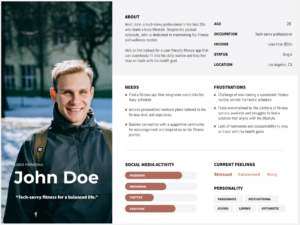
Meet John, a tech-savvy professional in his late 20s who leads a busy lifestyle. Despite his packed schedule, John is dedicated to maintaining his fitness and wellness routine. He’s on the lookout for a user-friendly fitness app that can seamlessly fit into his daily routine and help him stay on track with his health goals.
User Persona
- Name: John
- Age: Late 20s
- Occupation: Software Developer
- Location: Urban area
- Interests: Fitness, Technology, Nutrition
- Daily Routine: John starts his mornings with a workout and values tools that help him optimize his fitness regimen, even with his demanding work schedule.
Simple Motto: “Tech-savvy fitness for a balanced life.”
Goals and Expectations:
- Find a fitness app that integrates easily into his busy schedule.
- Access personalized workout plans tailored to his fitness level and objectives.
- Connect with a supportive community of fitness enthusiasts for encouragement and inspiration.
Frustrations:
- Challenge of maintaining a consistent fitness routine amidst his hectic schedule.
- The plethora of fitness options available and struggles to find a solution that aligns with his lifestyle.
- A lack of motivation and accountability to stay on track with his health goals.
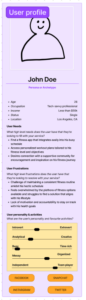
Now, try to draw a User persona about John. Here are the examples:
User journey
Next, we will define the user journey and apply some UX metrics to assess the performance.
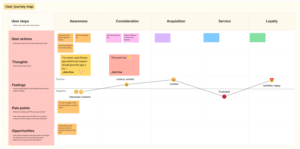
Phase 1: Awareness
- Specific scenario: John discovers a new fitness app through an influencer he follows on social media.
- Actions: John clicks on the influencer’s post promoting the app and navigates to the app’s website.
- Touchpoints: Social media platform (Instagram), app website.
- User thoughts: John is intrigued by the app’s features and considers downloading it to track his workouts.
- User feelings: Excitement about the prospect of using the app to improve his fitness routine.
- Process ownership: The marketing team is responsible for creating and distributing the influencer content.
UX measurement and analysis
- UX Metrics: Impressions, Click-Through Rate (CTR), Website Traffic.
- Application: Analyze CTR and website traffic to assess the effectiveness of marketing campaigns and identify high-performing channels.
Phase 2: Consideration
- Specific scenario: John explores different fitness apps available on the market and compares their features and pricing.
- Actions: John reads reviews and user testimonials, compares subscription plans, and seeks recommendations from friends. Touchpoints: Fitness app websites, review websites (e.g., Trustpilot), social media groups.
- User thoughts: John evaluates the pros and cons of each app based on features, user reviews, and pricing.
- User feelings: John feels confident in his decision-making process but seeks validation from trusted sources.
- Process ownership: The product team is responsible for maintaining accurate product information and providing assistance to potential users.
UX measurement and analysis
- UX Metrics: Time on Page, Bounce Rate, User Engagement.
- Application: Monitor time on page and bounce rate to gauge user interest and identify areas for improvement on product pages.
Phase 3: Decision
- Specific scenario: John decides to download a subscription-based fitness app that offers personalized workout plans and nutrition tracking and buy a subscription plan
- Actions: John adds a subscription to his cart, enters his credit card details, and clicks “confirm purchase.”
- Touchpoints: App checkout page, payment gateway (e.g., PayPal), confirmation email.
- User thoughts: John evaluates the benefits of the subscription against the cost and decides it’s worth the investment.
- User feelings: John feels satisfied with his decision to invest in his health and looks forward to using the app.
- Process ownership: The customer support team sends a welcome email and provides onboarding assistance to new subscribers.
UX measurement and analysis
- UX Metrics: Conversion Rate, Cart Abandonment Rate, Checkout Abandonment Rate.
- Application: Track conversion and abandonment rates during checkout to optimize the user flow and reduce friction points.
Phase 4: Service
- Specific scenario: John encounters a technical issue with the app and reaches out to customer support for assistance.
- Actions: John submits a support ticket detailing the issue he’s experiencing and provides screenshots for reference.
- Touchpoints: App support page, customer support ticketing system, email communication with support agent.
- User thoughts: John expects prompt and helpful assistance from the support team to resolve the issue quickly.
- User feelings: John feels frustrated by the technical issue but appreciates the responsive and helpful support from the team.
- Process ownership: The customer support team acknowledges John’s ticket, investigates the issue, and provides a resolution within 24 hours.
UX measurement and analysis
- UX Metrics: Customer Satisfaction (CSAT) Score, Net Promoter Score (NPS), User Retention Rate.
- Application: Collect CSAT and NPS scores to measure user satisfaction and loyalty, and analyze user retention rate to identify opportunities for engagement and retention.
Phase 5: Loyalty
- Specific scenario: John becomes a loyal user of the fitness app, regularly tracking his workouts, and achieving his fitness goals.
- Actions: John upgrades to a premium subscription, participates in app challenges, and refers friends to join the platform.
- Touchpoints: Loyalty program dashboard, app notifications, referral emails.
- User thoughts: John values the app’s features and community support, seeing it as an essential tool for his fitness journey.
- User feelings: John feels a sense of loyalty and belonging to the app’s community, appreciating the platform’s role in his fitness success.
- Process ownership: The loyalty program manager acknowledges John’s participation, rewards his loyalty with exclusive benefits, and seeks feedback to improve the program further.
UX measurement and analysis
- UX Metrics: Repeat Purchase Rate, Customer Lifetime Value (CLV), Referral Rate.
- Application: Measure repeat purchase rate and CLV to assess long-term value, and track referral rate to evaluate user advocacy and brand loyalty.
Conclusion
Understanding the user journey and leveraging UX metrics are essential for designing experiences that captivate and retain users. By considering elements like user persona, specific scenarios, actions, touchpoints, user thoughts, user feelings, and process ownership at each phase of the user journey, businesses can optimize the user experience and drive long-term success. By applying relevant UX metrics and analyzing criteria across each phase, businesses can gain valuable insights and continuously iterate to meet user needs and expectations in today’s dynamic digital landscape.