


Introduction
Choosing the right application architecture is one of the most critical decisions in modern software development. Two dominant architectural styles—Monolithic and Microservices—represent fundamentally different approaches to building, deploying, and scaling systems.
This article provides a clear, practical comparison between Microservices and Monolithic architectures, focusing on structure, scalability, development velocity, operational complexity, and real-world use cases. The goal is not to declare a universal winner, but to help you select the right approach for your context.
What Is a Monolithic Architecture?
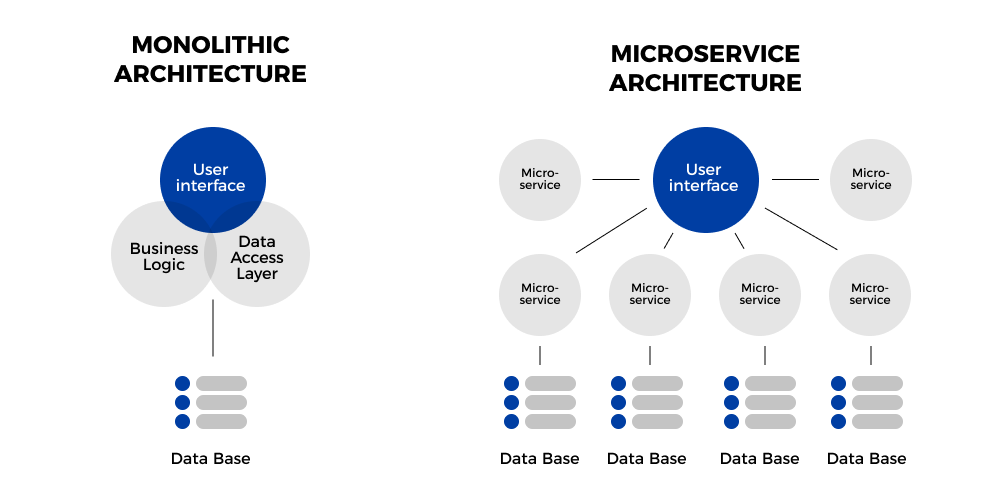
A Monolithic architecture is a traditional software design where all application components—UI, business logic, and data access—are built, deployed, and run as a single unit.
Key Characteristics
- Single codebase
- Single deployment artifact
- Shared database
- Tight coupling between components
Typical Structure
- UI
- Business Logic
- Data Access
- Database
All components are part of the same application and are deployed together.
What Is a Microservices Architecture?
A Microservices architecture breaks an application into a collection of small, independent services. Each service is responsible for a specific business capability and communicates with others via APIs or messaging.
Key Characteristics
- Multiple, independently deployable services
- Each service owns its data
- Decentralized governance
- Loose coupling
Typical Structure
- [Service A] → DB A
- [Service B] → DB B
- [Service C] → DB C
- (API / Messaging Layer)
Each service can be developed, deployed, and scaled independently.
Core Comparison
1. Development and Team Structure
Aspect Monolith Microservices Codebase Single, centralized Multiple repositories or modules Team Size Small to medium teams Medium to large, distributed teams Onboarding Easier initially More complex Coordination Centralized Requires strong DevOps and communication Insight:
Monoliths work well for small teams. Microservices shine when teams are large and autonomous.
2. Deployment and Release Management
Aspect Monolith Microservices Deployment Entire app deployed at once Services deployed independently Release Risk High (all features together) Lower (isolated changes) Rollback Whole system rollback Per-service rollback Insight:
Microservices significantly reduce release coupling but require mature CI/CD pipelines.
3. Scalability and Performance
Aspect Monolith Microservices Scaling Scale entire application Scale only bottleneck services Resource Usage Less efficient at scale More efficient but complex Performance Faster internal calls Network latency between services Insight:
Microservices offer superior horizontal scalability but introduce network overhead.
4. Technology Flexibility
Aspect Monolith Microservices Tech Stack Usually single stack Polyglot (per service) Upgrades Difficult, system-wide Incremental, service-level Innovation Speed Slower over time Faster experimentation Insight:
Microservices allow teams to adopt new technologies without rewriting the entire system.
5. Operational Complexity
Aspect Monolith Microservices Monitoring Simple Complex (distributed tracing) Debugging Easier Harder (cross-service issues) Infrastructure Simple Requires containers, orchestration, observability Insight:
Microservices demand strong DevOps maturity (Docker, Kubernetes, logging, tracing).
Advantages and Disadvantages Summary
Monolithic Architecture
Advantages
- Simple to build and deploy
- Easier debugging and testing
- Lower infrastructure cost
- Ideal for MVPs and early-stage products
Disadvantages
- Hard to scale selectively
- Slower development as codebase grows
- Risky deployments
- Limited technology flexibility
Microservices Architecture
Advantages
- Independent scaling and deployment
- Faster development for large teams
- Better fault isolation
- Technology flexibility
Disadvantages
- High operational complexity
- Requires advanced DevOps practices
- Increased latency due to network calls
- More difficult debugging and testing
When to Choose Monolithic Architecture
Choose Monolith if:
- You are building an MVP or early-stage product
- The team is small
- Business requirements are still evolving
- Time-to-market is critical
- Infrastructure and DevOps maturity is limited
Example Use Cases
- Startup applications
- Internal tools
- Proof-of-concept systems
When to Choose Microservices Architecture
Choose Microservices if:
- The system is large and complex
- Multiple teams work in parallel
- You need independent scaling
- High availability and fault isolation are critical
- You have mature DevOps capabilities
Example Use Cases
- E-commerce platforms
- Financial systems
- Large SaaS products
- Cloud-native applications
Conclusion
Microservices and Monolithic architectures are not competitors—they are tools for different stages and scales of software development.
- Monoliths prioritize simplicity and speed.
- Microservices prioritize scalability and team autonomy.
The right choice depends on your team size, system complexity, business goals, and operational maturity. Architecture should evolve with your product—not constrain it.