


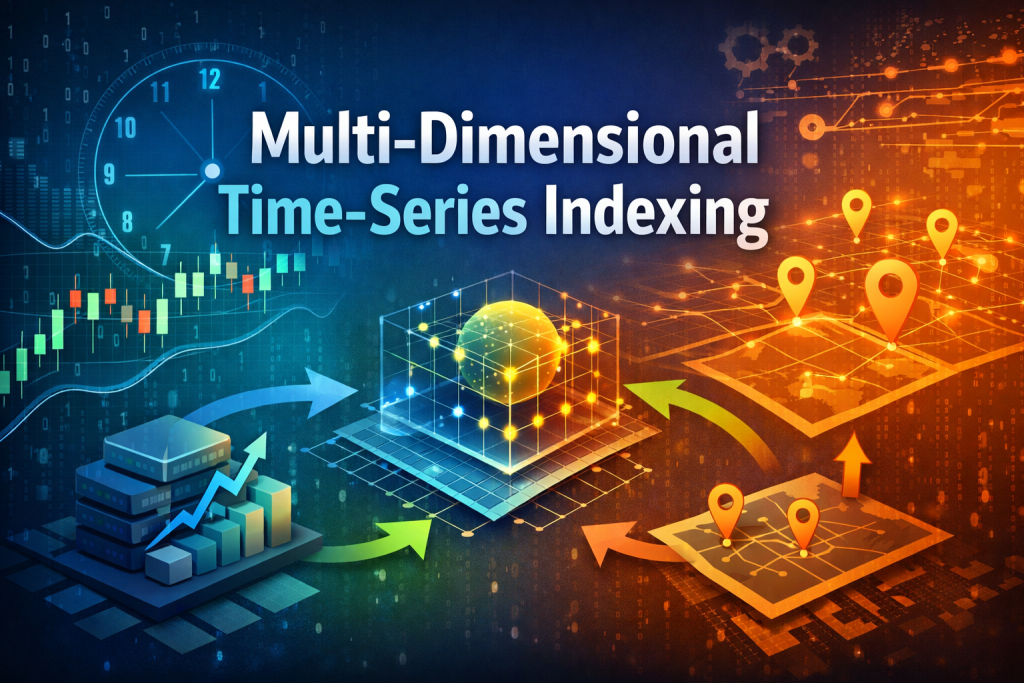
Introduction TO Multi-Dimenstional Time-Series
Almost every modern system today produces time-series data logs, metrics, user events, transactions, sensor readings, or location updates. As engineers, we usually start by storing this data with a timestamp and assume that querying by time will be enough.
But very soon, reality hits.
Product managers ask:
- “Show me clicks from the last hour”
- “Only for users near this location”
- “Only for a specific event type”
Suddenly, time alone is not enough.
This is where Multi-Dimensional Time-Series Indexing becomes important.
Why This Matters
At a small scale, you can scan data and filter it in memory.
At scale – millions or billions of events – this approach breaks.
Without proper indexing:
- Queries become slow
- Memory usage explodes
- The system fails to scale
- Costs increase dramatically
The real problem is that most queries filter on more than one dimension:
- Time
- Location
- Event attributes
A system that indexes only by time will waste resources scanning unnecessary data. Multi-dimensional indexing solves this by reducing the search space early and efficiently.
Understanding the Core Problem
Consider this query.”
“Find all click events from the last 1 hour within 5KM of Bangalore.”
This query has three dimensions:
- Time (last 1 hour)
- Geo-location (within 5 km)
- Attribute (event type = click)
If data is indexed only by time:
- You scan all events from the last hour
- Then filter by location
- Then filter by type
As data grows, this becomes expensive and slow.
The Core Idea: Index by Multi-Dimensions
Instead of relying on a single index, we combine multiple indexing strategies, each responsible for one dimension.
Think of it as narrowing down the data step by step.
1. Time Index(Primary Dimension)
This is the most common filter in time-series workloads, so it should always be the primary index.
How it works:
- Data is partitioned by time (hour/day/minute)
- Events inside a partition are ordered by timestamp
Benefits:
- Fast range queries (T1 -> T2)
- Easy data pruning
- Natural data lifecycle management
2. Geo-Location Index (Spatial Dimension)
Geo queries are expensive if handled naively.
Instead of scanning every point, spatial indexing techniques are used:
- Geohash
- QuadTree
- R-Tree
- S2 cells
Key idea:
Convert latitude and longitude into a spatial key.
Nearby locations share similar prefixes, making it easy to:
- Find nearby events
- Search within regions
- Filter by radius
This avoids full scans and enables efficient geo-based pruning.
Event Attribute Index (Filtering Dimension)
Attributes such as:
- eventType
- category
- status
- deviceType
are best handled using hash-based or inverted indexes.
Example:
"click" -> [eventIds]
"view" -> [eventIds]
Benefits:
- Constant time lookups
- very fast categorical filtering
- Low memory overhead when storing references instead of full objects
The Three-Level Indexing Hierarchy
1. Partitioning (Coarse Level)
Physical separation of data, usually by time.
2. Clustering / Ordering(Mid level)
Rows inside a partition are sorted by one or more dimensions.
3. Micro-Partition Metadata(Fine level)
Each block stores metadata like :
- min/ max timestamp
- min/ max location
- distinct attribute values
This enables data pruning, where entire blocks are skipped without reading row data.
This Concept is used heavily in systems like:
- Snowflake
- BigQuery
- ClickHouse
- Databricks
How a query executes in practice
for a real query:
Last 1 hour
Type = click
within 5 km
The system;
- selects only relevant time partitions
- prunes spatial blocks using geo metadata
- filters by attribute index
- Returns only matching events
Most data is never touched.
Performance impact
Multi-dimensional indexing gives:
- Lower query latency
- Higher throughput
- Reduced memory usage
- Better cache locality
- Horizontal scalability
Instead of scanning millions of rows, the system may touch only a thousand rows.
When to use and when not to
Use Multi-Dimensional indexing when:
- Data volume is large
- Queries are complex
- Real-time analytics is required
Avoid when:
- data size is small
- queries are small
- only time based access is needed
Design should always follow the query pattern, not assumptions.
Conclusion
Multi-dimensional time-series indexing enables fast, scalable analytics by aligning data storage with real-world query patterns. By indexing across time, location, and attributes, systems avoid costly full scans and deliver low-latency performance even at large scale. This approach is essential for building modern, high-performance time-series platforms.
For more tech-related blogs, you can visit Nashtech-Blogs official site.