


“AI doesn’t just write anymore — it remembers, reasons, and collaborates.”
When OpenAI released GPT-3 in 2020, it felt like science fiction had come true. For the first time, a machine could write, summarize, translate, and even converse in a way that felt genuinely human. Just a few years later, GPT-5 has taken that spark and turned it into a full-blown revolution in how we think, work, and create.
So how did we get here? Let’s explore the journey — from the early breakthroughs of GPT-3 to the powerful intelligence of GPT-5.
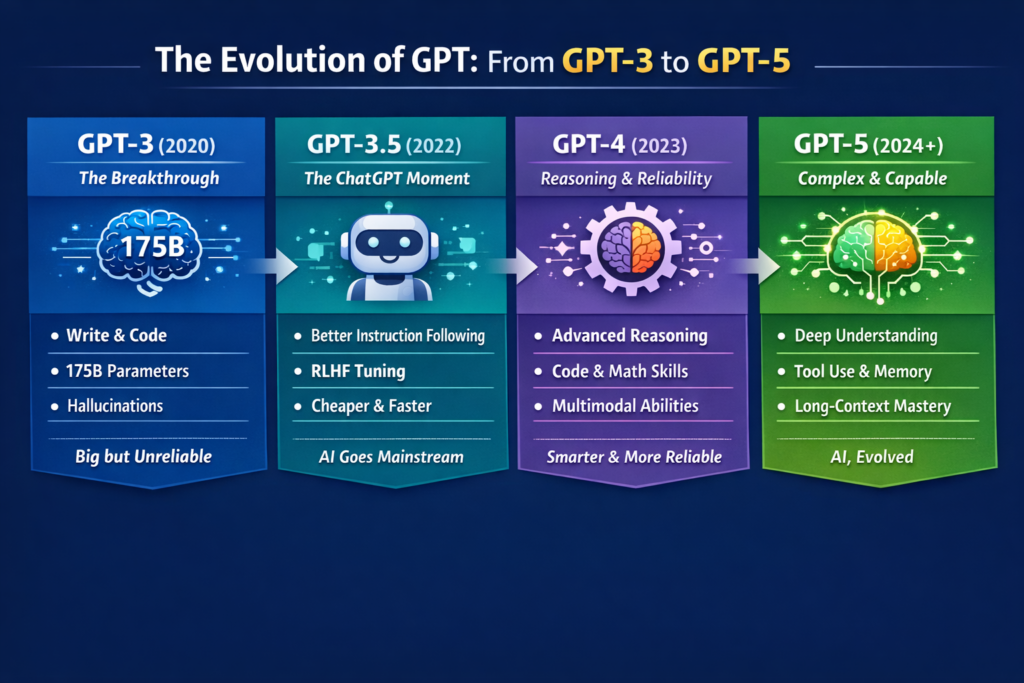
The Era of GPT-3: The Awakening of Generative AI (2020)
GPT-3 was a milestone not only for OpenAI but for artificial intelligence as a whole.
With 175 billion parameters, it was the largest language model ever built at the time. It could generate paragraphs of coherent text, code simple applications, and even mimic writing styles after reading just a few examples.
But GPT-3 was also limited. It often “hallucinated” — confidently inventing facts that weren’t true. It lacked consistent reasoning and memory, making it unreliable for professional use. Still, GPT-3 proved one thing: large-scale language models could understand and generate human-like text.
GPT-4: Smarter, Multimodal, and Safer (2023)
Then came GPT-4, and everything changed again.
GPT-4 introduced multimodal capabilities, meaning it could process both text and images. This was a leap forward: users could upload screenshots, graphs, or handwritten notes — and GPT-4 could analyze them intelligently.
It was also more factual and reliable, thanks to better training data, reinforcement learning with human feedback (RLHF), and stronger safety layers.
For developers and businesses, GPT-4 became a practical tool — powering apps, customer service bots, and even legal and medical support systems.
GPT-5: Toward True Understanding (2025)
With GPT-5, OpenAI has pushed the boundaries of what “language understanding” really means.
This generation focuses not only on size but on capability, adaptability, and context retention.
Key breakthroughs include:
- Long-term memory – GPT-5 can remember prior conversations, adapt to a user’s style, and learn continuously across sessions.
- Deep reasoning – it can plan steps, justify answers, and perform complex multi-stage analysis.
- Multimodal fluency – GPT-5 can process text, images, and audio in the same conversation.
- Real-world integration – it connects seamlessly with external tools, APIs, and databases, turning from a “chatbot” into a true AI assistant.
In short, GPT-5 is not just a text generator. It’s a system capable of understanding context, remembering goals, and acting intentionally — something earlier models could only approximate.
What This Means for the Future
The leap from GPT-3 to GPT-5 shows that AI evolution is not just about bigger models, but smarter and more aligned ones.
Language AI is now:
- More collaborative, working as a partner rather than a tool.
- More context-aware, understanding users’ needs over time.
- More integrated, bridging creativity, productivity, and reasoning.
But with this power comes responsibility. The future of AI will depend on how we balance innovation with ethics — ensuring that intelligence remains aligned with human values.
Final Thoughts
From GPT-3’s imagination to GPT-5’s reasoning, OpenAI’s journey mirrors our own pursuit of understanding language and thought.
Each generation brings AI closer to something we’ve only dreamed of — machines that don’t just generate words, but truly comprehend meaning.
The story of GPT isn’t about code — it’s about how humanity teaches intelligence to think, and in doing so, discovers more about itself.