


We know as part of the software development and deployment ecosystem, we should focus on effectiveness and efficiency. And Otomi gives us the power to streamline the process and optimize resources, containerization as a cornerstone of modern application deployment. Otomi redefines container management with its unparalleled efficiency and ease of use.
Purpose of Otomi
While Kubernetes offers a powerful framework for container orchestration, its complexity can pose challenges for organizations seeking a streamlined deployment solution. Otomi is a game-changer in the world of container management. Developed by Red Kubes, it is built upon the foundation of Kubernetes to provide a comprehensive platform that simplifies and accelerates the deployment lifecycle.
From installation to operation, Otomi streamlines the container management process, allowing organizations to focus on innovation rather than infrastructure. With its intuitive user interface and declarative configuration model, Otomi empowers teams to deploy applications with ease, reducing time-to-market and minimizing operational overhead.
What is Otomi?
Otomi stands as a self-hosted Platform as a Service (PaaS), enriching Kubernetes with tools tailored for developers and operations teams. It offers automation and self-service functionalities, delivering a seamless multi and hybrid platform experience from the get-go. Positioned within the CNCF landscape’s PaaS/Container Service segment, Otomi bridges various technologies within the CNCF ecosystem to provide immediate benefits. No more starting from scratch when creating or maintaining your Kubernetes-based platform or bespoke stack.
Features & Benefits
1.Multi-tenancy
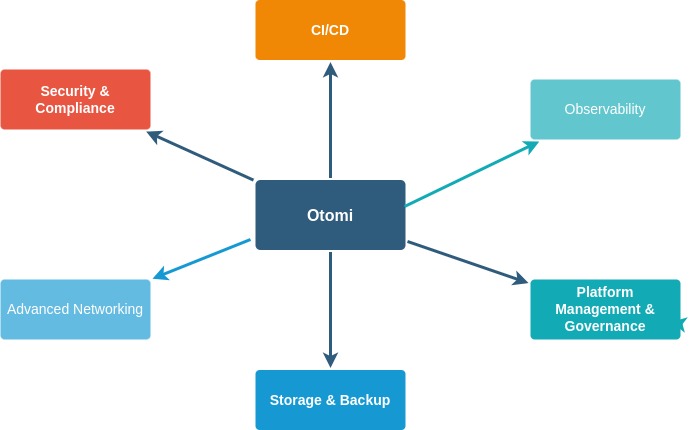
Otomi’s Teams feature rapidly onboards development teams, providing instant access to a shared Kubernetes cluster with integrated applications via OIDC, streamlining operations with workload separation, user-aware shared apps, and automated team configuration, while offering admin delegation options for tailored self-service capabilities.
2. Security
Otomi integrates production-ready security measures including workload isolation, image vulnerability scanning, policy enforcement, mTLS, secret management, a Web Application Firewall (WAF), Single Sign-On, and pre-configured RBAC.
3. Self-service UI
The self-service UI in Otomi lets developers to manage and access integrated applications like Harbor and Vault, along with provided dashboards. It also facilitates quick service exposure, serverless workload deployment via Knative, network policy configuration, egress rule setup, and Kubernetes Jobs/CronJobs creation, eliminating the need for writing YAML Kubernetes manifest.
4. Configuration as Code
Otomi’s Configuration as Code feature applies best practice-based defaults to all integrated applications, modifiable via UI or CLI using a predefined values schema. Operations teams can optimize configurations through the extensive schema or overrides, with all changes version-controlled and automatically updating the cluster state post-commit.
5. Advanced Ingress Architecture
With a single click on the web console, Kubernetes services can be instantly exposed to the public. If Istio is enabled, virtual services are auto-generated, and ingress resources are configured automatically for Single Sign-On (SSO) traffic and public exposure, linking a standardized ingress architecture to service endpoints seamlessly.
6. Full observability
Use Cases
Enterprise Application Deployment
Otomi simplifies the deployment of complex enterprise applications by providing a user-friendly interface for configuration and management. As a result it streamlines the process of deploying microservices-based applications, databases, and other components, ensuring consistency and reliability across environments.
DevOps Automation
Otomi accelerates DevOps practices by automating routine tasks such as cluster provisioning, configuration management, and scaling. Development teams can leverage self-service capabilities to deploy and manage applications without manual intervention, reducing deployment times and increasing efficiency.
Multi-Tenancy and Hybrid Cloud
With its multi-tenancy support and hybrid cloud capabilities, Otomi enables organizations to manage multiple environments and workloads efficiently. Whether deploying applications on-premises, in the cloud, or across multiple cloud providers, Otomi provides a unified platform for seamless management and operation.
Observability and Monitoring
Otomi’s observability stack, including logging, metrics, tracing, and alerting, empowers teams to monitor the health and performance of their applications effectively. Therefore Developers and operators can easily configure alerting endpoints and access logs and metrics via the self-service UI, ensuring timely detection and resolution of issues.
Security and Compliance
Otomi incorporates production-ready security best practices. Including workload isolation, image vulnerability scanning, policy enforcement, mTLS, secret management, and RBAC. Therefore organizations can ensure compliance with industry regulations and standards while maintaining a secure and resilient infrastructure.
Containerized Workloads
Otomi is well-suited for managing containerized workloads in various scenarios. Such as web applications, APIs, batch processing, and more. Moreover it provides tools for deploying, scaling, and managing containers effectively, enabling organizations to leverage the scalability and agility of containerized architectures.
Application Modernization
For organizations undergoing digital transformation or modernizing legacy applications, Otomi offers a platform for migrating and managing modern, cloud-native applications. Also it facilitates the adoption of microservices architectures, containerization, and DevOps practices.