


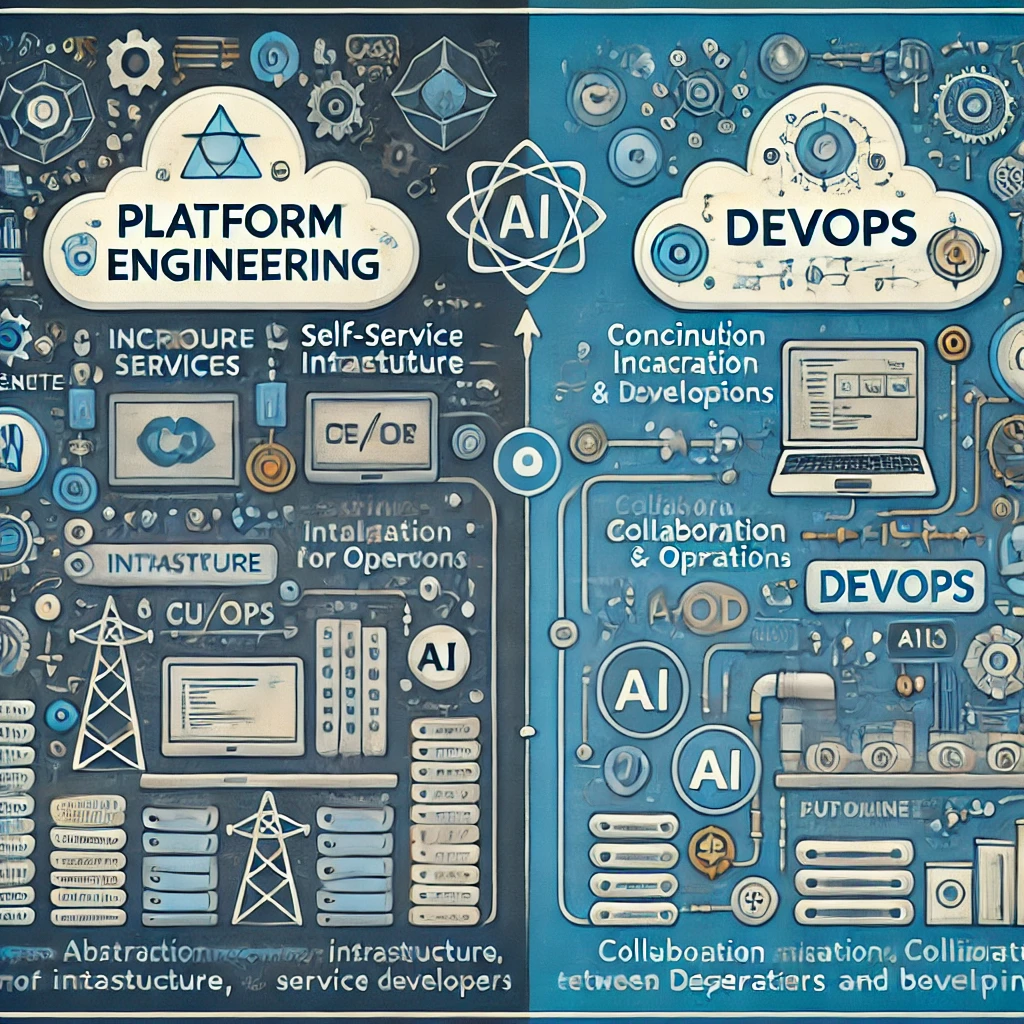
Overview
Hello Readers!! Welcome to my new blog!! Today we’ll discuss on Platform engineering vs DevOps. As the tech landscape continues to evolve, the distinction between different operational roles in software delivery is becoming more pronounced. Two roles at the forefront of modern cloud-native development are Platform Engineering and DevOps. Both aim to improve the efficiency and reliability of software delivery, but they approach this from different angles. Now, with the rise of Artificial Intelligence (AI), both fields are undergoing significant transformations.
In this detailed blog, we’ll dive deep into the following:
- What is Platform Engineering?
- What is DevOps?
- A comparison between the two.
- Tools used in Platform Engineering and DevOps.
- How AI is revolutionizing both fields with practical examples.
What is Platform Engineering?
Platform Engineering is the practice of designing and building self-service platforms that development teams use to provision and manage their applications. These platforms are internal, meaning they are built specifically for the organization’s unique use cases and infrastructure. The platform abstracts away the underlying complexities of cloud, infrastructure, and tooling, providing a standardized interface for developers to use.
The key idea behind platform engineering is to build reusable, scalable infrastructure that can serve multiple development teams, making it easier for them to deploy, test, and run applications without needing to manage low-level infrastructure concerns.
Key Concepts of Platform Engineering:
- Infrastructure Abstraction: Developers are provided with a layer of abstraction over infrastructure, such as Kubernetes clusters, databases, and cloud services, so they don’t have to deal with the nitty-gritty of infrastructure management.
- Self-Service Portals: Platform engineers provide developers with self-service tools to manage their applications and resources, such as deploying code, scaling services, and monitoring performance.
- Standardization and Consistency: Platform engineers define standardized development environments, tooling, and workflows that ensure consistency across teams.
Examples of Platform Engineering in Action:
- Spotify’s Backstage: Backstage is an open-source platform created by Spotify that allows developers to manage and build software at scale. It’s a single pane of glass for all developer tools and infrastructure.
- Netflix’s Titus: Netflix built Titus, an open-source container management platform, as their internal platform to handle all container workloads. Titus abstracts infrastructure management for developers, allowing them to focus on building applications.
Tools Used in Platform Engineering:
- Backstage: A developer portal for managing microservices, deployments, and infrastructure through self-service.
- Pulumi: A tool that lets platform engineers define infrastructure in programming languages like Python, Go, or TypeScript.
- Terraform: Used to provision and manage cloud infrastructure using code.
- Kubernetes: A platform for automating the deployment, scaling, and management of containerized applications.
What is DevOps?
DevOps is a cultural and technical movement that emphasizes collaboration between development and operations teams. DevOps focuses on automating and streamlining the entire software development lifecycle (SDLC), from code integration and testing to deployment and monitoring. It encourages a continuous integration/continuous delivery (CI/CD) approach, where code is deployed quickly and reliably into production.
The main goal of DevOps is to reduce friction between developers and operations, improve the speed and quality of software releases, and ensure that systems remain stable and reliable.
Key Concepts of DevOps:
- Collaboration: DevOps bridges the gap between developers and operations, ensuring that both teams work together from the planning phase to deployment and monitoring.
- Automation: The DevOps process relies heavily on automation, particularly around testing, deploying, and monitoring software. Tools like Jenkins, GitLab CI, and Ansible are commonly used.
- CI/CD Pipelines: A core principle of DevOps is to have CI/CD pipelines that continuously integrate code changes, test them, and deploy them automatically into production.
- Monitoring and Feedback Loops: Continuous monitoring ensures that performance metrics, errors, and issues are constantly fed back to teams to iterate quickly and improve.
Examples of DevOps in Action:
- Amazon’s Continuous Deployment: Amazon’s use of DevOps allows them to deploy code every 11.7 seconds. Their CI/CD pipelines allow for rapid, safe deployments without downtime.
- Etsy’s DevOps Transformation: Etsy moved to a DevOps model and reduced deployment times, allowing them to deploy changes multiple times per day without affecting site performance.
Tools Used in DevOps:
- Jenkins: A popular automation server used to implement CI/CD pipelines.
- GitLab CI: An integrated CI/CD tool that automates the testing, building, and deployment of applications.
- Ansible: A configuration management tool that helps automate software provisioning, configuration, and application deployment.
- Prometheus: A tool for monitoring and alerting, often used in DevOps to observe system metrics and application performance.
Platform Engineering vs. DevOps: A Detailed Comparison
| Aspect | Platform Engineering | DevOps |
|---|---|---|
| Focus | Building and maintaining internal developer platforms. | End-to-end automation of the software lifecycle. |
| Goal | Abstract infrastructure and provide a self-service platform for developers. | Foster collaboration and automate software delivery. |
| Scope | Infrastructure abstraction, standardization, and tooling. | Development, deployment, operations, monitoring, and automation. |
| Automation | Focuses on building reusable infrastructure components. | Automates the CI/CD pipeline and infrastructure provisioning. |
| Developer Experience | Developers use self-service tools to manage their apps. | Developers and operations work together throughout the process. |
| Tools | Backstage, Pulumi, Terraform, Kubernetes | Jenkins, GitLab CI, Ansible, Prometheus, Docker |
| Who Manages It? | Platform engineers design and manage internal platforms. | DevOps teams handle automation, monitoring, and deployment. |
| Team Structure | Dedicated platform engineers and development teams. | Cross-functional teams including both developers and operations. |
The Role of AI in Platform Engineering and DevOps
AI is revolutionizing both platform engineering and DevOps, unlocking new possibilities for automation, efficiency, and reliability. By leveraging machine learning and predictive analytics, AI enhances the ability to manage complex systems, optimize workflows, and respond proactively to problems before they become critical issues.
1. AI-Driven Automation
AI can automate infrastructure provisioning, workload balancing, and CI/CD pipelines far more effectively than traditional rules-based systems.
- In Platform Engineering: AI-driven tools like HashiCorp Nomad use intelligent scheduling algorithms to manage containerized workloads across large, distributed clusters. AI can dynamically allocate resources, optimize performance, and balance workloads across cloud environments.
- In DevOps: AI can automatically adjust CI/CD pipelines by identifying bottlenecks or inefficiencies in the testing or deployment phases. Tools like Spacelift integrate AI to make CI/CD pipelines self-optimizing.
2. Predictive Analytics and Monitoring
AI can predict potential system failures or performance issues before they happen, ensuring proactive maintenance and minimizing downtime.
- In Platform Engineering: AI-enhanced monitoring tools such as Datadog or Dynatrace provide deep insights into system performance, predicting resource exhaustion or potential bottlenecks in Kubernetes clusters.
- In DevOps: AI-driven monitoring tools like Moogsoft help teams detect anomalies in real-time, predicting incidents before they occur and automatically remediating low-level issues. Sentry uses AI to detect patterns in error logs and provides root cause analysis for software bugs.
3. Intelligent Incident Management
AI can enhance incident management by automating the detection, diagnosis, and resolution of issues.
- In Platform Engineering: AI tools such as PagerDuty can automate the incident response process by detecting anomalies in system behavior, alerting engineers, and even executing predefined recovery steps autonomously.
- In DevOps: AI tools like OpsGenie offer intelligent alerting and escalation based on the nature and severity of incidents. This improves response times and reduces human error during critical outages.
4. AI-Optimized CI/CD Pipelines
AI can analyze patterns in past deployments to optimize and streamline CI/CD processes.
- In Platform Engineering: AI helps optimize infrastructure usage by learning from historical data to allocate resources more efficiently during peak times. For instance, AI-driven cloud optimization tools like Harness use machine learning to decide when and how to scale resources based on past deployments.
- In DevOps: AI tools such as SeaLights enhance testing automation by predicting which parts of the codebase are most likely to fail, ensuring smarter test case generation and execution, thus optimizing the CI/CD process.
Practical Examples of AI in Action
- Kubernetes and AI: Kubernetes platforms like KubeFlow leverage AI/ML to streamline the process of deploying, scaling, and managing machine learning models. This showcases how AI can help not only with application deployment but also with AI workloads themselves.
- GitHub Copilot: For DevOps engineers, GitHub Copilot uses AI to assist in writing code for pipelines, improving efficiency and reducing the time needed to write automation scripts.
Conclusion: The Future of Platform Engineering and DevOps with AI
Platform Engineering and DevOps, while distinct, are both critical components in modern cloud-native software delivery. Platform Engineering focuses on building reusable, self-service infrastructure that simplifies the developer experience, while DevOps emphasizes end-to-end automation, collaboration, and continuous delivery.
By leveraging AI in Platform Engineering and DevOps, organizations can achieve faster deployments, better infrastructure management, and smarter monitoring, ultimately delivering more reliable and scalable applications to users.