


Introduction
We’re always on the hunt for the ideal combination of performance, security, and a development experience that doesn’t push us to the brink. We’ve all experienced the joy of working in an environment where those three things meld seamlessly, and we’ve all felt the crunch of debugging too many times for our own good. But what if we told you that there’s this emerging architecture that developers are falling in love with? Recently, our team has fallen for the JAMstack.
The acronym JAMstack may seem to represent just JavaScript, APIs, and Markup, but it’s much more than that. It’s not so much a “stack” in the traditional sense as it is a modern web development “architecture.” Building websites with JAMstack is a departure from the way we have historically built them. It’s an “architecture” for web development that JAMstack proponents say has all sorts of benefits over what has traditionally been the “frontend” part of a “frontend and backend” web development system.
What is JAMStack?
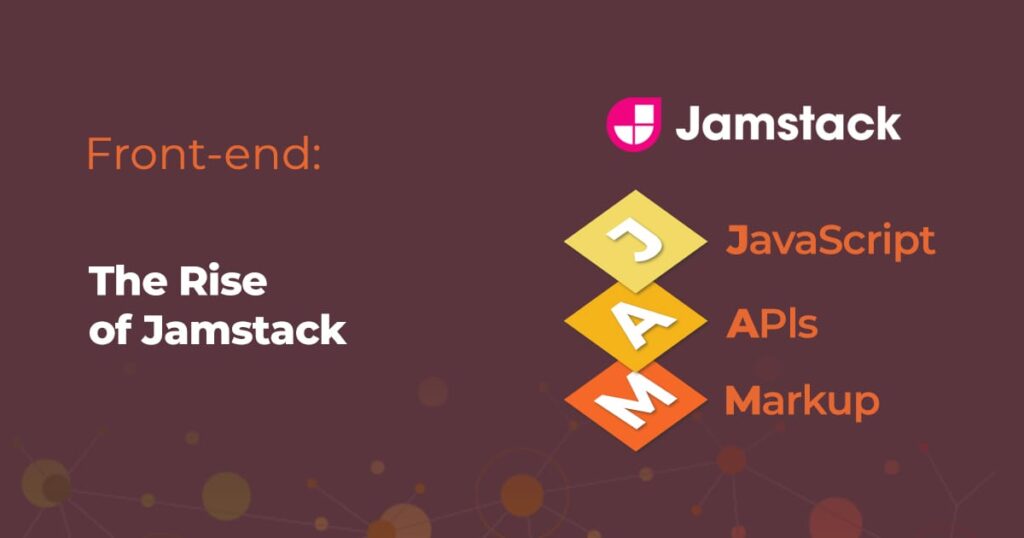
Developers leverage JavaScript as the primary language for dynamic client-side effects, enhanced by various frameworks and libraries.
We utilize APIs (Application Programming Interfaces) for server-side operations, data storage, and third-party services, maintaining a decoupled architecture.
Our initial approach involves prebuilt Markup (HTML, CSS, etc.), often generated statically, for the first load of our applications. This strategy minimizes server load and allows for greater scalability.
Key Components
- JavaScript: Developers enrich this main language with many frameworks and libraries for dynamic client-side effects.
- API: We ensure a decoupled architecture by using APIs for server-side operations, data storage, and third-party services.
- Markup: Our prebuilt Markup (HTML, CSS, etc.) optimizes the initial application load, often generated statically.
Core Principles
- Static Site Generation (SSG) : Sites are prebuilt into static HTML, reducing server load.
- Decoupling : Separation of the frontend from the backend, allowing for independent development and scalability.
- CDN’s and Edge Computing : Content is served from edge locations, minimizing latency.
Benefits of JAMStack
For Developers
- Improved Developer Experience : By using frontend tools and workflow you already know.
- Better Team work : Clean separation of frontend and backend teams
- Simple to Deploy : Automated builds and deployments with version control.
For Users
- Faster Load Time : Some of the benefits are that Static sites served from CDNs give pages incredibly fast load times.
- Enhanced Security: Minimal attack surface with serverless architectures.
- Scalability: Managing high traffic would not be difficult with backend bottlenecks.
Conclusion
JAMstack: Faster and Safer Web Development for Building Apps at Scale. A New Era 👩💻 🚀 This seismic change coming is not just evolution in technology: it’s good design, brilliant user experiences, convenient workflows and the future of our own profession. Frontend developers need to embrace this shift; not only is it key to their continued relevancy, but in an age when speed and security are prerequisites for any project, the pace of innovation has been ratcheted up. We future-proof our careers, unlock new opportunities and lead the way in industry by embracing JAMstack principles.
For more such blogs and updates follow Front-end Competency.
Follow NashTech Blogs for more amazing blogs.