



Introduction to data mesh
The data mesh is a new way of thinking about data, treating it as a valuable business product rather than just an IT asset. This approach encourages organizations to handle their data as a key business resource, making it as important as any other capital asset. The core idea of a data mesh is to connect those who produce data directly with those who use it, minimizing the reliance on traditional IT teams for data processing and transformation.
In a data mesh framework, different business domains such as sales or customer service organize and manage their own data.. This shift involves changes in how organizations structure their data teams and processes, aiming for greater efficiency and alignment with business goals.
Oracle supports this data mesh model, emphasizing the need for coordination between different business areas and their data. By doing so, companies can better harness their data, making it more accessible and useful for business decision-makers.
The Four Key Principles of Data Mesh
Four foundational principles guide the approach of data mesh to modern data management.
- Domain-Oriented Decentralized Data Ownership and Architecture
- Data as a Product
- Self-Serve Data Infrastructure as a Platform
- Federated Governance
Diagram of Data Mesh Architecture
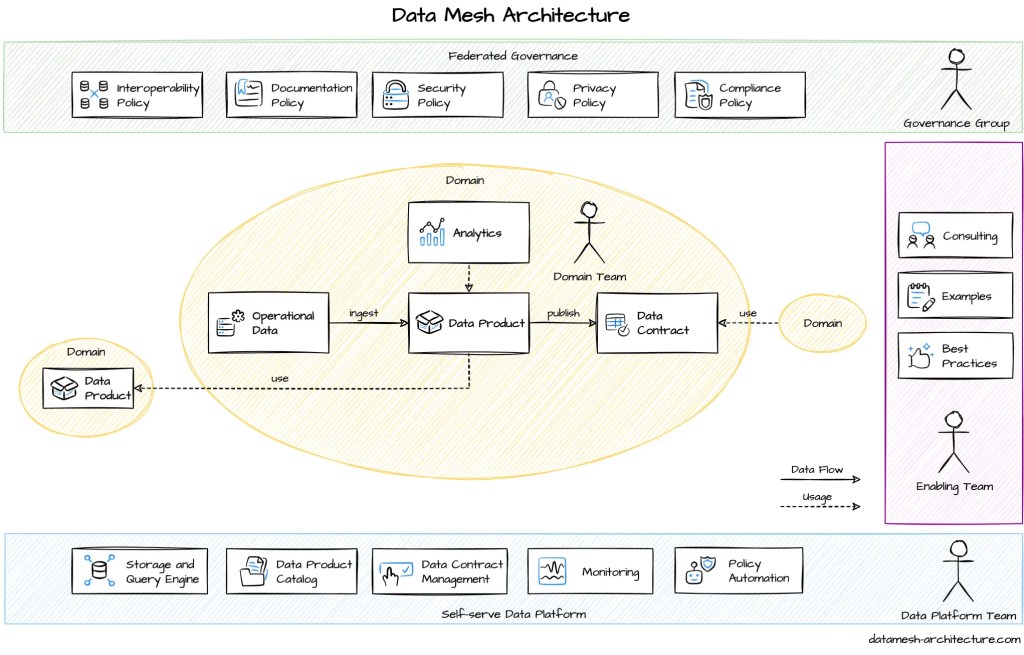
In this Blog , we will focus on Federated Governance a core principle to implement data mesh .
Federated Governance
Federated data governance is a concept where you can define data governance standards centrally, while allowing the local domain teams to choose how they execute these standards. In a data mesh, federated data governance means that while centralized standards are set, local domain teams have the freedom to apply these standards as they see fit for their specific needs. This model promotes collaboration between autonomous domain teams and centralized governance functions, coordinated by leaders in data governance.
This approach allows teams to integrate data governance policies early in their product development process (“shifting left”), ensuring compliance and efficiency throughout the data lifecycle. This practice is crucial for federated computational governance, aiming to enhance operational efficiency and adherence to regulations across the organization.
Components of Federated Data Mesh Governance
In a data mesh, data management is distributed across various business domains, such as marketing, sales, or finance. This decentralization allows domain teams to manage their own data according to their specific needs. However, effective data governance in such an environment requires controls at two distinct levels: global (horizontal) and local (vertical).
Global (Horizontal) Controls
Global controls are overarching rules and standards that apply across the entire organization. These policies are general guidelines based on fundamental principles in the data world. These principles come from laws, industry standards, and other important rules. They are applied consistently across all areas, creating a set of rules that covers all aspects of data management. For example, global policies ensure that everyone follows laws about data protection, legal responsibilities, and standards set by industries.
Local (Vertical) Controls
Certainly! Here’s a simplified and explained version of the paragraph about local policies:
Local policies are specific rules tailored for individual domains or specific uses. While they may still consider broader regulations and rules, they are designed to fit the unique needs of each domain. These policies apply vertically within their respective domains, focusing on specific tasks or cases. For example, local policies could include actions like hiding rows with ‘credit_card_number’ data, encrypting ‘home_address’ columns, or removing values tagged as ‘social_security_number’.
For instance, in a healthcare setting, an organization might set up domains for billing in different regions. Each domain manages customer data for its region. Within these domains, data users handling specific areas (like states or countries) might have restrictions on accessing data from other regions. In a data mesh, various business domains such as marketing, sales, or finance take active roles in distributing data management responsibilities.
Maintaining Effective Governance
The challenge of federated governance lies in balancing global and local policies to ensure they function as intended. It’s essential to avoid gaps in coverage while also preventing over-restriction, which can hinder domain teams’ ability to manage their data independently within the data mesh framework.
This requires continuous monitoring of data mesh activities and implementing detection systems for any unusual behavior. By vigilantly enforcing policies at both global and local levels, organizations can maintain a secure and efficient data mesh environment that upholds data privacy and security standards effectively.
Why it’s crucial in any data management strategy
Empowering Domain Autonomy and Accountability in Data Mesh
One of the key benefits of the data mesh approach is empowering domains with independence, autonomy, and accountability. Each domain understands its operations best, allowing them to decide how to manage and scale their data effectively. This autonomy ensures strong accountability, as each team oversees a data product from creation to use. This approach leads to high-quality, scalable, and reliable data products tailored to meet specific business needs
Encouraging Collaboration and Interdependence in Data Mesh
While domains maintain autonomy in managing their data, ensuring usability for consumers requires a degree of interconnection. This is why centrally-governed standards play a critical role.
A broader authority, such as a team of domain product owners, oversees issues affecting all domains to ensure consistency in data handling and processing. In the context of treating data as a product, similar to product development in large organizations, centrally-governed guardrails play an essential role. These guardrails provide a framework for interoperability, enabling domains to innovate within established boundaries.
Setting up a data mesh involves a team responsible for defining and maintaining these interoperability standards, ensuring that domains can operate flexibly while maintaining consistency and usability across the data ecosystem.
Effective Data Governance and Consumption in a Distributed Environment
Effectively governing and accessing data across an organization is achievable when domains operate independently yet collaboratively. Domains manage local processes while a central team establishes minimum standards for consistency and accessibility.
This well-governed data is a boon for consumers who can seamlessly integrate high-quality, easily discoverable data into their projects. They no longer need to search various teams to locate or transform datasets to fit their needs, streamlining their workflow.
Enabling Scalability Across the Organization
Enabling a network of independent yet collaborative nodes (such as individual data domains or services) that are effectively governed and easily consumable establishes a foundational pattern that can be scaled extensively across the organization. Each node (or component) can scale according to its own maturity level, contributing to overall organizational scalability.
Governance Federation Challenges
A federated data mesh model demands a high level of data maturity within an organization because it introduces a more dynamic and flexible method for domains to interact with each other and with data, compared to traditional centralized approaches.
However, the biggest challenges of implementing federated data mesh are not technical. The real difficulty is in cultivating a data mesh culture and mindset—changing .How people work and think about data to support this new approach.
- Organizations must be ready to extend trust as well as federate their technology as each domain has the necessary skills, infrastructure, and controls to operate independently while adhering to the guidelines for inter-domain cooperation.With many domains to manage, trying to control each one individually would go against the purpose of decentralization. Instead, domains need to be trusted to work independently, which can be difficult for organizations used to centralized control.
- For a data mesh to be effective, everyone—whether involved in creating or using data—needs to actively participate in their area of the data mesh.
Each domain’s trust in handling its data part brings major responsibility The organizations must highlight that these new methods simplify processes and benefit everyone. - Imagine if each domain managed their data independently without considering coordination or consistency with others—it would create chaos. Conversely, if all domains depended solely on a central data team, it would lead to delays and hinder innovation.The challenge is to strike the right balance for your organization, allowing domains to evolve and scale their data independently while ensuring their data remains consistent across the organization. This balance needs to be regularly adjusted as the organization develops and matures.
Conclusion
Federated data mesh governance offers a balanced approach that combines centralized standards with the flexibility of decentralized execution. By aligning governance principles with the specific needs of each domain, it enhances data quality and accessibility while empowering domain teams to innovate. This approach requires a cultural shift towards trust and collaboration and needs continuous adjustment as the organization evolves. Despite its challenges, federated governance is crucial for scalable, efficient, and effective data management in today’s complex data environments. It enables organizations to harness the full potential of their data, driving innovation and success.