


Quality assurance no longer ends with pre-deployment tests. In the modern digital landscape, ensuring robust software quality means continuously engaging with real-world usage even after launch. Shift right testing extends QA into production, harnessing live data to fine-tune applications and adapt to evolving user needs.
What Is Shift Right Testing?
Shift right testing involves validating software performance and usability after it’s been deployed. Rather than confining tests to development or staging environments, it leverages real-time monitoring, user feedback, and controlled experiments in production. This hands-on approach reveals issues that only emerge when applications run under genuine conditions, where diverse variables and unpredictable user behaviors are the norm.
Why Shift Right Testing?
While shift left testing (early-stage testing) is critical for detecting obvious bugs, it cannot simulate the unpredictability of a live environment. Shift right testing bridges that gap by enabling teams to:
- Capture Genuine User Interactions: Direct observation of live behavior uncovers nuanced insights into usability and functionality.
- Validate Under Real Loads: Production environments expose applications to real network variances, workload fluctuations, and data irregularities—conditions that staged tests rarely capture.
- Accelerate Feedback and Resolution: Immediate metrics allow teams to quickly identify issues, implement fixes, and improve overall satisfaction.
- Foster Continuous Improvement: Ongoing performance assessments help evolve the system with changing user needs and infrastructure dynamics.
Shift Left vs Shift Right Testing
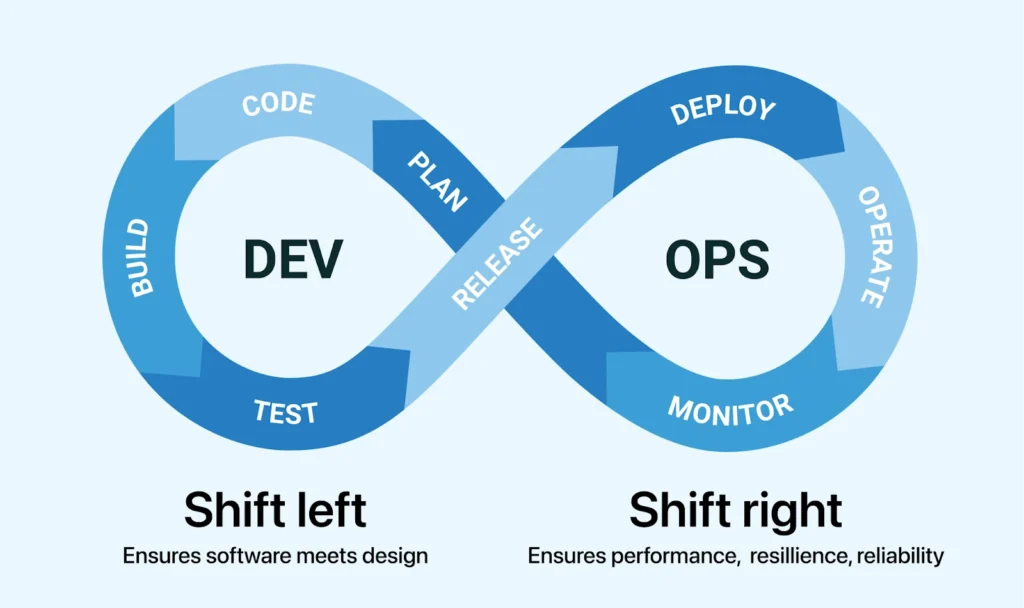
Uniting the predictive power of shift left with the reactive strength of shift right creates a holistic and resilient quality assurance strategy. Here’s how both approaches complement each other:
| Dimension | Shift Left Focus | Shift Right Focus |
|---|---|---|
| When It Happens | Early in development cycle | After deployment into production |
| Goal | Prevent defects before they reach production | Detect and resolve real-world performance issues |
| Testing Types | Unit tests, integration tests, static analysis | Observability, A/B tests, chaos testing |
| Tools | SonarQube, JUnit, Selenium | Prometheus, LaunchDarkly, Gremlin |
| Key Metrics | Code coverage, test pass rate | Latency, error rates, user satisfaction |
| Benefits | Faster dev cycles, lower defect cost | High system resilience, better user alignment |
How They Work Together
- End-to-End Risk Mitigation
- Early-stage testing catches regressions before they reach users.
- Production testing ensures performance and UX hold up under real-world conditions.
- Accelerated Feedback Loops
- Shift left testing informs build quality.
- Shift right insights feed back into future development and test design.
- Culture of Continuous Improvement
The combination fosters a DevOps culture focused on rapid iteration and learning from live usage.
Best Practices for Applying Shift Right Testing
To effectively implement shift right testing and harness its benefits without compromising user experience or system stability, organizations should follow these best practices:
- Start Small with Controlled Rollouts
- Use canary deployments and feature flags to minimize risk.
- Limit exposure to small user segments before broader releases.
- Establish Real-Time Observability
- Set up advanced logging, distributed tracing, and metrics dashboards.
- Adopt tools like Prometheus, Grafana, or Datadog for in-depth insights.
- Automate Feedback Loops
- Integrate alerting systems with CI/CD pipelines to accelerate issue resolution.
- Create automated rollback strategies for faster recovery from failures.
- Continuously Analyze User Behavior
- Leverage session replays, heatmaps, and clickstream analytics.
- Identify patterns that uncover usability bottlenecks or emerging trends.
- Practice Ethical and Secure Testing
- Anonymize sensitive data and enforce strict access controls.
- Conduct regular audits to remain compliant with data protection regulations.
- Test for Resilience, Not Just Functionality
- Introduce fault injection and latency simulations (chaos engineering) to verify system robustness under stress.
- Prepare for edge cases that may not arise during typical load scenarios.
- Cross-Functional Collaboration
- Ensure QA, DevOps, and SRE teams work closely to interpret telemetry data and drive improvements.
- Foster a “test in production” mindset across the organization with clear communication and shared goals.
Addressing Common Challenges
Shift right testing also brings challenges that require thoughtful mitigation:
- Risk to End Users: Testing in production might expose some users to unexpected bugs. Mitigation strategies such as canary releases, gradual rollouts, and robust rollback mechanisms can minimize adverse impacts.
- Data Security & Privacy: Handling live user data mandates stringent security protocols. Implementing encryption, data anonymization, and complying with regulatory standards are crucial safeguards.
- Managing Data Complexity: The volume and velocity of live data can be overwhelming. Investing in sophisticated observability platforms and training cross-functional teams ensures effective data analysis.
- Cultural Adaptation: Shifting to a continuous testing mindset requires a change in organizational culture. Encouraging agile practices, comprehensive training, and fostering interdepartmental collaboration helps ease the transition.
Conclusion
Shift right testing transforms quality assurance from a one-time checkpoint into an ongoing commitment. Leveraging live monitoring, data-driven experimentation, and proactive resilience testing, organizations create robust, adaptable applications tuned to real-world challenges. This method not only speeds up issue resolution and boosts user satisfaction but also fosters a culture of continuous improvement, which is vital in today’s dynamic digital landscape. As technology and user expectations evolve, blending shift left with shift right testing becomes essential for sustained excellence and innovation.