


Introduction:
In the world of cloud-native applications, Kubernetes has emerged in reality standard for container orchestration. However, managing Kubernetes deployments can be complex, especially when dealing with multiple services and configurations. In this blog post, we’ll explore how to simplify K8s deployments using Terraform and Helm, two powerful tools for infrastructure as code (IaC) and package management.
Why Terraform and Helm?
Terraform is a popular IaC tool that allows you to define and manage infrastructure as code. It provides a declarative configuration language to describe your infrastructure, making it easy to version, automate, and maintain.
Helm, on the other hand, is a package manager for K8S applications. It simplifies the process of deploying complex applications by providing a way to define, install, and manage K8sresources using “charts,” which are packages of pre-configured Kubernetes resources.
By combining Terraform and Helm, we can leverage the strengths of both tools to streamline K8s deployments, improve consistency, and reduce manual effort.
Getting Started:
To illustrate the power of Terraform and Helm for K8s deployments, let’s consider a common scenario: deploying a web server using Nginx. We’ll use Terraform to provision the necessary infrastructure on our Kubernetes cluster and Helm to deploy the Nginx application.
Step 1: Define Terraform Configuration:
We start by defining a Terraform configuration file (nginx.tf) to provision the K8sresources required for our Nginx deployment. This may include namespaces, service accounts, roles, and role bindings, depending on your specific requirements.
Step 2: Deploy Helm Chart with Terraform:
Next, we use Terraform’s Helm provider to deploy the Nginx Helm chart onto our Kubernetes cluster. We specify the Helm chart repository, chart name, and any custom values or configurations using Terraform variables.

Step 3: Apply Terraform Configuration:
Once our Terraform configuration is defined, we initialize Terraform (terraform init), review the planned changes (terraform plan), and apply the configuration (terraform apply). Terraform will handle the creation and management of K8s resources, including deploying the Nginx Helm chart.

Step 4: Accessing the Deployed Nginx Application:
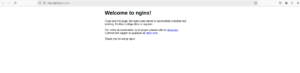
After successfully deploying the Nginx application using Terraform and Helm, the next step is to access the deployed application to ensure it’s functioning as expected. Depending on your Kubernetes cluster setup and networking configuration, in this we are using NodePort service.
Conclusion:
By combining Terraform and Helm, we’ve simplified the process of deploying Kubernetes applications like Nginx. Terraform allows us to define infrastructure as code, while Helm provides a convenient way to package and deploy K8s applications. Together, they enable us to automate and manage complex Kubernetes deployments with ease, improving reliability, consistency, and productivity.