


Introduction
When writing safe and efficient code in Rust, memory management plays a crucial role. Smart pointers are a significant part of managing memory and data securely and efficiently. In this blog, we will explore the world of smart pointers in detail, including their types, use cases, and how to use them effectively.
Understanding Smart Pointers in Rust
Before we dive into understanding smart pointers in Rust, it’s essential to have a brief idea about the traditional pointers in C++. Pointers in C++ are simply variables that store the memory address of their values. However, these pointers have some drawbacks like dangling pointers and memory leaks, which can lead to program crashes or other unexpected behavior. To overcome these issues, Rust introduced smart pointers, which are an abstract data type that offers additional features apart from the raw pointer. Smart pointers eliminate the drawbacks of traditional pointers and provide automatic allocation and deallocation of memory. They also deallocate the memory when the smart pointer goes out of scope to prevent memory leaks and dangling pointers.
Types of Smart Pointers
- Box<T>
- Rc<T>
- Arc<T>
- Mutex<T> and RwLock<T>
Box
The Box pointer is the simplest smart pointer used to allocate memory on the heap. When the Box pointer goes out of scope, its destructor is called, and the memory allocated on the heap is deallocated.
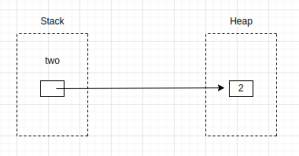
Example :
fn main() {
let two = Box::new(2);
println!("two: {}", *two);
}
Use Cases
- Storing data of unknown size at compile time.
- Creating recursive data structures.
Rc (Reference Counted)
“Rc” is a kind of smart pointer that is used to share ownership of immutable data across different parts of a program within the same thread. It keeps track of how many references exist to a particular value, allowing multiple parts of the code to access it concurrently. It also deallocates the memory when the last reference goes out of scope.
Example :
use std::rc::Rc;
fn main(){
let data = Rc::new(42);
let reference1 = Rc::clone(&data);
let reference2 = Rc::clone(&data);
println!("Data: {}", data);
}
Use Cases:
- Use Rc when you need shared ownership within a single thread.
Arc (Atomic Reference Counted)
Arc and Rc (reference counted) are similar in that they allow for sharing ownership of data across multiple parts of a program and threads. However, Arc is specifically designed to be thread-safe and maintain thread safety across multiple threads. It does this by keeping track of the reference count for a particular value in each thread, allowing multiple parts of the code to access it concurrently. To ensure thread safety, Arc uses atomic operations to manipulate the reference count.
Example :
use std::sync::Arc;use std::thread;fn main() {let data = Arc::new(42);let data_clone = Arc::clone(&data);let handle = thread::spawn(move || {println!("Data in thread: {}", data_clone);});handle.join().unwrap();println!("Data in main thread: {}", data);}
Use case:
- Sharing immutable data between multiple threads.
Mutex &RwLock
Mutex and RwLock are smart pointers that enable the sharing of mutable data across multiple threads. These smart pointers provide interior mutability by synchronizing the shared data across multiple threads. The Mutex provides flexibility by allowing only one thread at a time to access the data, while the RwLock allows multiple threads to read the data and only one thread can write on the data at a time.
Example :
use std::sync::{Arc, Mutex};
use std::thread;
fn main() {
    // Create a new Arc (Atomically Reference Counted) wrapping a Mutex
    // The Mutex will be used to synchronize access to the counter
    let counter = Arc::new(Mutex::new(3));
    let mut handles = vec![];
    for _ in 0..10 {
        // Clone the Arc to share ownership across threads
        let counter = Arc::clone(&counter);
        let handle = thread::spawn(move || {
            // Acquire a lock on the Mutex, blocking until available
            let mut num = counter.lock().unwrap();
            // Increment the counter
            *num += 1;
        });
        // Store the thread handle in the vector
        handles.push(handle);
    }
    // Wait for all threads to finish
    for handle in handles {
        handle.join().unwrap();
    }
    let result = counter.lock().unwrap();
    println!("Result: {}", *result);
}
Use Cases :
- Sharing mutable data between multiple threads safely.
Conclusion
Smart pointers in Rust are a powerful feature for memory management and concurrency features, they enhance the safety and efficiency of Rust programming by ensuring memory safety and preventing data races.