



Introduction
Imagine testing a computer program is like trying out a new recipe. To make sure the recipe (the program) turns out perfect, you need to taste it at different stages and adjust the ingredients accordingly. This tasting process is similar to testing the program with various scenarios. Now, just like you need different ingredients for a recipe, a computer program needs different kinds of data to be tested properly. This data is like the ingredients for the program and creating it can be a time-consuming task. Let’s see the picture of Smart Test Data Generation with AI in Selenium

But what if we had a smart assistant (AI) that could help us come up with different combinations of ingredients (test data) quickly and efficiently? This is where “Smart Test Data Generation with AI in Selenium” comes into play. It’s like having a super chef (AI) helping you create the perfect recipe (test scenarios) faster and better. We’re going to explore how Smart Test Data Generation with AI in Selenium works and why it’s a big deal for testing computer programs effectively. Let’s dive in!
1. Why is Test Data Important?
Think of test data as the fuel for your car—it’s what keeps things moving. In the context of automated testing, test data is what we feed into our tests to check if our applications work as expected. It’s like giving different foods to a robot chef to see if it can cook each dish perfectly.

Test data is a crucial component of software testing, serving various essential purposes to ensure the accuracy, reliability, and performance of software applications.
- Behavior Validation: Validates the expected behavior of the software under various conditions.
- Bug Detection: Helps identify bugs, errors, or unexpected behaviors in the application.
- Requirement Compliance: Verifies compliance with specified functional and non-functional requirements.
- Data Integrity: Ensures accurate storage and processing of data within the application.
- Performance Evaluation: Assesses application performance under varying conditions.
- Security Testing: Evaluates how the application handles and protects sensitive data.
- Error Handling: Verifies appropriate error messages and graceful exception handling.
- Regression Testing: Ensures that recent code changes do not adversely affect existing functionalities.
- Enhanced User Experience: Contributes to a smooth and satisfying user interaction with the application.
Automated testing frameworks like Selenium need a variety of test data to run effectively. However creating all this data by hand is slow, tedious, and prone to errors. That’s why using AI to create smart test data is such a game-changer.
2. Types of Test Data in Software Testing
Test data is essential for effectively validating the behavior and performance of software applications. Here are the main types of test data used in software testing:
1. Valid Data: Data that adheres to the application’s requirements and is expected to be accepted by the system. It helps ensure the software functions correctly with appropriate inputs.
2. Invalid Data: Data that violates the application’s rules or is not allowed. Testing with invalid data helps identify how the system handles unexpected inputs, errors, and exceptions.
3. Boundary Data: Data that lies on the boundaries of valid and invalid input ranges. It helps verify if the software handles edge cases accurately and processes inputs at the extremities correctly.
4. Null or Empty Data: Data containing no value (null) or an empty string. Testing with such data checks how the system handles missing or blank inputs and if it triggers appropriate responses.
5. Erroneous Data: Data intentionally modified to contain errors or inconsistencies. This type of data helps uncover vulnerabilities and weaknesses in the application’s error-handling capabilities.
6. Default Data: Data using default values set by the system. Testing with default data ensures the application functions correctly when no specific input is provided.
7. Random Data: Data generated randomly, providing a variety of inputs to test different scenarios. It helps in identifying unexpected behaviors and performance issues.
8. Stress or Performance Data: Data designed to stress the system by creating extreme conditions, such as high volumes of data or concurrent users. This helps evaluate system performance and stability
3. Traditional Test Data Generation Methods
Traditional test data generation methods have been utilized for decades to create data for testing software applications. These methods predate the integration of artificial intelligence (AI) and are often rule-based or manual approaches. Here are some traditional test data generation methods:
- Manual Data Entry
- Data Generation
- Boundary Value Analysis
- Equivalence Partitioning
- Static Test Data
- Database Copies
- Data Masking and Subsetting
- Dependency Analysis
- Historical Data Analysis
- Domain-Specific Languages (DSLs)
- Data Combination Techniques
The Role of AI in Revolutionizing Test Data Generation
Let’s understand the AI with same example AI is like a wizard that magically creates the perfect ingredients for testing software. It uses smart algorithms to whip up various kinds of data that help in testing. This wizardry speeds up the testing process, ensuring that no stone is left unturned. It’s like having an assistant chef who knows exactly what flavors work well together. With AI, we can test faster, smarter, and find bugs and problems in the software much more effectively. It’s a game-changer in the world of software testing, making everything faster, better, and just a lot more efficient.
1. How AI Revolutionizes Test Data Generation
AI transforms test data generation with its innovative approach:
- Learning from Patterns:
- AI algorithms study patterns in existing data and generate new data resembling these patterns.
- Understanding Application Needs:
- AI comprehends the application’s requirements and creates data that fits those needs accurately.
- Swift and Efficient Generation:
- AI swiftly creates a vast amount of diverse data, significantly speeding up the testing process.
- Adaptability to Changes:
- AI adapts to changes in the application, modifying the generated data accordingly, and maintaining relevance.
- Optimizing Test Coverage:
- AI ensures comprehensive coverage by generating data for various scenarios, including edge cases.
- Integration with Testing Tools:
- AI seamlessly integrates into testing tools, simplifying the overall testing workflow.
In a nutshell, AI works like a skilled assistant chef, swiftly preparing a variety of test data ingredients by learning from patterns and understanding what the application needs. This accelerates testing, ensures thorough coverage, and easily adapts to changes, making the testing process smarter and more efficient.
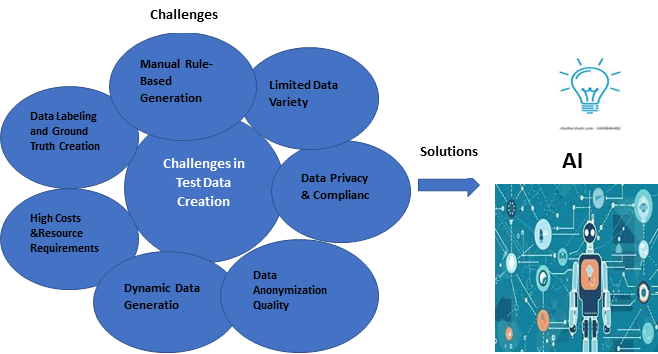
2. Challenges with AI solutions for Test data creation
Traditional automation in test data creation faces several challenges, and AI can help overcome these challenges in innovative ways.
| | Challenges in Traditional Automation | Solutions by AI in Test Data Creation |
| Manual Rule-Based Generation | Creating test data using manual rule-based approaches is time-consuming, error-prone, and may not cover diverse cases effectively. | AI, through generative models like GANs, learns from data patterns to efficiently generate diverse and realistic synthetic test data, overcoming these challenges |
| Limited Data Variety | Limited diversity in traditional automated test data due to predefined rules. | AI analyzes diverse data, identifying patterns to generate a broader range of test data, improving coverage. |
| Data Privacy and Compliance | Safeguarding sensitive data during automated test data creation. | Anonymize and de-identify data while complying with privacy regulations using advanced AI techniques like federated learning and differential privacy. |
| Data Anonymization Quality | Anonymizing data manually may result in residual identification risk, compromising privacy. | AI enhances data anonymization by automatically identifying and redacting personally identifiable information (PII) using NLP, preserving data utility while ensuring privacy. |
| Dynamic Data Generation | Adapting test data to evolving applications. | AI adapts and learns from new data patterns, keeping test data relevant with evolving applications through continuously learning models, mirroring real-world changes. |
| High Costs and Resource Requirements | High costs and resource demands of traditional automation tools. | AI streamlines test data creation, cutting costs and resources by automating the generation and management of diverse test datasets. |
| Data Labeling and Ground Truth Creation | Time-consuming manual data labeling for ground truth. | AI automates data labeling using techniques like active learning, optimizing the process by identifying uncertain samples for human review. |
Conclusion-
In conclusion, we will continue this blog in the next part. We will also see the integration of selenium with AI through the framework. Integrating AI-powered test data generation with Selenium presents a promising approach to enhance software testing. We will look at the approaches and advantages of AI in Test Data Generation using Selenium here
References-
https://cloud.google.com/vertex-ai/docs/generative-ai/learn/overview
https://www.linkedin.com/advice/0/how-do-you-use-artificial-intelligence-generate