


Introduction
Sustainability is no longer a buzzword. It has become a global priority.
From climate change carbon emissions to ethical business practices and renewable energy, sustainability affects governments, corporations, and individuals alike.
But what does sustainability really mean?
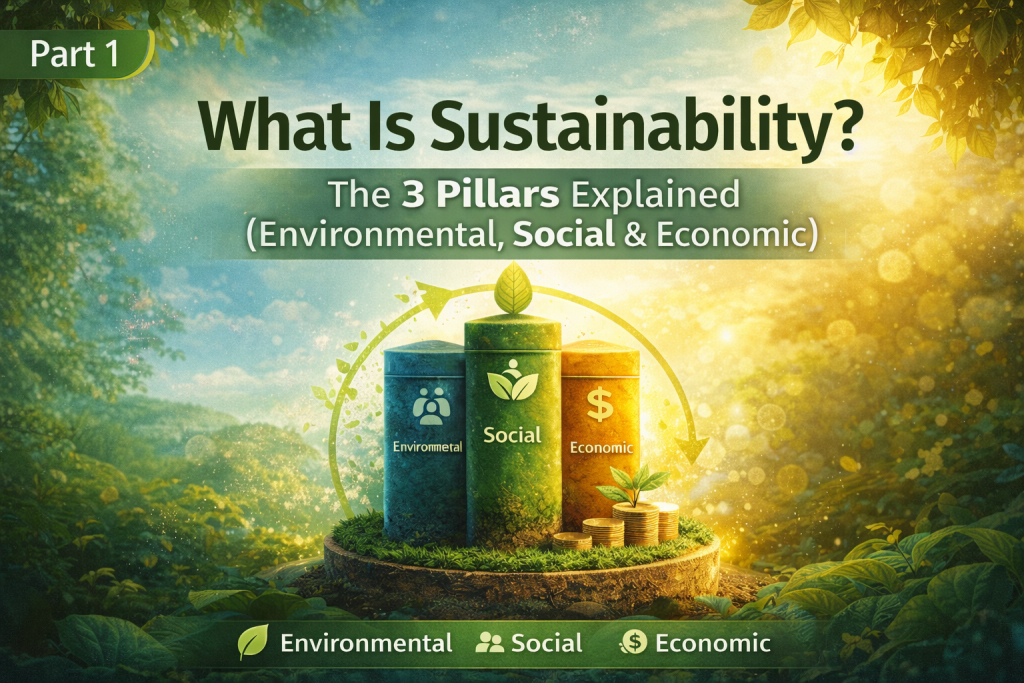
At its core, sustainability is about balancing three things:
- Environments protection
- Social responsibility
- Economic growth
It’s about building systems that work today – without damaging tomorrow.
In this first part, we’ll understand the foundations of sustainability and why it has become essential in the modern world.
What is Sustainability?
Sustainability means meeting present needs without compromising the ability of future generations meet theirs.
It is built on three:
1 Environment Sustainability
This focuses on protecting natural resources and reducing environmental harm.
Key areas include:
- Reducing carbon emissions
- Renewable energy adoption
- Wase management
- Water conservation
- Biodiversity protection
With rising global temperatures and extreme climate events, environmental sustainability has become urgent.
2 Social Sustainability
This pillar ensures fairness, equality, and community well-being.
It includes:
- Fair labor practices
- Workplace safety
- Diversity and inclusion
- Human rights protection
- Community engagement
A sustainable society ensures that economic growth benefits everyone – not just a few.
3 Economic Sustainability
This focuses on long-term financial growth without harming environmental or social systems.
It promotes:
- Responsible investment
- Ethical supply chains
- Risk management
- Efficient resource usage
Sustainable businesses think long-term, not just quarterly profits.
Why Sustainability is Now a Business Priority
Earlier, sustainability was considered optional – something companies did for reputation.
Today, it is strategic.
Here’s why:
Regular Pressure
Governments worldwide are introducing climate regulations, carbon taxes, and ESG compliance requirements.
Investor Expectations
Investors now evaluate companies based on ESG (Environmental, Social, Governance) metrics.
Consumer Awareness
Consumers prefer brands that demonstrate responsibility toward the planet.
Risk management
Climate risks directly impact operations, supply chains, and infrastructure.
Sustainability is no longer charity. It is risk management and a competitive advantage.
ESG: The Business Framework of Sustainability
It provides measurable indicators to evaluate sustainability performance.
Companies track:
- Carbon footprint
- Energy consumption
- Diversity ratios
- Board transparency
- Ethical governance
ESG reporting has become critical for attracting investors and building trust.
The Carbon Challenge
One of the biggest sustainability challenges is carbon emissions.
Emissions are categorized into:
- Scope 1: Direct emissions (company-owned operations)
- Scope 2: Indirect emissions (purchased electricity)
- Scope 3: Supply chain emissions
Many organizations struggle, especially with Scope 3, because it involves suppliers and partners.
Understanding emissions is the first step toward reducing them.
Conclusion of Part 1
Sustainability is not just about protecting nature. It is about building resilient systems – socially, economically, and environmentally.
Businesses that ignore sustainability risk are becoming irrelevant.
Businesses that embrace it gain long-term stability.
In part 2, we’ll go deeper into:
- How organizations implement sustainability
- Technology’s role in sustainability
- Carbon calculation systems
- Sustainability reporting
- The future of green technology