


One silent bottleneck that still affects test speed, coverage, and reliability in the dynamic field of software testing is test data. Even though automation frameworks have become more robust, test data handling is still frequently static, fragile, and done by hand.
A clever, dynamic, and framework-agnostic test data generation management strategy is not only useful but essential as teams expand testing across UI, API, and mobile platforms. The game-changer in this situation is plugin-based synthetic test data generation.
The Case for Modern Test Data Management
Consider creating a reliable Selenium test that fails because the test data was manually typed or stale, rather than because of a bug. Or worse, an Appium test that fails because a test email was blocked and reused
These issues often stem from:
- Rigid, hardcoded datasets
- Lack of reusability across frameworks
- No support for contextual or edge-case data
- Manual overhead in updating and maintaining test inputs
The solution isn’t just generating data, it’s building a system where test data becomes a first-class citizen, dynamically tailored, securely handled, and easily integrated with automation pipelines.
A Plugin-Based Architecture: The Bridge Between TDM and Automation
A modular, plugin-based Test Data Management (TDM) framework forms the basis of this strategy. Its goal is simple: automated tests should be able to ask for new, legitimate data whenever they need it, without having to know how or where it was produced.
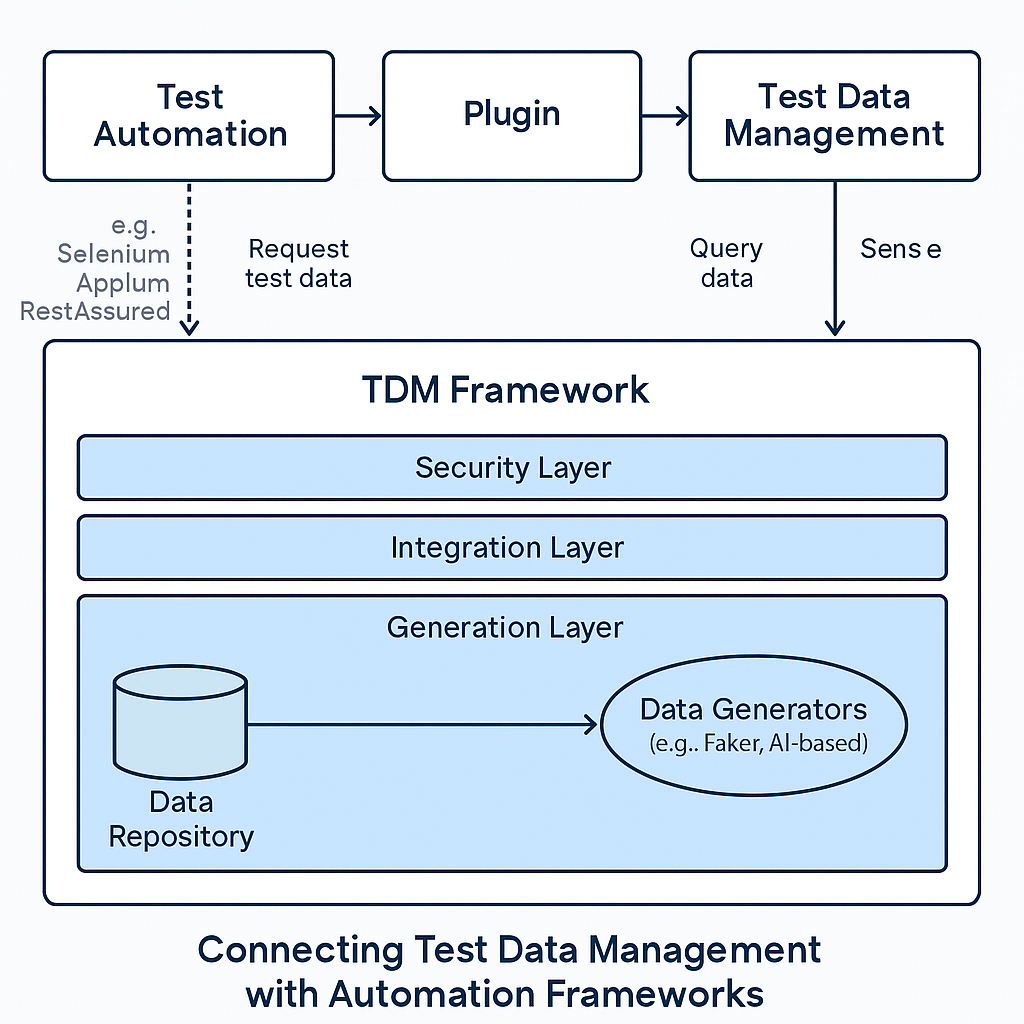
The architecture is structured into distinct functional layers, each with a distinct role, to support this. The system is simpler to expand, maintain, and incorporate into any test automation environment thanks to its tiered structure.
- Core Management: Handles logic and registration of data generators.
- Generation Layer: Produces data using static rules, randomised logic, or even AI.
- Integration Layer: Offers pluggable interfaces to frameworks like Selenium, Appium, and RestAssured.
- Security Layer: Ensures sensitive data is masked, tracked, and policy-compliant.
This separation of concerns allows the framework to scale, extend, and adapt without disrupting test logic.
The Role of Plugins in Framework Integration
The real power of this system lies in its plugin ecosystem. These plugins act as the bridge between the TDM framework and your test automation tools. Whether you’re running a mobile test on Appium or a UI test with Selenium, the plugin delivers the right data in the right format exactly when your test needs it.
Instead of dealing with complexity, testers rely on these plugins to handle the heavy lifting. They no longer need to manually create fake users, generate email addresses, or worry about data duplication. Instead, they work with high-level functions like:
getTestData("UserProfile")
getReusableData("Transaction")
The plugin takes care of everything in the background. It communicates with the engine that generates synthetic data, retrieves new artificial intelligence (AI)-powered or synthetic data, and feeds it straight into the test case.
Additionally, data consistency across testing platforms is guaranteed by the plugin. A user created in an API test, for instance, can be reused in a UI test without creating duplicates. Reusable data repositories and centralised storage make your test data generation a shared resource rather than a separate one.
Dynamic Data Generation: Contextual and Customizable
This framework lets you make both custom and random data. You can give the system specific parameters, like a user from the “Engineering” department, or let it make completely random profiles.
This flexibility meets a range of testing needs:
- Controlled testing with targeted input
- Exploratory testing with unexpected edge cases
- High-volume testing for performance or load scenarios
In addition, the system integrates with AI services like OpenAI or Gemini, allowing it to generate complex scenarios. You can easily simulate rare conditions, regulatory edge cases, or negative paths, without manual setup.
Built with Flexibility in Mind
The fact that this framework is built with developers in mind is what makes it stand out. It was made in Java and uses well-known libraries like Faker to make data that looks real. The layered structure keeps things neat, modular, and easy to fix.
Here are some ways the framework helps with real-world use:
- Developers can register new plugins or generators with minimal setup
- Testers can change behaviour across environments (dev, QA, staging) using simple config files
- Works smoothly in Visual Studio Code and integrates with GitHub Actions for CI/CD pipelines
This design enables teams to evolve quickly without rewriting code. Need to support a new data type or testing tool? Just plug it in and go.
Key Benefits at a Glance
- Framework-agnostic integration
Works with any test tool (Selenium, Appium, RestAssured, etc.) - Dynamic, real-time data
Replace stale test inputs with tailored, on-demand data - Built-in security and compliance
Includes masking, access control, and audit logs - Developer + QA synergy
Designed for smooth collaboration between coders and testers - DevOps-ready scalability
Easily scales for parallel testing and CI pipelines
Final Thoughts: Delivering Test Data as a Service
In today’s fast-moving development cycle, reliable test data is just as critical as fast execution. Hardcoded or duplicated data slows you down and clutters your automation.
That’s why this plugin-based architecture makes such a difference. Instead of relying on static data, your test automation tools now use a smart, flexible service that quickly generates and manages clean, relevant data.
You’re not just creating test data, you’re optimising the entire testing process. You make your tests smarter, your runs faster, and your maintenance lighter.
By treating test data as a service, not a problem, you simplify QA workflows and build confidence into every release.