Introduction
In Software Testing, we write test cases, define expected results, and verify that the system behaves correctly. We are humans, and humans bring bias into everything they do.
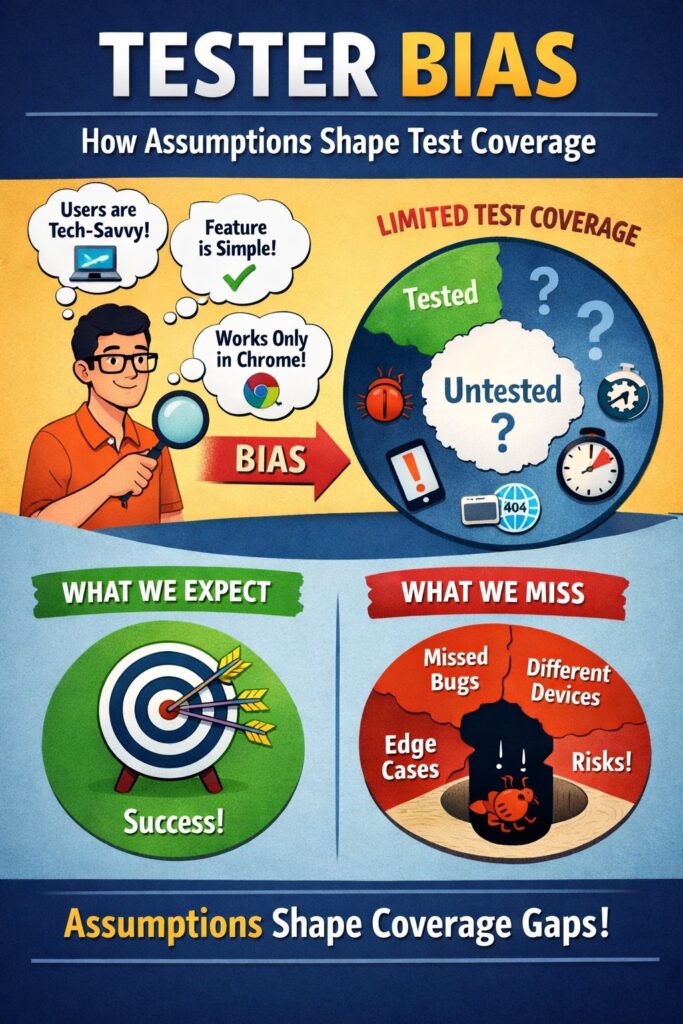
Every test case reflects our assumptions about how the system should behave, how users will interact with it, and where failures are most likely to occur. These assumptions dictate test coverage in powerful yet subtle ways, often quietly leaving critical gaps unnoticed.
What Tester Bias Really Looks Like
Tester bias isn’t about being careless or lazy. It’s about being human.
We test what we believe will work, based on the business requirement.
Most tests follow the happy or critical path. We check valid inputs, expected flows, and normal usage scenario.
But it also means we often avoid the uncomfortable truth: What if this breaks in a way I didn’t expect?
We Avoid What We Don’t Understand
Complex or poorly documented scenarios of the system often get less testing. Not because they’re less risky, but because they’re harder to talk about.
Ironically, those are usually the parts that need the most attention due to how messy they tend to be.
We assume users behave within the realm of our expectation.
We expect users to follow rules, read messages, and provide valid input. Real users may or may not do that.
When tests assume “reasonable” behavior, production leakage quickly proves them wrong.
How Bias Dictates Test Coverage
This is why high test coverage can still miss critical bugs.
The feature may be covered, but only under conditions we expected.
Edge cases, weird combinations, and unexpected input stay unexplored , not because we chose to ignore them, but because we didn’t think of them during the testing phase.
A Simple Real-World Example
Testing a form that asks for a user’s age.
Most tests check:
- Valid numbers
- Typical values
- Basic boundaries
But real failures come from:
- Negative values
- Very large numbers
- Non-numeric input
- etc …
The form looks easy to test and well-tested, yet it still breaks in production.
Where Bias Enters the Testing Process
Bias actually starts earlier than most teams realize, often before the first test is written.
The moment we start deciding “What should I test?”, we are already making assumptions:
- Which behaviors matter
- Which inputs are “normal”
- Which failures are unlikely
- Which areas are safe to ignore
These decisions shape the test suite long before automation or execution comes into play.
How to Notice Bias in Your Own Tests
If your tests never surprise you, they might not be pushing the boundary hard enough.
- Tests that closely follow the code structure
- Very few tests for negative cases
- Tests that almost never fail
- Heavy reliance on coverage numbers for confidence
- Test that are too “perfect”
Managing Bias Is the Real Goal
The goal isn’t to eliminate bias. That’s almost impossible.
- Let someone else review your tests
- Use exploratory testing
- Try mutation testing to challenge your logic
- Rotate who writes and owns tests
- Write tests from user’s point of view
Different perspectives detect different problems.
Final Thought
Your test suite is not a map of your system. It’s a map of your thinking.
The more willing you are to challenge your own bias, the more valuable your tests become.
Tests don’t show the whole system; they show what you thought to check.