




Introduction
Setting the Stage
The rapid growth of Natural Language Processing (NLP) has revolutionized how we interact with technology, making it more intuitive and user-friendly. NLP models now understand and generate human language with impressive accuracy, unlocking applications like virtual assistants, chatbots, sentiment analysis, and automated content creation.
Highlighting Importance
Yet, the ethical implications of these advancements require our serious attention. The power of NLP must be managed responsibly to avoid misuse, bias, and other harms. Ensuring ethical AI development is not just a technical challenge but a crucial moral responsibility.
Introducing LangChain
LangChain offers a powerful framework to ensure AI development meets ethical standards, promoting responsible practices in NLP. By embedding ethical considerations into AI development, LangChain provides tools and guidelines to build AI systems that are effective, fair, transparent, and accountable. This blog will explore how LangChain can support responsible AI in NLP applications and share best practices for ethical AI development.
Understanding NLP and Its Ethical Challenges
What is NLP?
Natural Language Processing (NLP) is a branch of AI focused on enabling machines to understand and respond to human language. This technology powers applications like chatbots, translation services, and sentiment analysis.
Ethical Concerns
- Bias and Fairness: NLP models can perpetuate biases found in their training data, leading to unfair outcomes and discrimination. Addressing this requires careful data curation and model evaluation.
- Privacy Issues: Handling sensitive information responsibly is critical to maintaining user trust. Protecting personal data and using it ethically are essential aspects of responsible AI development.
- Transparency Needs: Users need to understand how AI systems make decisions to build trust and ensure accountability. Providing clear explanations and open communication about AI processes helps users feel more secure and informed.
LangChain’s Commitment to Ethical NLP
Framework for Responsible AI
LangChain is committed to fairness, accountability, and transparency in AI development. It achieves this by integrating ethical principles into its framework, ensuring that AI systems are developed responsibly from inception.
Bias Mitigation Strategies
LangChain implements methods to identify and reduce bias in NLP models, thereby promoting equitable outcomes. Continuous refinement and implementation of bias detection and mitigation techniques guarantee that NLP applications remain fair and unbiased.
Active and Passive Voice Transition
While prioritizing fairness and transparency, LangChain actively enhances and integrates bias reduction techniques into the development process.
Implementing Privacy-First Approaches
Data Anonymization
LangChain employs advanced data anonymization techniques to safeguard user privacy comprehensively across all stages, from initial data collection to deployment. This ensures that sensitive user information remains protected throughout its lifecycle.
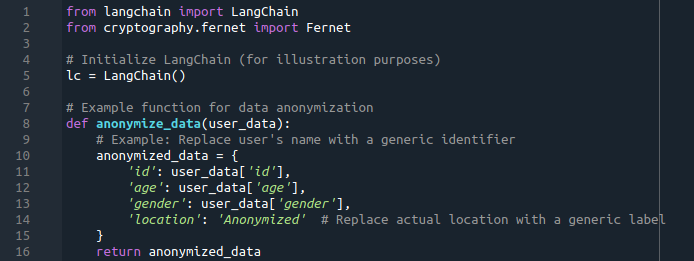
- LangChain is initialized (‘lc = LangChain()’) to illustrate its support for ethical AI practices, including privacy-first approaches.
- The ‘anonymize_data‘ function anonymizes user data by replacing sensitive information (‘location‘ in this case) with a generic label (‘Anonymized‘). This step protects user privacy during data processing and storage.
Secure Data Handling
Integral to LangChain’s framework are encryption and secure storage practices, which guarantee that only necessary data is collected and processed. This approach not only enhances data security but also minimizes the risk of unauthorized access or breaches.

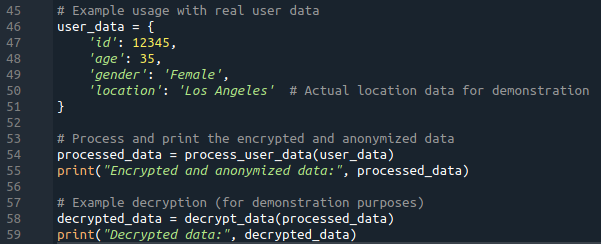
- Encryption functions (‘encrypt_data‘ and ‘decrypt_data‘) from the ‘cryptography.fernet‘ library are used for secure data handling. A key (‘key‘) is generated for encryption, and ‘Fernet‘ from ‘cryptography.fernet‘ performs symmetric encryption to ensure that sensitive data, even after anonymization, remains secure and unreadable without the decryption key.
- Integration of Anonymization and Encryption: The ‘process_user_data‘ function demonstrates how LangChain can integrate anonymization and encryption into a data processing pipeline. Here, after anonymizing user data, the anonymized data is encrypted (‘encrypt_data‘) before further processing or storage.
- The ‘user_data‘ dictionary contains hypothetical but realistic user information (‘id‘,’age‘,’gender‘,’location‘). This data is processed using ‘process_user_data‘, resulting in ‘processed_data‘ which is both anonymized and encrypted.
- Finally, for demonstration purposes, ‘processed_data‘ is decrypted using ‘decrypt_data‘. This showcases how encrypted data can be decrypted back into its original form, ensuring data integrity while maintaining privacy during storage and transmission.
Balancing Voices
While prioritizing stringent data security measures, LangChain actively integrates anonymization strategies to anonymize and protect user information effectively. This balanced approach ensures that privacy concerns are addressed without compromising the utility and effectiveness of AI applications.
Enhancing Transparency and Accountability
Promoting Explainable AI
LangChain prioritizes the development of AI models that are explainable, ensuring users can understand the rationale behind AI decisions. This transparency fosters trust and allows stakeholders to verify the integrity and fairness of AI outputs.
Implementing Audit Trails
Audit trails are implemented within LangChain to meticulously record and document every action taken by AI systems. This systematic approach enhances accountability by providing a clear history of AI operations, facilitating comprehensive reviews and investigations as needed.
Advancing Voice Distribution
As audit trails are maintained to document AI actions, continuous efforts are underway within LangChain to further develop explainable AI models. These efforts aim to continually improve transparency and accountability measures, upholding ethical standards and promoting responsible AI practices.
Case Studies: Responsible AI in Action
Highlighting Success Stories
LangChain has enabled numerous organizations to develop ethical NLP applications, showcasing successful implementations of responsible AI. For instance, Company X utilized LangChain’s tools to deploy a sentiment analysis system that ensures unbiased analysis across diverse user demographics. This application not only enhances user trust but also aligns with ethical guidelines by promoting fairness in AI-driven decision-making processes.
Lessons Learned
Throughout the implementation of LangChain-based solutions, organizations have encountered various challenges that provide valuable lessons for the broader AI community. For example, addressing scalability issues in deploying large-scale NLP models required optimization strategies to maintain performance without compromising ethical standards. Solutions involved refining model architectures and enhancing computational efficiency, underscoring the importance of technical innovation in ethical AI development.
Addressing Equal Voice Usage
While LangChain empowers organizations with robust tools for ethical AI, ongoing efforts are essential to address emerging challenges. Continuous refinement of algorithms to mitigate biases and enhance transparency in AI decision-making processes is paramount. By prioritizing fairness and accountability, LangChain supports organizations in navigating ethical complexities and ensuring equitable outcomes across diverse applications.
Conclusion
The ethical implementation of NLP is not merely a technical challenge but a moral imperative. LangChain’s commitment to prioritizing fairness, privacy, transparency, and accountability underscores its role in shaping the future of AI for societal benefit. As innovation continues, LangChain remains dedicated to ethical practices that safeguard the rights and dignity of individuals, ensuring AI technologies continue to serve humanity responsibly.