



Introduction
Generative artificial intelligence (AI) is revolutionizing how machines create new content. From realistic images to music and text, generative AI pushes the boundaries of creativity. In this post, we will explore how .NET empowers developers to harness generative AI’s potential. .NET provides an accessible platform to build and deploy sophisticated AI models that can learn, adapt, and generate new content with astonishing accuracy. Let’s dive into the world of development and innovation.
Understanding Generative AI
What is Generative AI?
Generative AI refers to algorithms that can generate new, previously unseen data. These models learn from existing datasets to produce original content, such as images, sounds, or text, that is similar but not identical to their training data.
How it works?
Gen AI uses statistical patterns found in data to output new instances. This process often involves complex neural networks that can capture and reproduce the structures of the input data.
Types of Generative Models
- Variational Autoencoders (VAEs): These models create new data that’s similar to their input while also learning a compressed representation.
- Generative Adversarial Networks (GANs): GANs use two competing networks to produce new data, with one network generating candidates and the other evaluating them.
- Recurrent Neural Networks (RNNs): RNNs are particularly good at generating sequential data, like text or music, by predicting the next item in a sequence.
.NET Framework for Generative AI
.NET’s versatility and robust libraries make it an excellent choice for developing generative AI applications. Here are some examples that illustrate the power of .NET in this domain:
1. Advantages of Using .NET:
- Versatility: For instance, a developer proficient in C# can easily transition to using F# for certain data science tasks, thanks to .NET’s multi-language support.
- Robust Libraries: Libraries like ML.NET , TensorFlow allow for easy integration with machine learning models, while TensorFlow.NET enables deep learning capabilities within the .NET environment.
- Scalability: A generative AI model developed using .NET can be deployed on a local machine, a server farm, or cloud platforms like Azure, providing flexibility in scaling the application.
2. ML.NET: Machine Learning Made Easy
ML.NET is an open-source, cross-platform framework developed by Microsoft to empower .NET developers with machine learning capabilities. It also provides AutoML api.
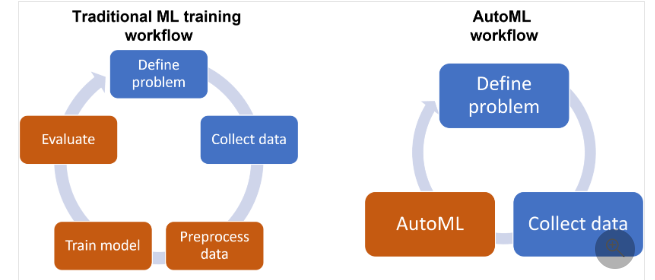
AutoML: Automated machine learning (AutoML) automates the process of applying machine learning to data. Given a dataset, you can run AutoML to iterate over different data transformations, machine learning algorithms, and hyperparameters to select the best model.
- Example: A developer can use ML.NET to build a recommendation system that suggests products to users based on their browsing history, leveraging generative models to predict user preferences.
3. TensorFlow.NET: Bridging .NET and TensorFlow
TensorFlow is a freely available framework for machine learning created by Google. It’s designed for constructing neural networks and executing a wide array of machine learning processes. The framework operates on a structure known as a data flow graph, where the nodes represent mathematical computations, and the tensors, which are arrays of data, act as the connecting edges.
- Example: An artist can use TensorFlow.NET to create a GAN that generates new artwork, learning from a dataset of classical paintings to produce original pieces that mimic the style of old masters.
- After installation of the Tensorflow.NET SDK, we can build a basic console application using the TensorFlow.NET framework, the sample code for console application and it’s relevant output would look like this –
using System;

using static Tensorflow.Binding;
namespace TensorFlowNET.Examples{
class Program{
static void Main(string[] args){
var hello = tf.constant("Hello, TensorFlow!");
Console.WriteLine(hello);
}
}
}
Output –
4/24/2024 12:50:18 PM Starting Hello World
tf.Tensor: shape=(), dtype=string, numpy=Hello, TensorFlow.NET!
4/24/2024 12:50:18 PM Completed Hello World
Example: Hello World in 0.1273463s is OK!
TensorFlow.NET v0.20.1.0
TensorFlow Binary v2.3.0
1 of 21 example(s) are completed.
Press [Enter] to continue...
Building Generative Models
Generative models are at the forefront of AI research, enabling machines to create new content. There are 3 most popular generative models using .NET – which we have already discussed above (refer subheading – Types of Generative Models). We will discuss one of them, Variational Autoencoders (VAE) and its implementation using TensorFlow.NET in a bit more detail:
Developing a Variational Autoencoder (VAE) using .NET involves several steps, from setting up the environment to coding the neural network architecture. Here’s a high-level overview of the process:
- Environment Setup:
- Set up a machine learning environment with libraries such as ML.NET and TensorFlow.NET, which can be installed via NuGet package manager.
- Data Preparation:
- Load and preprocess your dataset. For image data, this might include normalization.
- Building the Encoder:
- Define the encoder part of the VAE, which compresses the input into a latent space representation.
- Use layers like Dense for fully connected layers and apply non-linear activation functions.
- Latent Space Sampling:
- Create a custom function to sample from the latent space.
- Building the Decoder:
- Define the decoder, which reconstructs the input data from the latent space representation.
- Defining the Loss Function:
- Implement the VAE loss function, which is a combination of Generative and Latent loss.
- Training the Model:
- Train the model on your data, ensuring to use both the encoder and decoder.
- Model Evaluation and Generation:
- Evaluate the model’s performance using appropriate metrics.
Natural Language Processing (NLP)
Natural Language Processing (NLP) focuses on granting computers the capability to process, and mimic human language. This domain includes a range of activities, including analyzing text, converting languages, and creating conversational agents. Utilizing advanced techniques from machine learning and deep learning, NLP systems are good at deriving significance from written information.
Integration with .NET Core:
.NET Core provides a robust and scalable environment for building modern applications. The integration of NLP with .NET Core extends the capabilities of developers, allowing them to leverage NLP functionalities seamlessly within their applications.
1. NLP Libraries and APIs: .NET Core supports the integration of various NLP libraries and APIs. Libraries like SpaCy, NLTK (Natural Language Toolkit), and pre-trained models such as BERT can be integrated into .NET Core applications, empowering developers to perform advanced language processing tasks.
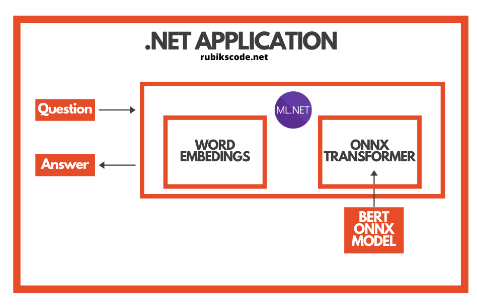
2. Custom NLP Modules: Developers can build custom NLP modules using .NET Core, developing solutions to meet specific application requirements.
3. Microservices Architecture: .NET Core’s supports microservices architecture which aids in implementing NLP in applications. Developers can design microservices that focus on specific NLP tasks, promoting scalability & maintainability.
4. Azure Cognitive Services Integration: Microsoft Azure offers Cognitive Services, including NLP services, that seamlessly integrate with .NET Core. Developers can leverage Azure Text Analytics, Language Understanding (LUIS), and Translator services to enhance their applications.
Challenges
The challenges encountered when developing and working with Generative AI in .NET are as follows –
- Availability of Libraries: While TensorFlow.NET provides a strong foundation for implementing deep learning models, the availability of specialized libraries and pre-trained models within the .NET ecosystem is limited compared to Python-based frameworks. This pose challenges while developing specific generative tasks.
- Performance Overhead: The interoperability between .NET and TensorFlow.NET introduces a performance overhead compared to native TensorFlow implementations in Python. This overhead can also impact training and inference speed.
- Integration with Existing .NET Applications: Integrating Generative AI models into existing .NET applications may present challenges due to differences in infrastructure requirements.
- Limited Tooling and Ecosystem: .NET ecosystem lacks specialized tools, frameworks, and components for Generative AI tasks. Developers may need to rely on general-purpose libraries and tools which can increase development complexity and time-to-market.
As the .NET ecosystem continues to evolve, addressing these challenges will lead to more innovation in Generative AI applications within the .NET framework.
Conclusion
As we wrap up our exploration of combining the capabilities of GenAI with .NET, we can conclude ii is immensely useful. Leveraging libraries like TensorFlow.NET and ML.NET, we can develop powerful tools that will help in multiple scenarios. From generating lifelike images to composing music, Generative AI fuels creativity to new heights within the .NET ecosystem.
Yet, there are certain challenges such as optimization and ethical considerations which demand careful attention. TensorFlow.NET and ML.NET empower developers to optimize performance and navigate ethical concerns, ensuring responsible innovation.
References
- NLP & .NET Core Integration – https://www.linkedin.com/pulse/natural-language-processing-nlp-net-core-integration-action-kelahmet-popuc/
- TensorFlow.NET Documentation – https://tensorflownet.readthedocs.io/en/latest/
- NLP with .NET | Medium – https://medium.com/@turkmvc/natural-language-processing-nlp-with-net-7fa9fe59a524
- AutoML | Microsoft – https://learn.microsoft.com/en-us/dotnet/machine-learning/automated-machine-learning-mlnet