


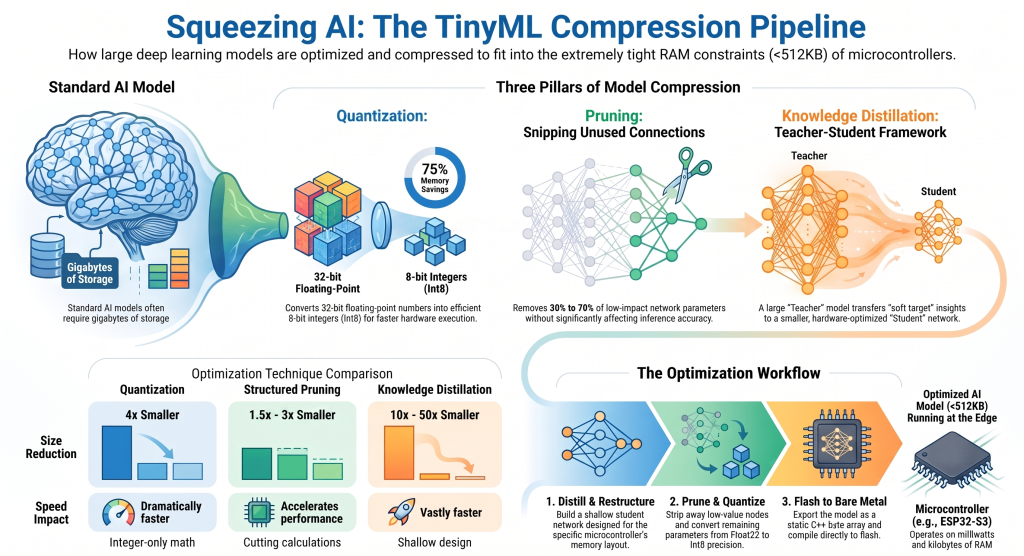
A standard deep learning model trained in the cloud – whether it is an object detector, a speech processor, or a natural language classifier – can easily consume hundreds of megabytes or even gigabytes of storage. Running these networks requires fast GPUs and massive power supplies.
But when you target the Microcontroller Edge, the rules change completely.
Popular microcontrollers like the ESP32-S3 or an ARM Cortex-M4 operate on milliwatts of power but offer very tight constraints—frequently giving you less than 512 Kilobytes of usable RAM. Trying to deploy a raw cloud-trained AI model directly to an embedded chip is impossible; the model is simply too heavy.
To bridge this massive architectural gap, engineers rely on three foundational Model Compression techniques: Quantization, Pruning, and Knowledge Distillation. By deploying these strategies, you can reduce a model’s memory footprint by up to 50x while keeping its intelligence intact.
1. Quantization: Simplifying the Mathematical Precision
During cloud training, neural networks rely on 32-bit floating-point numbers () to represent weights and activations. This level of precision handles granular fractions effortlessly but places a heavy tax on microcontrollers, where floating-point math chips are either absent or slow, and every numerical value consumes 4 full bytes.
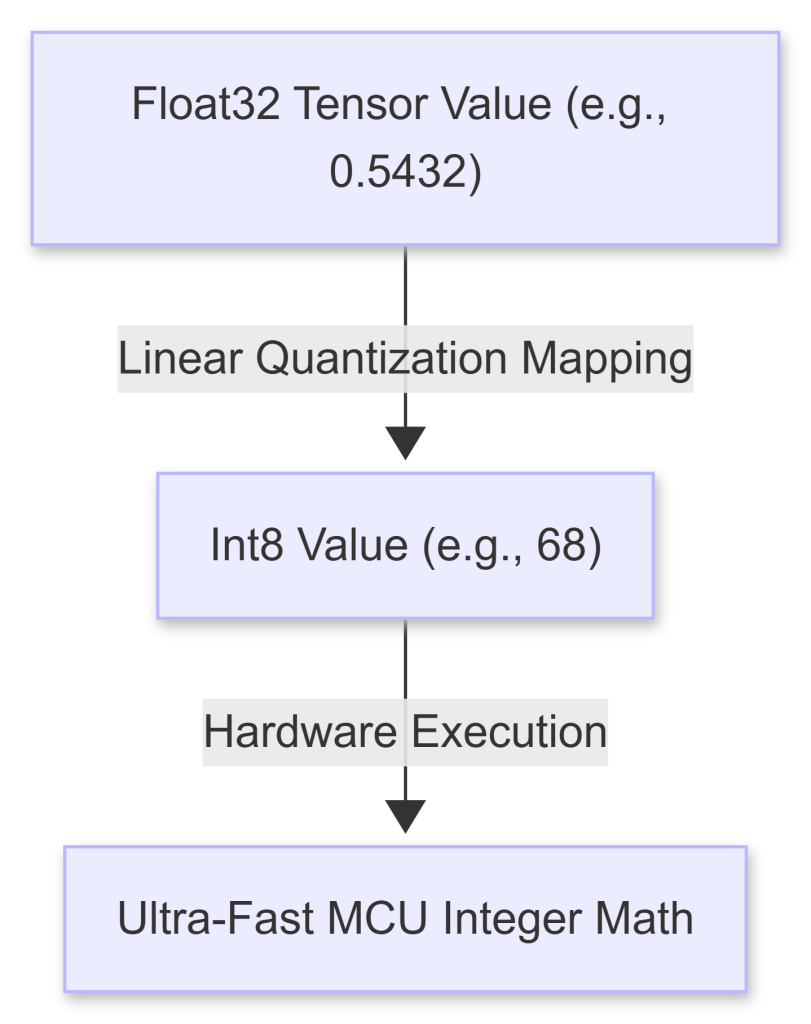
Quantization is the process of lowering this numerical resolution—mapping high-precision fractions into highly efficient 8-bit integers () that span plain whole numbers from -128 to 127.
The Scale Factor Equation
o execute this conversion without destroying the underlying patterns, frameworks map floating-point arrays onto integer arrays using a scaling factor () and a zero-point integer ():
Where:
- represents the input weight or activation value.
- is the resulting compressed integer.
Float32 Range:  [-1.0  -----------------------------  1.0]
                      \                           /
                       \                         /
Int8 Range:     [-128  ------------ 0 ------------ 127]
Why Quantization Matters
- 4x Flash & RAM Savings: Dropping from 32 bits per weight to 8 bits immediately cuts the storage requirement by exactly 75%.
- Hardware Acceleration: Microcontroller processing units chew through whole-number calculations orders of magnitude faster than multi-byte floating-point math.
2. Pruning: Snipping Away Unused Connections
If quantization focuses on making the math simpler, pruning is about cutting away unnecessary structural components altogether.
During the training phase, neural networks form millions of interconnected pathways. However, post-training analysis consistently reveals that a massive percentage of these connection weights drift extremely close to zero. These low-value weights consume RAM but contribute virtually nothing to the network’s final predictions.
Pruning acts as an algorithmic pair of shears, identifying these low-impact parameters and deleting them entirely from the graph.
[Before Pruning]                      [After Pruning]
   (Neuron A)                            (Neuron A)
    /   |   \                             /      \
 weight weight weight                    weight   [Cut]
  0.8    0.02   -0.95                     0.8     -0.95
    \   |   /                             \      /
   (Neuron B)                            (Neuron B)
Engineers typically approach pruning via two methodologies:
- Unstructured Pruning: Individual weak weights are removed regardless of location. While this reduces the overall file size when compressed, it creates a sparse matrix full of numerical “holes,” which standard microcontrollers cannot always calculate any faster.
- Structured Pruning: Entire channels, columns, or operational layers are snipped out together. This leaves behind a smaller, dense matrix that perfectly fits the linear computing layout of an embedded processor, accelerating execution speed.
By applying structured pruning, you can typically strip out 30% to 70% of a model’s network connections before experiencing any noticeable loss in inference accuracy.
3. Knowledge Distillation: The Teacher-Student Framework
When compressing an existing large model still leaves it too large for an embedded device, engineers pivot to an architecture-level approach: Knowledge Distillation.
Instead of trying to shrink a heavy cloud model down to a microcontroller size, you build a completely separate, lightweight “Student” network designed from day one to match your hardware limits. You then run both networks simultaneously in a training environment, using the high-accuracy “Teacher” model to train the nimble Student.
                     +----------------------------+
                     |  Large Teacher Model       |
                     |  (Deep Layers / Float32)   |
                     +--------------+-------------+
                                    |
                                    | Generates Soft Targets
                                    v
+------------------------+   Distillation Loss   +------------------------+
| Hard Labels            |<--------------------->| Small Student Model    |
| (Ground Truth Data)    |                       | (Shallow / Bare-Metal) |
+------------------------+                       +------------------------+
Soft Targets vs. Hard Targets
Instead of just learning from binary training data (e.g., [1 = Cat, 0 = Dog]), the student network learns from the teacher’s nuanced probability distributions, known as soft targets (e.g., [0.85 Cat, 0.15 Dog]).
These soft targets contain dark knowledge—hidden insights about structural similarities that the teacher discovered during training. As a result, the student network achieves high accuracy levels while using a fraction of the computational layers.
The TinyML Model Compression Optimization Flow
Squeezing intelligence into bare-metal flash arrays requires a systematic optimization sequence to protect accuracy metrics from degrading:
1.Train the Teacher Network:
Cloud Step.
Train a full-sized, uncompressed neural network using float32 precision within an unconstrained cloud environment until it achieves top performance.
2.Transfer Knowledge via Distillation:
Architecture Step.
Build a shallow student network designed for your microcontroller’s memory layout and train it to mimic the teacher’s output distribution.
3.Apply Structural Pruning:
Optimization Step.
Analyze the student model matrix, isolate low-value nodes or channels, and strip them away to clean up the computing graph.
4.Execute Post-Training Quantization:
Compression Step.
Convert the remaining model parameters from Float32 to Int8 integers using optimization libraries like TensorFlow Lite for Microcontrollers.
5.Flash Firmware to Bare Metal:
Deployment Step.
Export the compressed model array as a static C++ byte array header file and compile it straight onto your microcontroller’s flash storage.
Core Compression Techniques Compared
Choosing the right optimization tool depends entirely on your specific hardware limits:
| Optimization Technique | Primary Impact Matrix | Approximate Size Reduction | Effect on Processing Speed |
| Quantization (Float32 Int8) | Lowers mathematical precision | 4x smaller | Dramatically faster execution on integer-only microcontrollers |
| Structured Pruning | Deletes zero-impact neurons/channels | 1.5x to 3x smaller | Accelerates performance by cutting out matrix calculations |
| Knowledge Distillation | Restructures the model architecture | 10x to 50x smaller | Vastly faster execution due to a shallow, optimized design |
Summary
Thanks to the combined power of quantization, pruning, and knowledge distillation, AI models do not need to stay locked away in energy-intensive data centers. By systematically stripping out mathematical clutter and restructuring network layers, we can distill advanced intelligence into compact, self-contained binary structures.
This model compression pipeline allows developers to build low-power, instant-response TinyML applications that run entirely offline on simple, inexpensive microcontrollers.