


The world of frontend frameworks is evolving rapidly. In 2025, developers have more choices than ever before, each offering different strengths, weaknesses, and use cases. Whether you’re building a complex web application or a lightweight blog, choosing the right frontend framework is essential for performance, scalability, and maintainability.
Below are the most popular and powerful frontend frameworks in 2025 based on developer adoption, performance benchmarks, and community support.
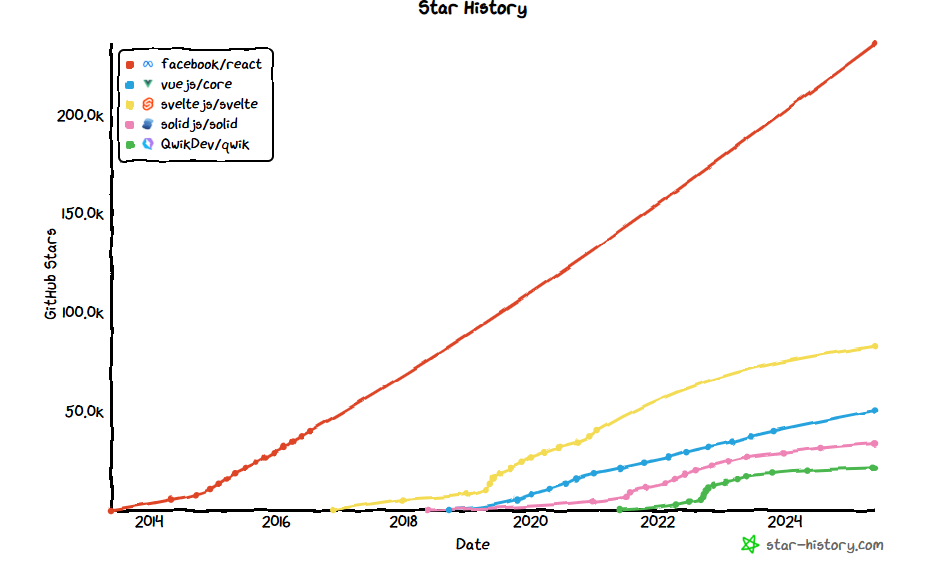
1. React – The King of Frontend Frameworks

React remains one of the most widely used frontend frameworks in 2025. Backed by Meta (Facebook), React continues to evolve with features like Server Components and Suspense. React is a popular JavaScript library for building fast, reusable user interfaces using a component-based approach. It uses a virtual DOM to efficiently update only the necessary parts of the UI, improving performance. React’s declarative syntax and unidirectional data flow make managing complex apps easier. Backed by a large ecosystem and community, React is widely adopted for modern web development.
- ✅ Pros:
- Huge ecosystem and strong community
- Works with React Native for mobile apps
- Flexible and highly customizable
- ❌ Cons:
- Steeper learning curve
- Requires multiple libraries for routing and state
Best use case: Enterprise apps, cross-platform development
2. Vue.js 4 – Simplicity Meets Power

Vue.js is a developer-friendly framework that combines ease of use with flexibility. Vue 4 introduces performance boosts and improved TypeScript support. Vue.js is a progressive JavaScript framework designed for building versatile and performant web applications at any scale. Its standout feature is its reactive data binding—unlike traditional frameworks, Vue updates the UI efficiently by automatically syncing the DOM with underlying data changes. Instead of re-rendering the entire interface, Vue employs a virtual DOM and fine-grained reactivity to update only what’s necessary. This leads to smooth, fast user experiences even in complex apps.
- ✅ Pros:
- Simple syntax and gentle learning curve
- Rich official libraries (Vue Router, Pinia)
- Excellent for quick development cycles
- ❌ Cons:
- Smaller community than React
- Less corporate adoption in the West
Best use case: Small to mid-sized web apps, prototyping
3. Svelte + SvelteKit – Compiler-Based Frontend Framework

Svelte is a unique frontend framework that compiles components into vanilla JS at build time, eliminating the virtual DOM. Svelte takes a compiler-first approach, instead of running a virtual DOM at runtime like React or Vue, it compiles your components into highly optimized JavaScript during build time. This JavaScript directly updates the DOM with no extra abstraction layer, resulting in smaller bundles and faster performance. In short: write Svelte components → compile → get clean, imperative JS → direct DOM updates.
- ✅ Pros:
- High performance and minimal bundle size
- Clean and readable syntax
- Built-in routing and SSR with SvelteKit
- ❌ Cons:
- Limited community and plugins
- Still niche compared to Vue/React
Best use case: Performance-sensitive apps, landing pages
4. SolidJS – Lightning Fast Reactivity
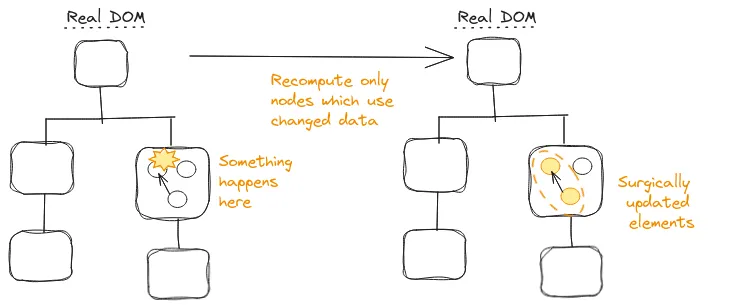
SolidJS brings React-like syntax with superior performance. It’s gaining traction among developers looking for cutting-edge frontend frameworks. Unlike virtual DOM frameworks that diff and re-render entire trees, SolidJS embraces fine-grained reactivity. As shown in the diagram, when data changes, SolidJS recomputes only the exact reactive nodes that depend on it—no more, no less. This results in surgical DOM updates, directly and efficiently patching only what’s necessary. The result? Blazing-fast updates with no runtime overhead or reconciliation logic—just pure, reactive precision.
- ✅ Pros:
- Blazing fast rendering
- Familiar to React users
- Lightweight and efficient
- ❌ Cons:
- New and less mature
- Limited ecosystem
Best use case: Dashboards, dynamic UIs, experiments
5. Qwik – The Future of Frontend Frameworks

Qwik is redefining how frontend frameworks work with its resumability model. It delivers instant loading and optimal performance. Qwik is a next-generation JavaScript framework designed for instant loading web applications at any scale. Its standout feature is resumability—unlike traditional hydration, Qwik apps don’t re-run code on the client after initial load. Instead, the app state is serialized on the server and resumed precisely at the point of user interaction. This leads to ultra-fast Time-to-Interactive, even for large apps. Qwik is built with performance-first principles, emphasizing fine-grained lazy loading, component-level code splitting, and minimal JavaScript execution by default
- ✅ Pros:
- Near-zero JS on initial load
- Resumable hydration improves SEO and speed
- Built for large content sites
- ❌ Cons:
- Unfamiliar architecture for most developers
- Ecosystem still growing
Best use case: SEO-heavy apps, e-commerce, blogs
Comparison Table of Frontend Frameworks
| Framework | Pros | Cons | Ideal For |
|---|---|---|---|
| React | Mature, flexible, mobile support | Complex, verbose setup | Enterprise, large-scale apps |
| Vue.js | Simple, fast to learn | Less global enterprise use | Startups, MVPs |
| Svelte | Fast, small bundle size | Small ecosystem | Lightweight apps, blogs |
| SolidJS | Very fast, modern design | Less popular, fewer tools | Interactive UIs, experiments |
| Qwik | Fastest loading, SEO-friendly | Steep learning curve | Content-rich, performance-focused apps |
Conclusion: Which Frontend Framework Should You Use?
Choosing the best frontend framework in 2025 depends on your project size, team expertise, and performance requirements.
- Use React for scalable, cross-platform apps.
- Pick Vue for a balanced and beginner-friendly option.
- Try Svelte or SolidJS for performance-focused builds.
- Choose Qwik if SEO and speed are your top priorities.
No single framework is the best for everything—but by understanding the frontend frameworks landscape, you’ll be better equipped to make the right decision for your next project.