


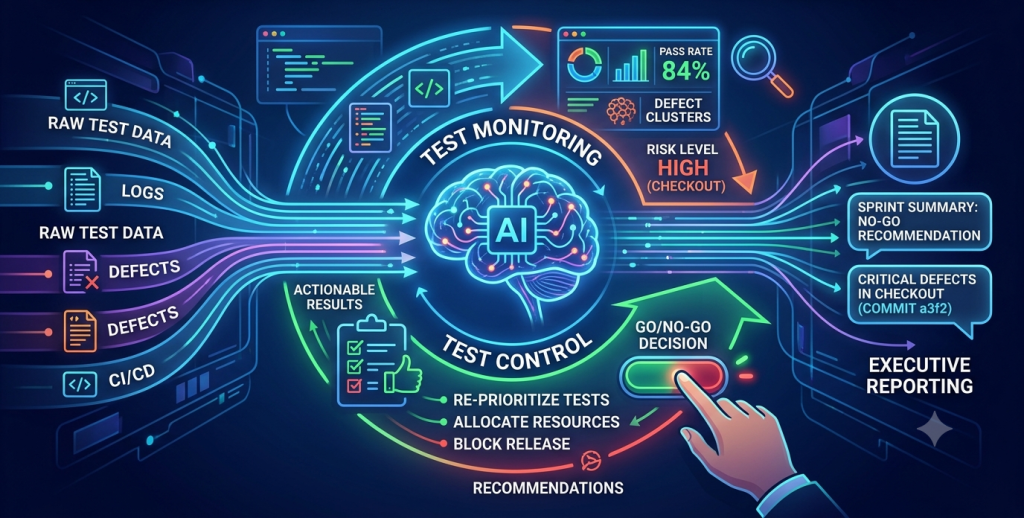
In modern software delivery, testing teams generate enormous volumes of data every day – from automated execution logs and defect reports to CI/CD pipeline results and test management dashboards. While this data contains valuable insights, extracting actionable intelligence quickly remains a significant challenge. Generative AI (GenAI) is changing this landscape by transforming raw test data into meaningful metrics, risk assessments, and decision-support recommendations. In this blog, we explore how Generative AI strengthens Test Monitoring and Test Control, helping a tester move from simply observing quality trends to making informed release decisions faster and more confidently.
1. Understanding Test Monitoring and Test Control
Although often discussed together, Test Monitoring and Test Control serve different purposes within the testing lifecycle.
1.1 Test Monitoring: Understanding What Is Happening
Test Monitoring focuses on collecting, analyzing, and visualizing testing data. The objective is to provide real-time visibility into project quality, execution progress, defect patterns, coverage, and emerging risks.
Typical monitoring questions include:
– What is the current pass/fail rate?
– Which modules are experiencing the most defects?
– Is testing progressing according to schedule?
– Are there signs of regression risks?
For example, GenAI can automatically detect that the pass rate of a Login module has dropped from 95% to 72% across two consecutive sprints and immediately alert the team before release.
1.2 Test Control: Deciding What to Do Next
If monitoring answers “What is happening?”, test control answers “What should we do about it?”
Using insights generated during monitoring, GenAI can recommend corrective actions such as:
– Re-prioritizing test execution
– Reallocating testing resources
– Adjusting schedules
– Deferring low-risk test cases
– Blocking releases when critical risks are detected
For instance, when 200 test cases remain unexecuted near a release deadline, GenAI can recommend prioritizing the 50 highest-risk test scenarios, postponing low-priority tests, and assigning additional testers to critical business modules.
2. Key Areas Where GenAI Adds Value
2.1. Automated Monitoring and Metrics Analysis
Traditional reporting often requires manual effort from a tester. GenAI can continuously analyze test execution data and generate metrics automatically.
Capabilities include:
– Pass/fail trend analysis
– Risk prediction
– Schedule deviation detection
– Defect clustering
– Release readiness assessment
Instead of manually reviewing thousands of execution logs, teams receive concise insights presented in natural language.
2.2. Intelligent Test Control Recommendations
Beyond reporting metrics, GenAI can propose actions based on project priorities and quality risks.
Examples include:
– Increasing testing efforts in modules with rising defect rates
– Delaying releases for unstable functionality
– Recommending additional regression coverage
– Optimizing test execution sequences
This allows project teams to react proactively rather than waiting for quality issues to become production incidents.
2.3. Executive Reporting and Continuous Learning
At the end of a sprint, GenAI can generate comprehensive testing summaries highlighting:
– Test completion status
– Critical defects discovered
– Quality achievements
– Lessons learned
– Improvement opportunities
A typical AI-generated summary might be: “95% of test cases passed. Three critical defects were detected within newly developed modules. Future releases should strengthen code review practices and regression validation for new features.”
2.4. Dynamic Dashboards and Natural Language Insights
Not every stakeholder is a testing expert. Product managers, delivery managers, and executives often need concise business-oriented reports rather than detailed technical data.
GenAI can automatically create dashboards accompanied by human-readable summaries such as: “Testing progress has reached 78%. The primary risk area is the payment integration module. Testing is expected to be completed within the next three days.”
This improves transparency and enables faster decision-making across the project.
2.5 A Practical Example: AI-Driven Test Monitoring
Consider a CI/CD pipeline producing automated test execution results across four application modules:
– Authentication
– Product Catalog
– User Profile
– Checkout
The dataset contains 50 automated test executions. GenAI processes the raw CSV output and extracts meaningful metrics.
Step 1: Data Processing and Metrics Generation
After analyzing the execution results, AI identifies:
Test Progress:
– Total test cases: 50
– Passed: 42
– Failed: 8
– Pass rate: 84%
– Fail rate: 16%
Defect Trend Analysis
All failed tests are concentrated within the Checkout module.
Failure categories include:
UI-related failures:
– Timeout issues
– Element visibility problems
– Non-clickable elements
– Page loading delays
API-related failures:
– Payment service errors
– Tax calculation inconsistencies
– Inventory processing failures
– Runtime exceptions
This concentration indicates a high likelihood of a regression defect rather than isolated test instability.
Risk Identification
The failures share a common characteristic:
– Every failed test references the same commit ID
– Failures affect both UI and API layers
– Payment and checkout workflows show systemic instability
Based on these indicators, GenAI identifies commit as a probable regression source with significant business impact because it affects revenue-generating functionality.
Step 2: Executive Summary for Release Management
Rather than requiring managers to interpret raw logs, GenAI produces an executive-ready summary:
The sprint achieved an overall pass rate of 84%, with 42 out of 50 automated test cases passing successfully. All eight failures are concentrated within the Checkout module and are strongly correlated with commit, indicating a likely regression introduced during recent development changes. The issues impact critical user journeys, including payment processing, order confirmation, and guest checkout functionality. A No-Go recommendation is advised until the Checkout defects are resolved and regression testing confirms system stability.
From Monitoring to Control: The Complete AI-Driven Quality Cycle
Generative AI enables a complete quality intelligence workflow:
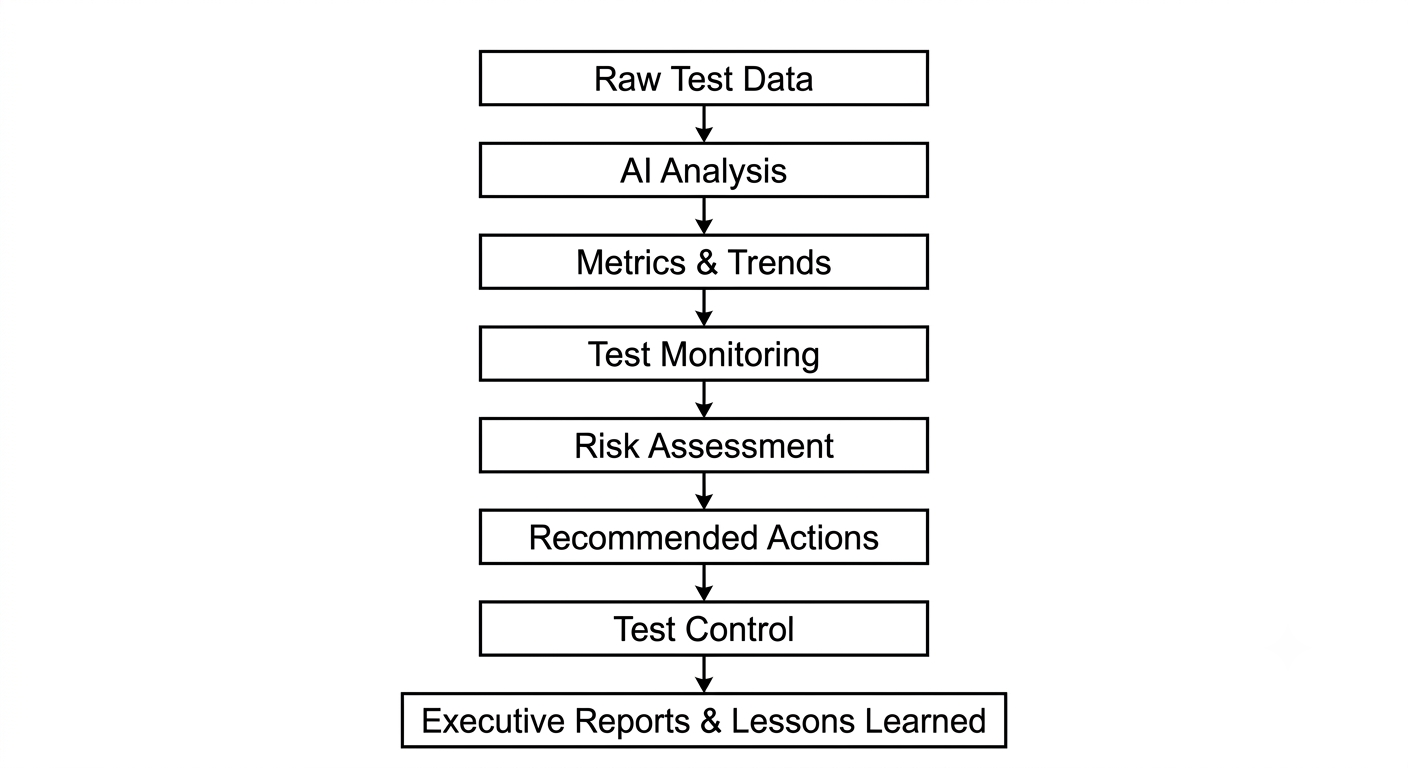
Instead of spending hours gathering metrics and manually preparing reports, the testing teams can focus on solving quality problems while AI continuously analyzes data and recommends next steps.
3. Real-World Case Study: Accelerating Test Monitoring During a Content Management System Migration
Note: To ensure project confidentiality and data security, all real project-related information used in this case study has been anonymized and replaced with representative data.
During a CMS migration program from platform A to B, we were responsible for validating the major digital platforms.
The migration involved thousands of content entries, integrations, customer journeys, and business workflows. To ensure release quality, the project relied heavily on automated regression testing executed through CI/CD pipelines.
Over the course of the migration, the team executed hundreds of automated regression test cases using Playwright-based automation suites across multiple environments.
3.1. The Challenge
Although automation significantly reduced manual testing effort, the reporting process remained time-consuming.
Every day, the team had to review information from multiple sources:
– Playwright execution logs
– JUnit XML reports
– Azure DevOps pipeline results
– Test execution dashboards
– Defect tracking systems
The typical daily reporting workflow involved:
– Collecting execution artifacts from multiple pipelines.
– Identifying newly failed test cases.
– Comparing failures against previous executions.
– Determining whether failures were caused by application defects, environment issues, or test instability.
– Preparing a summary report for stakeholders.
This process typically requires approximately 90 minutes per day, particularly during intensive regression cycles.
3.2 GenAI-Powered Test Monitoring Solution
To address this challenge, the project team introduced a GenAI-powered test monitoring assistant.
The solution consumed raw testing artifacts directly from the CI/CD ecosystem and automatically performed:
– Monitoring Activities
– Test pass/fail rate analysis
– Regression trend detection
– Failed test clustering
– Flaky test identification
– Module-level risk assessment
– Environment stability monitoring
– Control Activities
Based on detected risks, the AI assistant generated recommendations such as:
– Prioritizing investigation of high-risk failures
– Escalating critical business-flow regressions
– Recommending re-execution of potentially flaky tests
– Identifying modules requiring additional validation before release
– Example AI-Generated Insight
Instead of analyzing hundreds of log entries manually, the team received summaries such as: “Checkout and Content Publishing modules account for 82% of newly failed tests in the latest execution. Most failures originated after deployment. Similar timeout patterns were detected across 17 tests, indicating a potential shared backend dependency issue rather than isolated application defects.”
For release management teams, GenAI also generated executive-friendly summaries: “Overall regression pass rate remains above 95%. No critical failures detected in customer checkout journeys. Five failures were identified in content-authoring workflows, all linked to a known issue currently under remediation. Release readiness is considered low risk.”
3.3. Business Impact
The implementation delivered measurable results:
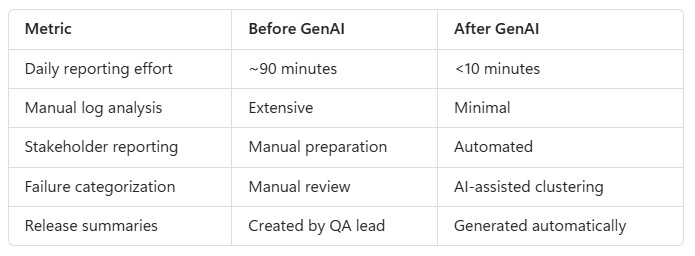
Key benefits included:
– More than 85% reduction in reporting effort
– Faster identification of regression risks
– Improved visibility for project stakeholders
– Consistent reporting across teams
– Increased focus on defect resolution rather than data collection
3.4. Key Takeaway
This project demonstrated that the biggest value of Generative AI in testing is not replacing testers—it is eliminating the manual effort required to transform massive amounts of test execution data into actionable insights. By automatically monitoring quality metrics, detecting risk patterns, and producing executive-level summaries, GenAI enabled the team to make faster and more informed release decisions throughout a complex enterprise migration program.
4. Conclusion
Generative AI is transforming software testing from a reactive activity into an intelligent, data-driven discipline. By automating test monitoring, identifying defect patterns, assessing risks, and recommending corrective actions, GenAI helps organizations improve release quality while accelerating delivery.
The true value lies not only in understanding testing data but in turning that data into decisions. As testing environments continue to grow in complexity, AI-powered Test Monitoring and Test Control will become essential capabilities for modern testing organizations seeking faster, smarter, and more reliable software delivery.