



What is the Repository Pattern?
At its core, the Repository Pattern is a design pattern that mediates between the domain logic and data mapping layers of an application. It acts as a middleman, abstracting away the details of data access and providing a clean interface for working with data.
Imagine you have an application that needs to interact with a database. Without the Repository Pattern, your application code might directly interact with the database through queries and commands scattered throughout the codebase. This tight coupling makes it challenging to switch databases, test the application, or maintain consistency across data access logic.
The Repository Pattern addresses these issues by providing a layer of abstraction between the application code and the data source. Instead of directly interacting with the database, the application communicates with repositories, which encapsulate the logic for retrieving, storing, and manipulating data.
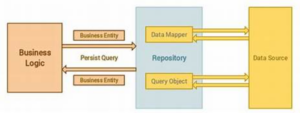
Key Components of the Repository Pattern
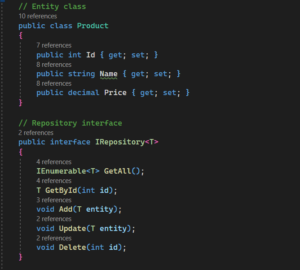
- Repository Interface: At the heart of the pattern is the repository interface, which defines the contract for data access operations. This interface typically includes methods for common CRUD (Create, Read, Update, Delete) operations and other queries relevant to the domain.
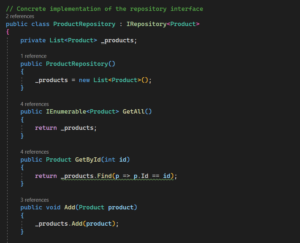
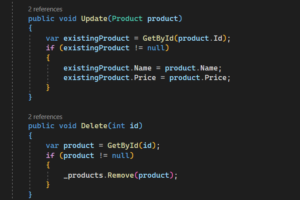
- Concrete Repository Implementations: Concrete classes implement the repository interface and provide the actual implementation for data access. These classes are responsible for translating domain-specific operations into database queries or other data access mechanisms.
- Domain Entities: Repositories work with domain entities, which represent the business objects within the application. These entities encapsulate both data and behavior relevant to the domain.
- Data Source: Repositories interact with the underlying data source, which could be a database, an external API, or any other data storage mechanism. The repository shields the rest of the application from the details of how data is persisted or retrieved.
Advantages of Using the Repository Pattern
- Separation of Concerns: By abstracting data access logic into repositories, the Repository Pattern promotes a separation of concerns within the application. Business logic remains isolated from the details of data storage and retrieval, improving code maintainability and readability.
- Testability: Repositories can be easily mocked or stubbed during unit testing, allowing developers to test the application’s business logic in isolation from the data access layer. This facilitates automated testing and ensures that changes to the data access code don’t break existing functionality.
- Flexibility and Scalability: Since the application code interacts with repositories through well-defined interfaces, it’s easier to swap out one data storage mechanism for another without affecting the rest of the codebase. This flexibility is particularly valuable as applications evolve and grow in complexity.
- Centralized Data Access Logic: The Repository Pattern centralizes data access logic within the application, making it easier to enforce consistency and apply optimizations. Developers can encapsulate complex querying logic within repository implementations, reducing duplication and improving code maintainability.
Implementing the Repository Pattern
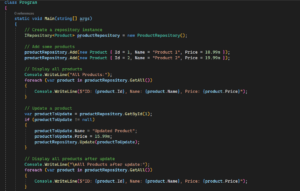
Implementing the Repository Pattern effectively requires careful consideration of the application’s architecture and design. Here are some best practices to keep in mind:
- Define Clear Interfaces: Design repository interfaces that clearly define the contract for data access operations. Keep the interfaces focused and cohesive, avoiding unnecessary complexity or duplication.
- Choose Appropriate Abstractions: Use appropriate abstractions to decouple the application code from specific data storage technologies. This allows repositories to work with different data sources without requiring changes to the rest of the codebase.
- Separate Concerns: Ensure that repositories are responsible for data access logic only and don’t mix business logic with data manipulation. Keep domain entities clean and focused on representing business concepts, avoiding direct database interactions.
- Consider Performance: Pay attention to the performance implications of repository implementations, especially when dealing with large datasets or complex querying requirements. Implement caching strategies or optimizations where necessary to improve performance.

Conclusion
The Repository Pattern is a powerful tool for managing data access in software applications. By abstracting away the details of data storage and retrieval, it promotes modularity, testability, and maintainability. When implemented correctly, the Repository Pattern can simplify the development process, making it easier to build robust and scalable applications.
Whether you’re working on a small personal project or a large enterprise system, understanding and leveraging the Repository Pattern can help you write cleaner, more maintainable code. By embracing this pattern, you can build applications that are easier to test, maintain, and extend, ultimately delivering better value to your users.