



Imagine receiving a request from an auditor:
Explain why customer Alice (with id CUST004) was approved for coverage 6 months ago.
The problem? Today’s customer profile looks completely different.
- Their credit score has deteriorated.
- Additional claims have been filed.
- Their risk grade has changed.
- The underwriting model has been refreshed multiple times.
Looking only at today’s data can lead to incorrect conclusions about yesterday’s decisions.
This is precisely why Delta Lake’s Time Travel capability is so powerful. Instead of relying on backup copies, snapshots, or manual archives, Delta Lake allows us to query the exact version of data that existed when the underwriting decision was made.
How Underwriting Decisions Changes Over Time?
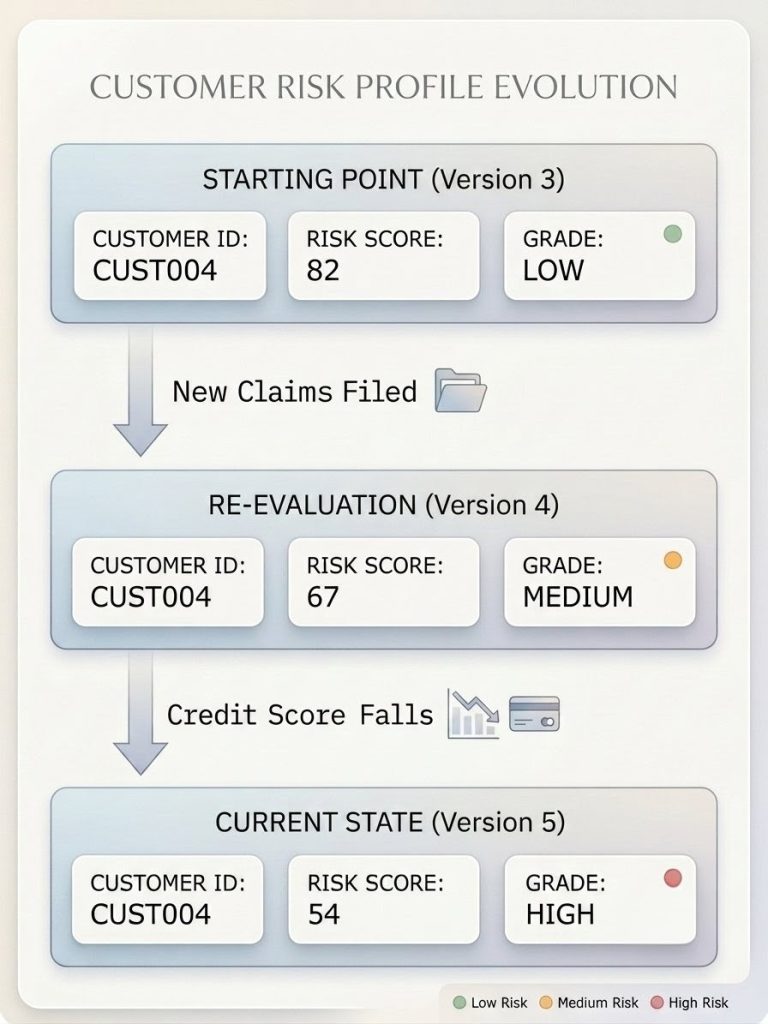
Imagine CUST004 filed a claim and had a credit score change in past. Without Time Travel, analysts would only see the latest version (Version 5). But, with Time Travel, they can inspect previous versions (Version 3 & 4) too, or any version retained in the Delta transaction log.
Recap: Insurance Data Pipeline
In our previous blog, Creating a Single Risk Profile for Underwriters with Delta Lake, we explored how an Underwriting Risk Profile data pipeline can be built using Delta Lake. The solution leveraged the Medallion Architecture, organizing data across Bronze, Silver, and Gold layers, each serving a distinct purpose in transforming raw data into actionable underwriting insights.
Before diving into Delta Lake Time Travel, let’s briefly revisit that architecture and understand how each layer contributes to the creation of a comprehensive underwriting risk profile.
Bronze Layer
Raw source systems are ingested into Delta tables:
bronze.policy_raw
bronze.claim_raw
bronze.credit_raw
These contain:
- Policy information
- Claims history
- Credit scores
All stored as Delta tables.
Silver Layer
Policy Standardization
silver_policyFunctions:
- Removes duplicate policies
- Standardizes customer identifiers
Claims Aggregation
silver_claims_summaryCalculates:
- Total claims
- Total claim amount
- Most recent claim date
Credit Snapshot
silver_creditUses window functions to identify the latest credit score per customer.
Gold Layer
Customer Risk Base
gold.customer_risk_baseCombines:
- Policy data
- Claims history
- Credit information
into a unified underwriting view.
Risk Score Calculation
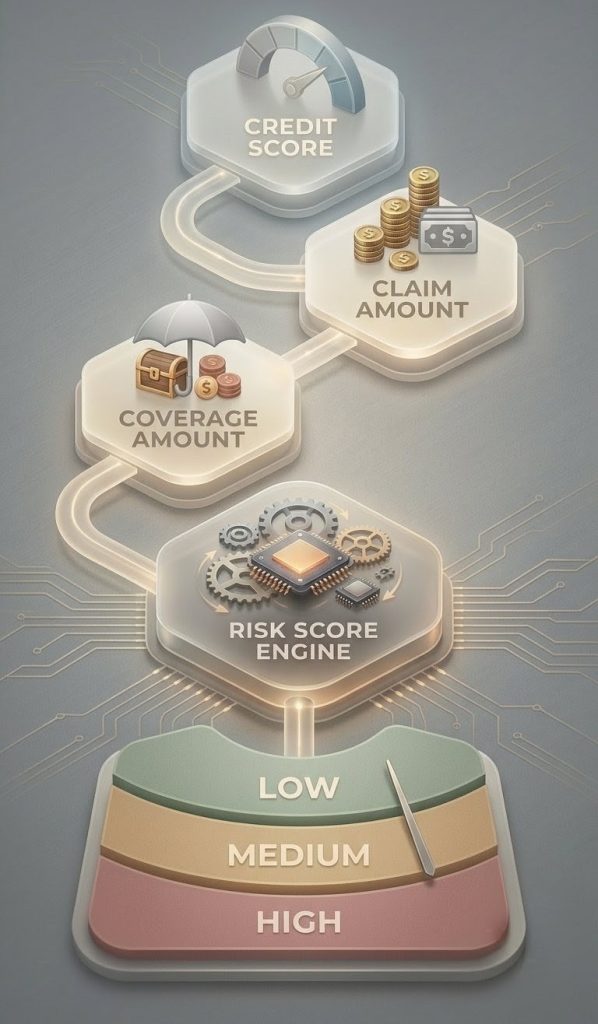
The solution calculates composite risk scores using:
- Credit score
- Claims history
- Coverage amount
Output table:
customer_risk_scoreExample:
| Risk Score | Risk Grade |
|---|---|
| 85 | LOW |
| 72 | MEDIUM |
| 55 | HIGH |
Final underwriting profiles are stored in:
gold.underwriting_risk_profileVisual: Risk Score Generation
Real-World Use Cases
Use Case #1: Regulatory Investigation
A regulator reviews a policy issued in 2026.
Current Situation
| Metric | Current Value |
| Customer | CUST004 |
| Credit Score | 640 |
| Risk Band | High |
At Time of Underwriting
| Metric | Historical Value |
| Credit Score | 690 |
| Risk Band | Medium |
The regulator asks:
Why was this customer approved?
Time Travel provides the answer instantly:
SELECT *
FROM gold.underwriting_risk_profile
VERSION AS OF 3
WHERE customer_id = 'CUST004';
No backups, no database restores, no manual investigations.
Use Case #2: Model Validation
A model governance team deploys a new underwriting model. Six months later they want to compare – Old Model vs New Model using the exact same population.
SELECT *
FROM gold.customer_risk_score
VERSION AS OF 4;
This enables reproducible analysis using historical data exactly as it existed when the prior model was active.
Use Case #3: Claims Dispute Investigation
A customer challenges a premium increase. The insurer must determine:
- What claims existed?
- What credit score was available?
- What risk category was assigned?
Using Time Travel:
SELECT *
FROM gold.underwriting_risk_profile
TIMESTAMP AS OF '2026-07-13';
This reconstructs the underwriting context exactly as it existed on that date.
Adding Time Travel to This Implementation
Because all layers are stored as Delta tables, Time Travel capabilities are immediately available.
Step 1: View Delta History
DESCRIBE HISTORY gold.underwriting_risk_profile;Example:
| Version | Timestamp |
| 5 | 2026-07-13 |
| 4 | 2026-03-09 |
| 3 | 2026-01-08 |
Step 2: Query a Historical Version
SELECT *
FROM gold.underwriting_risk_profile
VERSION AS OF 5;
Returns the table exactly as it existed at Version 5.
Step 3: Compare Current vs Historical State
Current:
SELECT *
FROM gold.underwriting_risk_profile
WHERE customer_id='CUST004';Historical:
SELECT *
FROM gold.underwriting_risk_profile
VERSION AS OF 3
WHERE customer_id='CUST004';
Analysts can quickly identify how customer risk characteristics changed over time.
Sample Delta Lake Time Travel Queries
View Table History
DESCRIBE HISTORY gold.underwriting_risk_profile;| Version | Timestamp | User Name |
|---|---|---|
| 6 | 2026-07-29T16:25:09.000Z | gupta.himanshu |
| 5 | 2026-07-13T19:35:22.000Z | gupta.himanshu |
| 4 | 2026-03-09T19:17:03.000Z | gupta.himanshu |
| 3 | 2026-01-08T19:12:31.000Z | gupta.himanshu |
Query a Specific Version
SELECT *
FROM gold.underwriting_risk_profile
VERSION AS OF 3;
Query a Historical Timestamp
SELECT *
FROM gold.underwriting_risk_profile
TIMESTAMP AS OF '2026-07-29 16:25:09';| Customer ID | Total Coverage | Total Claims | Credit Score | Risk Band | Underwriting Risk Grade | Profile Refresh TS |
|---|---|---|---|---|---|---|
| CUST018 | 275000 | 4 | 740 | Medium | LOW | 2026-07-29T16:25:06.227Z |
| CUST012 | 350000 | 4 | 710 | Medium | MEDIUM | 2026-07-29T16:25:06.227Z |
| CUST030 | 375000 | 4 | 600 | Medium | MEDIUM | 2026-07-29T16:25:06.227Z |
Investigate a Single Customer
Current Profile:
SELECT *
FROM gold.underwriting_risk_profile
WHERE customer_id = 'CUST004';
Historical Profile:
SELECT *
FROM gold.underwriting_risk_profile
VERSION AS OF 6
WHERE customer_id = 'CUST004';| Customer ID | Total Coverage | Total Claims | Credit Score | Risk Band | Underwriting Risk Grade | Profile Refresh TS |
|---|---|---|---|---|---|---|
| CUST004 | 75000 | 6 | 640 | High | MEDIUM | 2026-07-29T16:25:06.227Z |
Review Historical Credit Data
SELECT *
FROM silver.credit
VERSION AS OF 3
WHERE customer_id = 'CUST006';
Audit Historical Claims Data
SELECT *
FROM silver.claims_summary
VERSION AS OF 3
WHERE customer_id = 'CUST015';
Compare Two Versions Side-by-Side
WITH old_data AS (
    SELECT *
    FROM gold.underwriting_risk_profile
    VERSION AS OF 2
),
new_data AS (
    SELECT *
    FROM gold.underwriting_risk_profile
    VERSION AS OF 5
)
SELECT
    n.customer_id,
    o.risk_score AS old_risk_score,
    n.risk_score AS new_risk_score
FROM new_data n
JOIN old_data o
ON n.customer_id = o.customer_id
WHERE n.risk_score <> o.risk_score;
How Does Delta Lake Time Travel Impact Storage?
One of the most common questions architects ask is:
If Delta stores historical versions, won’t storage costs explode?
The answer is generally No.
How Delta Stores Historical Data
Delta Lake does not create a full copy of a table every time data changes. Instead it maintains:
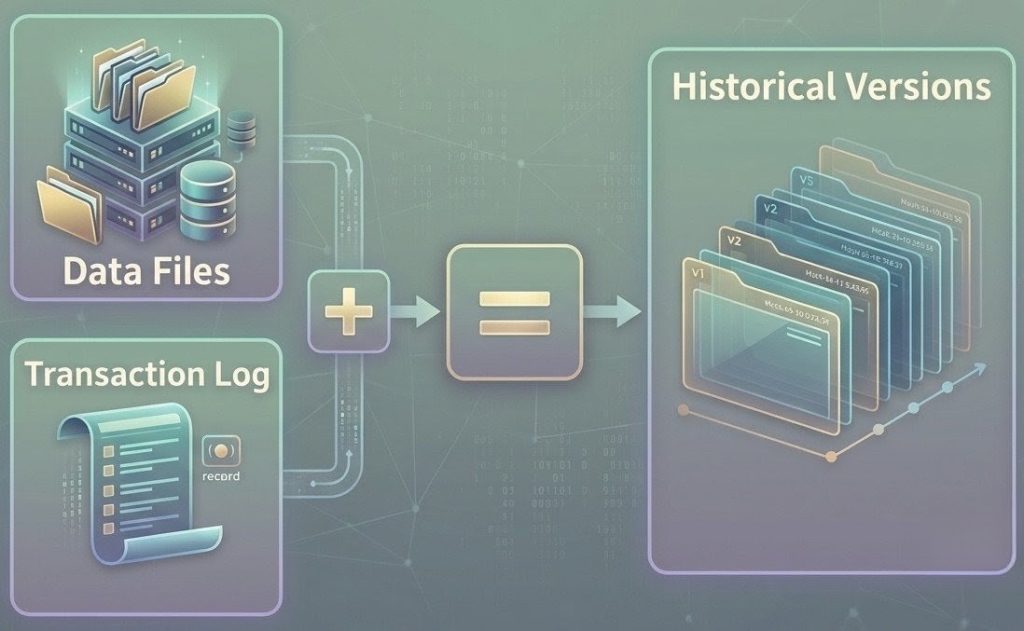
Only modified or newly created files are written. Unchanged data files are reused across versions.
Storage Example
Traditional Snapshots
| Month | Storage |
| Month 1 | 1 TB |
| Month 2 | 1 TB |
| Month 3 | 1 TB |
| Total | 3 TB |
Delta Time Travel
| Component | Storage |
| Base Data | 1 TB |
| Month 2 Changes | 50 GB |
| Month 3 Changes | 40 GB |
| Total | 1.09 TB |
Delta is significantly more storage-efficient than maintaining complete snapshots.
The Real Storage Driver: Retention Period
The primary factor affecting storage is Retention Duration
Examples:
- 30 Days
- 90 Days
- 1 Year
- 7 Years
Insurance providers often require longer retention due to:
- Regulatory mandates
- Audit requirements
- Model governance
- Claims investigations
Managing Historical Data with VACUUM
VACUUM gold.underwriting_risk_profile;Or
VACUUM gold.underwriting_risk_profile RETAIN 720 HOURS;After VACUUM removes historical files, older versions are no longer available for Time Travel queries.
Time Travel + SCD Type 2 = Complete Auditability
The implementation already includes SCD Type 2 tracking using:
- effective_start_date
- effective_end_date
- is_current
- record_hash
Together, Delta Time Travel and SCD Type 2 provide a robust audit framework.
| Capability | Delta Time Travel | SCD Type 2 |
| Reconstruct Exact Table State | ✅ | ❌ |
| Track Attribute Changes | ❌ | ✅ |
| Built Into Delta Lake | ✅ | ❌ |
| Regulatory Investigations | ✅ | ✅ |
| Long-Term Historical Reporting | Limited by Retention | ✅ |
| Model Validation | ✅ | ✅ |
Best Practice
Use both:
- Time Travel provides operational and investigative history.
- SCD Type 2 provides long-term business history.
Together they deliver a complete underwriting audit trail.
In-Summary
For underwriting systems, the most important question is often not:
What does this customer look like today?
but rather:
What did this customer look like when the underwriting decision was made?
The solution described here already maintains policy, claims, credit, risk score, and underwriting profile data in Delta tables while preserving customer history through SCD Type 2 design. By leveraging Delta Lake Time Travel, insurance providers can:
- Reconstruct historical underwriting decisions
- Accelerate regulatory investigations
- Validate machine learning models
- Resolve customer disputes
- Establish end-to-end auditability