


What does UX mean?
UX stands for user experience, a term widely used in various fields to describe how satisfied people feel before, during, and after using products or services.
Highlights of UX definition
- User perceptions and responses
- Attitudes and behaviors
- Consequences for a brand’s image and services
- The experience happens before, during and after using products or services
More details about UX definition, you can find out at The ISO definition of UX.
Customer Experience, Employee Experience and Citizen Experience
Different groups of users have unique behaviors, leading to the division of UX into three main categories:
- Customer experience (CX): This focuses on how customers perceive and interact with our business.
- Employee experience (EX): Concerned with the satisfaction and efficiency of employees in company culture, using internal tools and systems.
- Citizen experience (CzX): Pertains to interactions between citizens and government services.
UX is responsible for guiding users throughout their interaction with our products and services, known as touch-points. The goal of UX design is to meet users’ expectations. Touch-points in Customer Experience include physical stores, mobile apps, websites, email, phone calls, social media and others. Ensuring positive experiences at these touch-points increases the likelihood of making a sale, while negative experiences may drive potential customers away to competitors.

UX in digital applications
The realm of UX is vast, encompassing a wide array of intricate activities and outcomes in UX design. However, the focus of UX in this series revolves around developing UX specifically for digital applications, a pivotal aspect in today’s digital landscape. These applications range from websites to mobile apps, smartwatch apps, and desktop apps, all of which customers engage with daily to access a brand’s services.
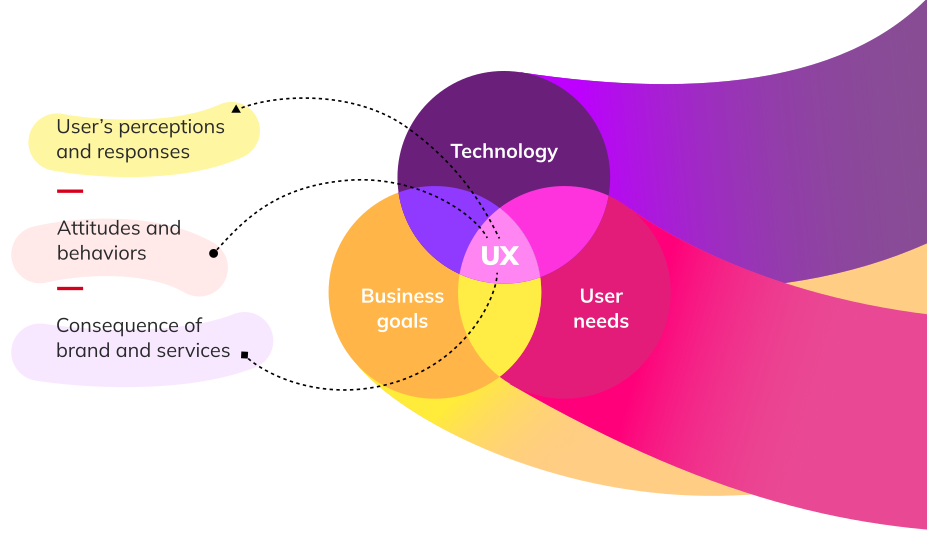
Our objective is to craft applications that deliver exceptional experiences to meet users’ expectations. Nevertheless, effective UX design considers not only user expectations but also other real-world constraints such as technology limitations, business objectives, and user needs. Balancing these constraints ensures the healthy and sustainable growth of the application.
Why UX matters?
Imagine a user browsing an online store to purchase a pair of shoes. The user’s behaviors and attitudes significantly influence their experience on the website.

Recognizing the value of the user’s time, we can improve the application to assist them in quickly finding their desired shoes. Additionally, simplifying the registration process and minimizing redundant data can enhance the user’s comfort. These UX enhancements have the potential to attract more customers to the business.
UX benefits for business and development
Improved applications can increase the likelihood of making a sale for businesses. Moreover, in the long term, development budgets can be reduced.
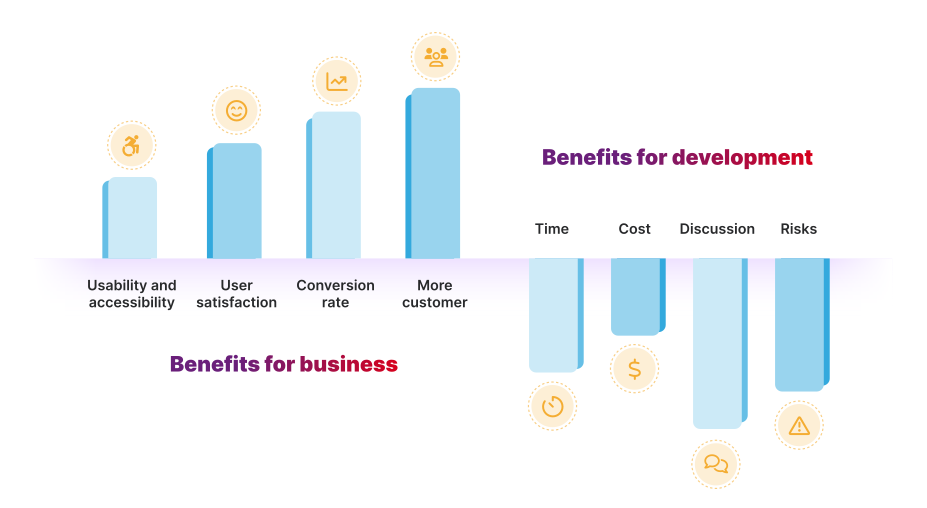
Various studies and practical applications have demonstrated that implementing UX design in projects yields a positive return on investment for both business and development. For further insights into the benefits of UX, you can refer to the article titled “The Return on Investment of UX Design: Numbers Don’t Lie”.
UX becomes a competitive advantage
The rapid changes in the digital landscape are reshaping our interactions. Today, every business faces fierce competition from many competitors offering similar products and services. However, businesses that effectively leverage technology and prioritize providing superior user experiences will emerge as leaders in this highly competitive market.
We would love to hear your idea about UX in digital application design, please leave your comment below.