
In the modern world of distributed systems and microservices, efficient communication between services is crucial. gRPC (gRPC Remote Procedure Call) is a high-performance, open-source RPC framework designed by Google. It enables seamless communication between services across different environments. This blog post will delve into what gRPC is, its key components like Protocol Buffers and Streaming, and its underlying architecture.
What is gRPC?
gRPC is a modern RPC framework that enables client and server applications to communicate transparently, making it easier to create connected systems. It is language-agnostic and can generate client and server code in multiple programming languages, including C++, Java, Python, Go, and many others.
Key Features of gRPC:
- High Performance: Optimized for high throughput and low latency communication.
- Language Agnostic: Supports multiple languages and platforms.
- Scalability: Designed for scalable microservices architecture.
- Bi-directional Streaming: Supports advanced streaming capabilities.
- Pluggable Authentication: Integrates with various authentication mechanisms.
Protocol Buffers
Protocol Buffers, or protobufs, are Google’s language-neutral, platform-neutral, extensible mechanism for serializing structured data. It’s used both to define the service methods and message types used in gRPC.
How Protocol Buffers Work:
- Define the Protocol: Write a .proto file that specifies the structure of the data and the RPC methods.
- Generate Code: Use the protocol buffer compiler
protocto generate data access classes in the desired programming language. - Serialize/Deserialize: These classes include methods to serialize/deserialize your structured data to/from a binary format.
Example of a .proto file:
syntax = "proto3";
message HelloRequest {
string name = 1;
}
message HelloReply {
string message = 1;
}
service Greeter {
rpc SayHello (HelloRequest) returns (HelloReply);
}
In this example, HelloRequest and HelloReply are the messages, and Greeter is a service with an RPC method SayHello.
Streaming in gRPC
gRPC supports four types of service methods, which allow for a variety of communication patterns:
- Unary RPC: The client sends a single request and receives a single response.
- Server Streaming RPC: The client sends a single request and receives a stream of responses.
- Client Streaming RPC: The client sends a stream of requests and receives a single response.
- Bidirectional Streaming RPC: Both the client and the server send a stream of messages to each other.
Benefits of Streaming:
- Efficiency: Reduces the overhead by maintaining a single connection.
- Real-time Communication: Supports real-time updates and data push from server to client.
- Improved Latency: Data can be sent and processed incrementally, improving latency.
gRPC Architecture
The architecture of gRPC can be broken down into several key components:
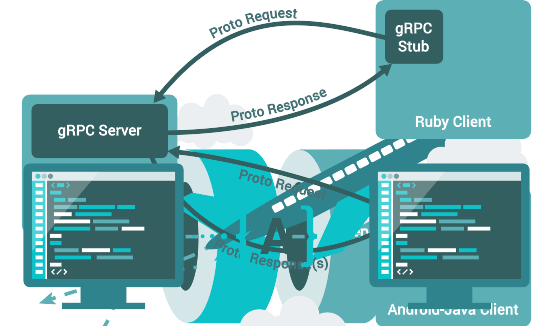
Communication Flow:
- Client Stub: The client calls a method on the stub.
- Serialization: The stub serializes the request using Protocol Buffers.
- Transport: The serialized request is sent over HTTP/2 to the server.
- Deserialization: The server deserializes the request.
- Server Processing: The server processes the request and sends back a response following the same serialization and transport steps.
Example Workflow:
- A client calls the
SayHellomethod on the stub. - The stub serializes the
HelloRequestmessage. - The message is sent to the server over an HTTP/2 connection.
- The server deserializes the message, processes it, and sends back a
HelloReply.
Conclusion
gRPC is a powerful framework for building efficient, scalable, and language-agnostic microservices. By leveraging Protocol Buffers for serialization and supporting advanced streaming capabilities, gRPC ensures high performance and real-time communication. Its architecture, based on HTTP/2, further enhances its ability to support a variety of communication patterns, making it an ideal choice for modern distributed systems. Whether you are building a new microservice or migrating an existing one, gRPC offers the tools and flexibility to meet your needs.