


Nowadays, we often hear about Agentic AI and AI Agents. So, how are they different, and how are they applied? In today’s article, we will learn about their meaning and scope of application and the relationship between Agentic AI and AI Agents.
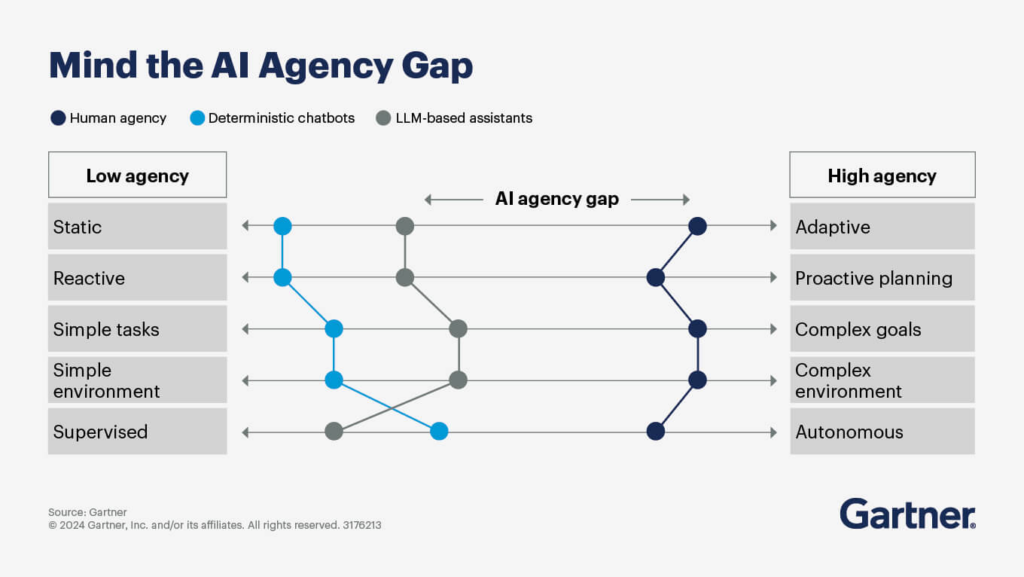
Agentic AI
Usually, it refers to AI systems that can work independently as agents and automatically execute tasks without human interaction at each step.
Characteristics:
- Ability to make decisions based on assigned goals or instructions.
- Often operates with a high degree of autonomy, determining the actions necessary to achieve desired outcomes.
- This may include the ability to plan, learn, and adapt to changing environments.
- Example: An intelligent resource management system that self-optimizes the allocation of resources within an organization.
AI Agent
An AI Agent is an artificial intelligence system component or agent responsible for performing specific tasks in a defined environment.
Characteristics:
- More focused on a task or tool role, often operating according to a predefined model.
- Often, it has higher dependency properties, requiring clearly defined instructions or interactions from other components.
- Examples: Chatbot support clients, information retrieval systems, or gaming agents in simulated environments.
Compare the differences
| Criteria | Agentic AI | AI Agent |
|---|---|---|
| Autonomy | High autonomy, deciding on actions | More Limited, performing specific tasks |
| Scope | Comprehensive, solving complex and broader problems | Limited within a certain scope |
| Applications | System administration, autonomous robots. | Chatbot, game AI, support agents. |
| Flexibility | Can learn and adapt | Usually less learned and dependent on existing logic |
Example:
- Agentic AI: An AI system controls logistics management, from receiving orders and coordinating transportation to predicting goods demand.
- AI Agent: A chatbot can answer client’s questions regarding order status.
When can an AI Agent coordination system be called Agentic AI?
Creating multiple AI Agents to coordinate and work together can lead to a more complex and autonomous system. However, whether the system is called Agentic AI depends on how the AI Agents interact and the overall system’s autonomy level.
- High autonomy: The AI Agents in the system are capable of operating independently and coordinating with each other without constant human supervision.
For example, an AI warehouse management system in which each AI agent autonomously undertakes separate tasks such as inventory checking, coordinating shipping robots, and optimizing storage locations, but they coordinate to achieve a common goal. - Collective decision-making ability: The system can synthesize information from agents and make high-level decisions to achieve a comprehensive goal.
For example, a group of AI drones coordinates for search and rescue. Each drone has its own mission but operates towards a common goal. - Adaptive and learning: The system executes according to fixed logic but can also learn from data or the environment to improve its coordinated performance.
In this case, the coordination of AI Agents creates a Multi-Agent System (MAS), which can be considered Agentic AI if the entire system acts as a single overall agent with autonomous goals and behaviors.
Conclusion
The distinction between Agentic AI and AI Agents lies in their scope, autonomy, and purpose. While AI Agents are specialized components designed to perform specific tasks within defined constraints, Agentic AI represents a higher level of intelligence, capable of acting independently, making complex decisions, and adapting to dynamic environments to achieve overarching goals.
In modern applications, systems can evolve from a collection of AI Agents to a more cohesive Agentic AI by integrating advanced coordination, autonomy, and learning mechanisms. This transformation allows for greater scalability, efficiency, and problem-solving capabilities across industries, from cloud optimization to robotics and beyond.
Understanding this difference empowers developers and organizations to design systems that align with their objectives, whether narrowly focused automation or broadly adaptive intelligence. Agentic AI embodies the vision of a self-governing system, while AI Agents remain the building blocks of such innovations.
1 thought on “Agentic AI vs AI Agent”
This is a well-explained breakdown of Agentic AI versus AI Agents. The comparison table and real-world examples make the differences in autonomy, scope, and flexibility very easy to grasp. I especially liked the explanation of when coordinated AI agents evolve into true Agentic AI—the multi-agent system perspective adds a lot of clarity. The conclusion nicely ties everything together and highlights how organizations can intentionally design systems based on their goals. A concise yet insightful read for anyone exploring autonomous AI systems.
Comments are closed.