



In today’s AI-driven world, businesses are rethinking how they build software. The AI FullStack Developer has emerged as a strategic asset, not just a coder, but a system thinker who can build, connect, and scale intelligent solutions from end to end.
The Evolution of FullStack: From Code to Cognitive Systems
In the early days, Full Stack Developers were primarily responsible for building both the front-end and back-end layers of web applications—crafting user interfaces, handling server-side logic, and managing databases. However, as digital ecosystems have evolved, so too has the definition of what it means to be Full Stack. Today, FullStack Developers are no longer just coders—they are architects of intelligent, AI-powered systems.
Modern FullStack Developers – AI FullStack Developers – are expected to:
- Understand end-to-end system architecture, including AI components
- Integrate with LLM APIs (e.g., OpenAI, Anthropic, Cohere)
- Leverage AI-powered developer tools like GitHub Copilot and Amazon CodeWhisperer
- Deploy scalable systems on cloud platforms (AWS, Azure, GCP)
- Optimize applications with AI-native UX patterns
See how our team applies these skills on our Case Studies page.
Key Skills Every AI FullStack Developer Brings
| Skill Area | Description |
| Prompt Engineering | Craft effective prompts to generate accurate AI responses |
| LangChain / LlamaIndex | Use frameworks to build AI-powered apps with context retrieval |
| Vector Databases | Implement semantic search using Weaviate, Pinecone, or ChromaDB |
| DevOps for AI (CI/CD + Cloud) | Automate deployment of AI components with CI/CD pipelines. GitHub Actions, Docker, and serverless AI deployment |
| AI-First Frontend Design (AI-UX Design) | Create interfaces optimized for human-AI interaction (e.g., chat, suggestion engines) |
Learn more about LangChain or GitHub Copilot to explore their roles in modern FullStack development.
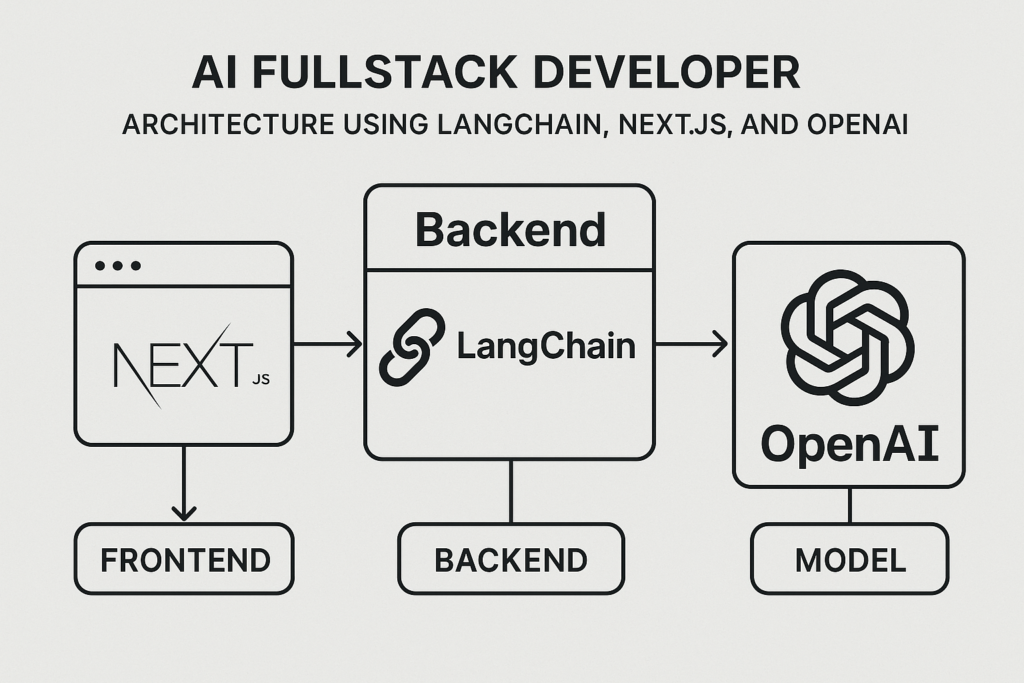
Use Case: Building an AI-Driven Knowledge Assistant with an AI FullStack Developer
Here’s a real-world example of how an AI FullStack Developer adds value.
A growing company needed an intelligent assistant to help employees quickly retrieve internal documents. Instead of hiring multiple roles, they on-boarded one experienced AI FullStack Developer.
- Frontend: Built using Next.js, TailwindCSS, and Clerk
- Backend: Powered by NestJS, LangChain, and OpenAI API
- Vector DB: ChromaDB used for semantic search
- Deployment: Automated with GitHub Actions on AWS
As a result, the developer delivered an MVP in just three weeks. Support ticket volume dropped by 30%, and employee productivity increased. That’s the impact of hiring the right AI FullStack Developer.
Why Businesses Need AI FullStack Developers?
Modern FullStack Developers are not just generalists — they are strategic technologists capable of delivering end-to-end value. Here’s why businesses, especially in the AI era, should prioritize hiring FullStack engineers with AI capabilities:
1. End-to-End Ownership of the Product Stack
FullStack engineers can take a business idea and turn it into a fully functional product, from the frontend interface, backend logic, to cloud infrastructure and AI integration. This minimizes communication friction, shortens delivery cycles, and improves overall product cohesion.
2. AI Integration from Day One
AI is no longer an add-on — it’s a core differentiator. FullStack developers who understand AI (e.g., OpenAI, LangChain, vector databases) can embed intelligent features like chatbots, smart search, personalization engines, and predictive analytics into your product from the first sprint.
3. Faster Time-to-Market
In a fast-paced business environment, every week matters. With an AI FullStack Developer, your team can move from concept to MVP in record time. For example, many businesses release a working prototype in under a month. This helps validate ideas quickly and enables adaptation to market demands without delay.
4. Lower Hiring and Operational Costs
Instead of hiring separate frontend, backend, AI, DevOps, and infrastructure specialists, one FullStack Developer can cover multiple responsibilities. This reduces staffing costs, onboarding time, and cross-team overhead, especially crucial in early-stage or lean teams.
5. Improved Scalability and System Architecture
Modern FullStack engineers are trained to design systems with future growth in mind. They can implement scalable APIs, modular frontends, and microservices architectures — all while following cloud-native best practices and ensuring maintainability.
6. Alignment with Business Goals
Great FullStack developers don’t just code — they think in terms of business value. They understand user needs, product-market fit, and cost-efficiency. This makes them valuable collaborators for Product Owners, CTOs, and startup founders.
7. Built-In DevOps & CI/CD Knowledge
In addition to coding, today’s AI FullStack Developers are comfortable with DevOps workflows. They utilize tools such as Docker, GitHub Actions, and cloud-based CI/CD pipelines to automate deployments and ensure reliability.
As a result, your product can scale faster, deploy faster, and recover faster — without hiring extra DevOps engineers.
8. Security and Performance Awareness
A competent FullStack developer ensures that both frontend and backend follow best practices in terms of:
- Security (e.g., authentication, rate-limiting, encryption)
- Performance (e.g., caching strategies, query optimization, lazy loading)
9. Greater Flexibility During Uncertain Times
In dynamic or uncertain markets, businesses must adapt quickly. FullStack developers provide the flexibility to pivot product direction, iterate quickly, or reallocate responsibilities without restructuring entire teams.
10. Ideal for AI-Native Product Teams
If you’re building an AI-first product, you need developers who have a deep understanding of AI. AI FullStack Developers can connect your frontend, backend, and AI pipeline seamlessly.
For instance, they know how to:
- Work with LLM APIs
- Implement RAG (Retrieval-Augmented Generation)
- Integrate vector databases like Weaviate or Pinecone
In short, they turn AI theory into working software — fast.
Bottom line: Hiring AI-ready FullStack Developers is no longer a tactical choice — it’s a strategic investment that gives businesses the agility, innovation, and resilience needed to compete in the modern digital economy.
How to Access FullStack Talent That Understands AI
Hiring individual frontend, backend, and ML engineers is costly and coordination-heavy. Instead, partner with tech talent providers that specialize in AI-aware FullStack engineers — professionals who:
- Understand your business goals
- Are trained in emerging AI development patterns
- Can independently deliver MVPs or support AI integration in existing systems
Conclusion
AI is not replacing FullStack Developers — it’s enhancing their value. Developers who embrace AI become the new generation of Technical Leads, able to drive innovation, integrate intelligent systems, and deliver impact fast.