


For years, artificial intelligence had only one home: the cloud. Giant, air-conditioned data centers packed with high-end graphics cards did all the heavy lifting. If your device wanted to recognize a face or translate a sentence, it had to send raw data across the internet to these digital brains and wait for a response.
But things are changing. AI is moving out of the cloud and closer to the physical world.
In tech circles, we call this Edge AI. But here is the catch: “the edge” is not just one place. It is a massive spectrum ranging from high-powered server racks to tiny chips that run on a single watch battery.
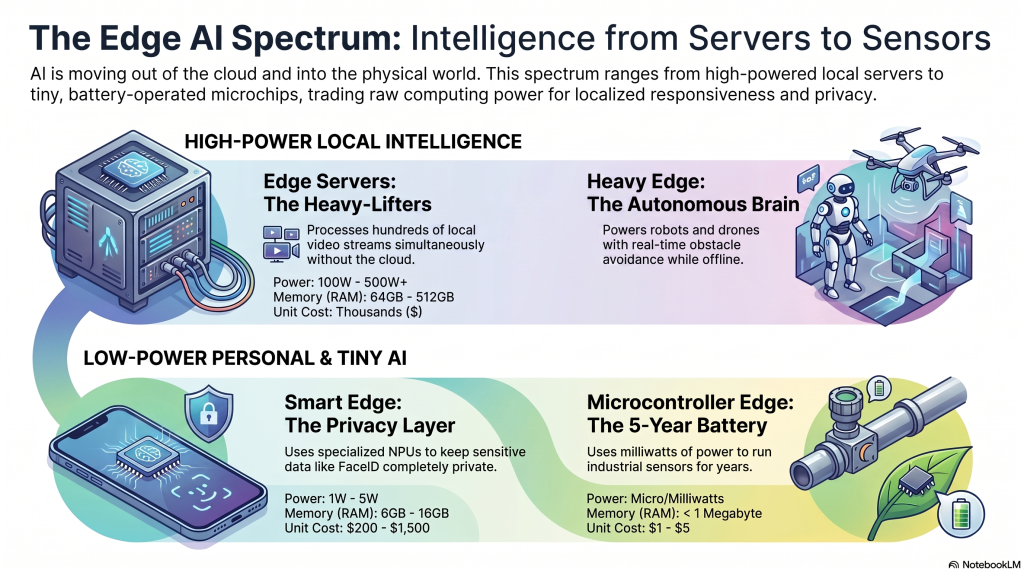
Visualizing the Hierarchy of Intelligence
As processing moves from left (the central cloud) to right (individual physical sensors), the physical size, cost, and power draw of the hardware shrink dramatically, while privacy and localized responsiveness spike.

To build, design, or even talk about modern AI products, you need to understand this spectrum. Let’s break down the four main layers of Edge AI.
1. Edge Servers & Gateway AI (The Heavy-Lifters)
Think of this layer as a mini-cloud brought directly to the field. Instead of sending data hundreds of miles away to a centralized data center, we place a smaller, specialized server right inside the building where the action happens.
- Where you find it: Factory control rooms, 5G cell towers, hospital server rooms, or smart building basement hubs.
- The Hardware: Rack-mounted servers equipped with enterprise-grade accelerators (like NVIDIA EGX or industrial Intel Xeon chips).
- Power & Memory: Hundreds of watts of power; hundreds of gigabytes of RAM.
- How it is used: A great example is a smart shopping mall. Instead of sending 500 security camera feeds over the internet, a local Edge Server processes all 500 video streams simultaneously in real-time, looking for security incidents locally.
2. Heavy Edge & Embedded Edge (The Local Brains)
If we move one step closer to the action, we find Embedded Edge. These are compact, self-contained computers. They do not look like traditional servers; they are built directly into machinery or smart appliances.
- Where you find it: Autonomous delivery robots, smart traffic lights, self-driving cars, and high-end drones.
- The Hardware: Single-board computers like the Raspberry Pi 5, or dedicated robotic brains like the NVIDIA Jetson Orin series.
- Power & Memory: 5 to 50 watts of power; 4 to 32 gigabytes of RAM.
- How it is used: Think of a self-driving delivery robot navigating a crowded sidewalk. It cannot risk losing its internet connection for even a second. It uses its Embedded Edge hardware to run real-time obstacle avoidance algorithms locally, ensuring safety even if it goes completely offline.
3. Smart Edge & Mobile Edge (The Everyday Devices)
This is the layer of Edge AI that you likely interact with every single day. Modern personal devices now come equipped with specialized hardware blocks called NPUs (Neural Processing Units) designed specifically to run AI math incredibly fast and with very little battery drain.
- Where you find it: Smartphones, tablets, laptops, and smart home hubs.
- The Hardware: Smartphone processors with built-in neural engines (like Apple Silicon, Qualcomm Snapdragon, or Google Tensor).
- Power & Memory: 1 to 5 watts of power; 6 to 16 gigabytes of RAM.
- How it is used: When you use FaceID to unlock your phone, or use an offline voice assistant on your device, you are using Mobile Edge AI. The raw image of your face or the audio of your voice never leaves your device, keeping your personal data completely private.
4. Microcontroller Edge (The TinyML Devices)
At the very far end of the spectrum lies the extreme edge: the Microcontroller Edge.
Unlike the other three layers, this category does not rely on microprocessors, nor does it run large operating systems like Linux or Android. Instead, it runs bare-metal code on simple, inexpensive microchip computers. The software methodology used to run machine learning on this hardware is known as TinyML.
- Where you find it: Smart rings, fitness trackers, soil sensors, industrial vibration monitors, and smart toothbrushes.
- The Hardware: Microcontrollers (MCUs) like the ARM Cortex-M family or the ESP32-S3.
- Power & Memory: Milliwatts or microwatts of power; Kilobytes of RAM (less than 1/40,000th of a modern smartphone).
- How it is used: A tiny sensor attached to a water pipe monitors the sound of water flow. Using a TinyML model running locally on the microchip, it can hear a microscopic leak and shut off the main valve instantly. Because it uses virtually no power, it can run on a single coin-cell battery for five years without a charge.
The Edge AI Spectrum at a Glance
To easily compare these four layers, we can look at their hardware requirements, power needs, and target use cases side-by-side:
| Layer | Power Consumption | Memory (RAM) | Cost Per Unit | Internet Dependency | Primary Use Case |
| Edge Server | 100W – 500W+ | 64GB – 512GB | Thousands of USD | Optional (Local Network) | Processing hundreds of camera streams in a building |
| Heavy Edge | 5W – 50W | 4GB – 32GB | $50 – $1,000 | Completely Optional | Robot navigation and autonomous driving |
| Smart Edge | 1W – 5W | 6GB – 16GB | $200 – $1,500 | Optional | Real-time on-device features (FaceID, voice-to-text) |
| Microcontroller Edge | Micro/Milliwatts | Under 1 Megabyte | $1 – $5 | 100% Offline | Simple keyword spotting, anomaly detection, smart sensors |
Why This Spectrum Matters
Understanding this hardware hierarchy helps developers and companies make smart design choices. You do not need a 100-watt Embedded Edge computer to detect if a machine is vibrating weirdly; a $2 Microcontroller Edge chip can do it. Conversely, you cannot expect a tiny microchip to process a 4K video stream at 60 frames per second.
By placing the right level of intelligence at the right layer of the spectrum, we can build a world where devices are faster, cheaper, more secure, and incredibly energy-efficient.